

On Wednesday, gold prices fell to their lowest level in about two months, indicating that even as central banks continue to buy, it is difficult to offset the pressure caused by rising yields on U.S. Treasury bonds and a stronger dollar.
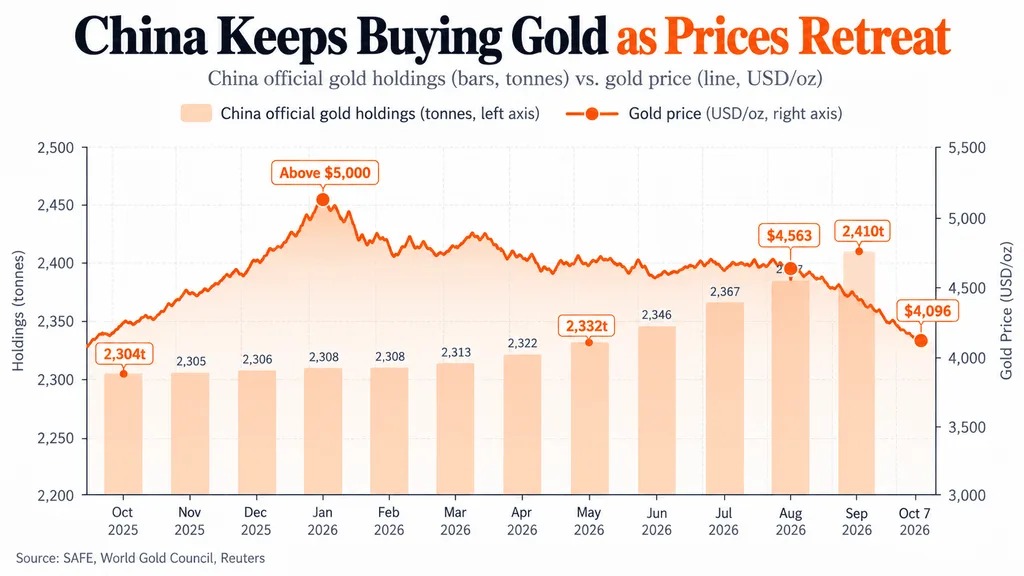
Spot gold fell by about 1.6% to $4,096 per ounce; December-delivered US gold futures tumbled to $4,122.
Meanwhile, China continues to increase its gold holdings. Official reserve data shows that China's gold holdings increased again in September, extending the People's Bank of China's gold purchase record to 23 consecutive months.
This comparison is quite noteworthy, as since 2022, central bank demand has become one of the strongest structural supports for gold.
China continues to buy gold as gold prices fall
China's official gold holdings increased from 76.73 million ounces in August to 77.47 million ounces in September, continuing to steadily advance the diversification of its reserves.
Just a few days ago, Coinpaper pointed out that global gold ETF holdings had reached a record 4,189 tons, and China added another 20.2 tons of gold in August.
The combination of ETF and the central bank's requirements has helped gold maintain its exceptional resilience despite rising borrowing costs.
However, the trend on Wednesday indicates that structural demand cannot prevent sharp short-term corrections.
U.S. Treasury yields are surpassing the demand for safe-haven assets.
The biggest immediate problem facing gold comes from the bond market.
The yield on 10-year U.S. Treasury bonds has risen to over 5.3%, reaching the highest level in over two decades. Higher yields increase the opportunity cost of holding gold, as gold bars themselves do not generate any income.
The US Dollar Index also rose by about 0.7%, making gold priced in dollars more expensive for overseas buyers.
This is in sharp contrast to just a day ago: at that time, the gold price was still above $4,160, and market expectations for an immediate interest rate hike by the Federal Reserve declined, briefly overshadowing the pressure from high yields. Our latest update on gold prices also highlights this tension.
Silver, platinum, and palladium also tumbled significantly, indicating that this round of decline is not merely due to the selling of gold itself.
$4,000 is becoming a key price level.
This round of selling has brought the psychologically important $4,000 level back into focus.
Morgan Stanley previously regarded this level as a potential bottom for gold prices, believing that after a deeper correction, physical buying and central bank demand might become more active.
The author, Ethan Mercer, is a financial journalist who covers cryptocurrency, stocks, and the global economy. He studied economics and finance before turning to market reporting, with a particular focus on Bitcoin, stocks, monetary policy, and investor sentiment. His work focuses on explaining daily market fluctuations and the broader trends behind them.