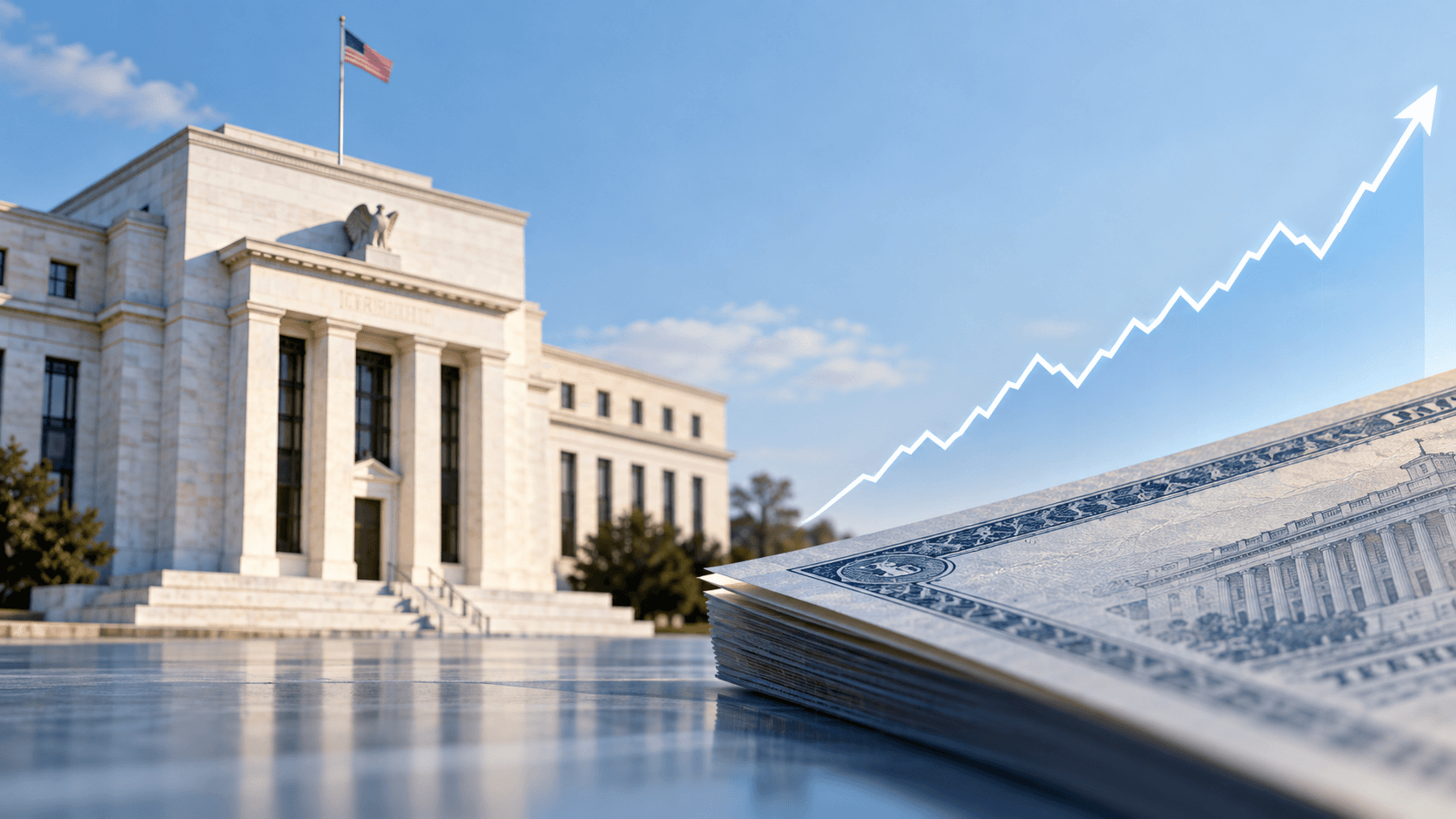












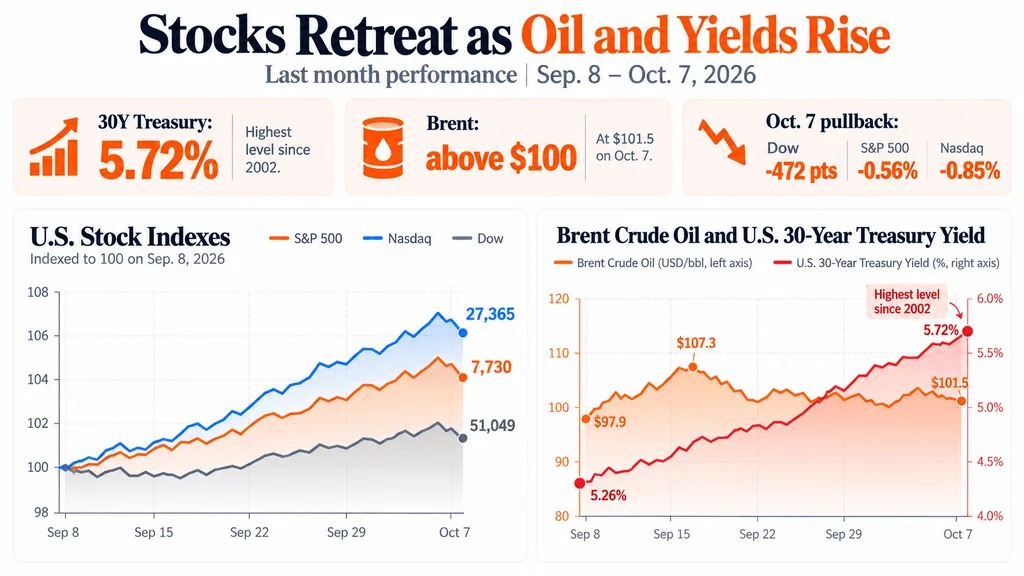
The Dow Jones Industrial Average fell by about 472 points in the morning session, a decline of about 0.9%; the S&P 500 Index fell by about 0.6%; the Nasdaq Composite Index fell by about 0.9%.
The main pressures come from the bond and energy markets. Brent crude oil has returned above $100 per barrel, and the yield on 30-year U.S. Treasury bonds has risen to 5.72%, reaching the highest level since 2002. Investors were also awaiting the release of the minutes from the Federal Reserve's September meeting that day.
This trend forms a sharp contrast with the previous day. Just on Tuesday, the S&P 500 and the Nasdaq just set new highs.
Crude oil and U.S. Treasury yields reversed the supporting factors from Tuesday.
The rebound on Tuesday benefited from falling oil prices and a slight decline in bond yields.
On the other hand, the market environment on Wednesday was completely the opposite.
Brent crude oil once rebounded above $102, the yield on 10-year U.S. Treasury bonds rose to 5.35%, and the U.S. Dollar Index increased by about 0.6%. Higher yields will increase the discount rate for future corporate earnings and make bonds more competitive compared to stocks, especially having a greater impact on higher-valued growth stocks.
Against the backdrop of U.S. Treasury yields remaining above 5%, the importance of this development is also increasing.
Chip stocks led the decline.
The tech sector is one of the weakest parts of the market.
Micron Technology fell by about 2.3%, NVIDIA fell by about 0.7%, and the Philadelphia Semiconductor Index fell by about 2.3%. Eight of the 11 sectors in the S&P 500 index declined, while the energy and healthcare sectors saw slight gains.
The weakening market also exposes the fact that the breadth behind the recent record-breaking market trends is not strong.
On Wednesday, approximately 73% of the components in the S&P 500 index fell, with a much larger number of stocks hitting 52-week lows than those reaching 52-week highs.
This continues a pattern previously pointed out by Coinpaper: at that time, over 70% of the stocks in the S&P 500 were still at least 10% below their respective highs.
Fed minutes and financial reports will be the next round of tests
Fed meeting minutes may reveal the extent of internal divisions among policymakers after they unanimously agreed to raise interest rates by 25 basis points in September.
Currently, the market generally expects that the Federal Reserve will keep interest rates unchanged in October, but there is still a possibility of another rate hike in December.
Subsequently, market attention will quickly shift to the earnings season.
Analysts expect that the earnings of S&P 500 components will increase by about 30.6% year-on-year in the third quarter, with the technology and energy sectors being the main contributors.
Earnings growth also, to some extent, explains why technology stocks, which have a high proportion of artificial intelligence, have shown resilience despite bond yields rising to decades-high levels.
Ethan Mercer
Ethan Mercer is a financial journalist who covers cryptocurrency, stocks, and the global economy. He studied economics and finance before turning to market reporting, with a particular focus on Bitcoin, stocks, monetary policy, and investor sentiment. His work primarily explains daily market fluctuations as well as the broader trends behind them.