

This seems contradictory: the Federal Reserve has cut interest rates, yet the yield on 10-year U.S. Treasury bonds has risen.
But the Federal Reserve does not directly control the yield of 10-year Treasury bonds.
The central bank sets very short-term policy interest rates. The yield on longer-term U.S. Treasury bonds, on the other hand, is determined by investors, who take into account their expectations for inflation, economic growth, government borrowing, and future Federal Reserve policies over the coming years when setting prices.
The Federal Reserve's framework regarding the yield curve generally divides long-term yields into two parts: expectations for future short-term interest rates, and the term premium that investors require for holding bonds with longer maturities.
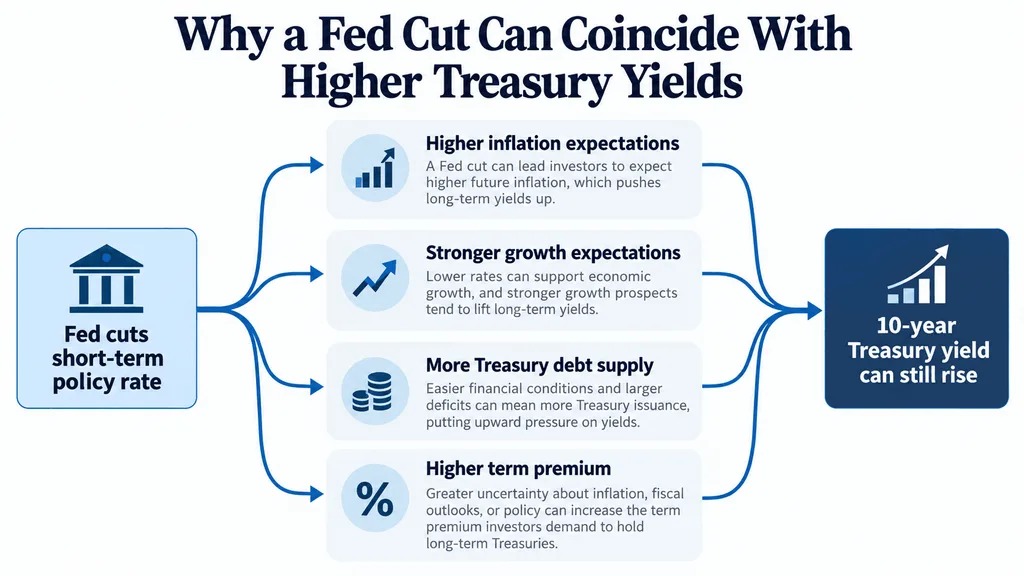
This is why, even as the Federal Reserve cuts interest rates, long-term yields may still rise.
Cutting interest rates may actually raise long-term expectations.
Assume that the Federal Reserve cuts interest rates in order to support economic growth.
Investors may come to the conclusion that more relaxed policies will keep the economy strong for a longer period, drive up inflation, or force the Federal Reserve to reverse its stance again later on.
If market expectations are that future short-term interest rates will be higher than previously assumed, then even if current policy interest rates have just been lowered, the yield on 10-year government bonds may still rise.
This is also why, during a loose monetary policy cycle, strong economic data can drive up the yield on U.S. Treasury bonds. Coinpaper has recently observed this trend: after strong data on U.S. business activity, the yield on 10-year U.S. Treasury bonds rose above 5%.
Inflation may overshadow the impact of interest rate cuts.
Inflation is particularly important because U.S. Treasury bonds promise fixed payments.
If investors expect inflation to be higher over the next decade, then these future payments will shrink in real value. Therefore, bondholders will demand a higher nominal yield as compensation.
This pressure may come from stronger wage growth, rising commodity prices, fiscal stimulus, or an economy that is hotter than expected.
Higher U.S. Treasury yields will subsequently spill over to other markets as well. Regarding why rising yields would hit AI and tech stocks, Coinpaper has pointed out that higher risk-free interest rates will lower stock valuations and increase borrowing costs.
More government debt will also push up yields.
The supply of U.S. Treasury bonds is equally important.
If the U.S. government issues more debt, investors will have to absorb more bonds. With an increase in supply, higher yields may be required to attract enough buyers, especially when demand does not grow accordingly.
This means that monetary policy may be shifting towards easing, while fiscal borrowing is exerting pressure in the opposite direction.
The term premium adds another layer of impact. When uncertainties surrounding inflation, deficits, or future interest rates rise, investors may demand additional compensation in order to be willing to hold 10-year government bonds.
Coinpaper has also reported similar deviations recently, that is, why when the yield on U.S. Treasury bonds rose to decades-high levels, VIX still remained at low levels.
The key point is simple: The Federal Reserve's interest rate cuts are just one factor that affects long-term yields.
If inflation risks, growth expectations, government borrowing, or yield premiums rise significantly enough, then even as the Federal Reserve cuts interest rates, the yield on 10-year U.S. Treasury bonds could still move upward.
This is not about the bond market ignoring the Federal Reserve, but rather that the bond market is thinking further ahead.
Adrian Cole
Adrian Cole has been engaged in financial market reporting for over 6 years, with a focus on crypto assets, stocks, and macroeconomic trends. He tracks Bitcoin, major altcoins, the U.S. stock market, interest rates, commodities, as well as data that drives market fluctuations. Over the years, he has written hundreds of market updates and analysis articles, with an emphasis on price trends, investor sentiment, and the connections between traditional finance and digital assets.