Key Points
- The XRPL predictor has stored the price data for RLUSD and EUROP.
- DIA Publishes prices of major cryptocurrencies and stablecoins
- Data update lag highlights that challenges still exist in institutional-level infrastructure
The native price oracle infrastructure of XRP Ledger ( XRPL ) now includes the market data for Ripple's RLUSD stablecoin, as well as the euro-denominated stablecoin EUROP. It also covers XRP, Bitcoin, Ethereum, and other digital assets, thereby expanding the range of pricing information available for blockchain-based financial applications.
According to the XRPL price data dashboard, DIA is the only identified provider of a production environment among the mainnet accounts it monitors, and the ledger records two PriceOracle objects.
As Ripple expands its bank custody services and stablecoin settlement capabilities, this progress adds another component to the institutional-level infrastructure of XRPL.
However, the tracker marked both of these observed oracle objects as expired, which has also raised questions from the outside world regarding the freshness of the data and its production availability.
XRP Ledger Prophet Tracking RLUSD, EUROP and Major Cryptocurrencies
The XLS-47 PriceOracle feature of XRPL allows providers to directly publish external market prices into the native ledger objects.
Each object can store the prices of up to 10 asset pairs, allowing the application to avoid having to call the provider's external API every time it needs to query information.
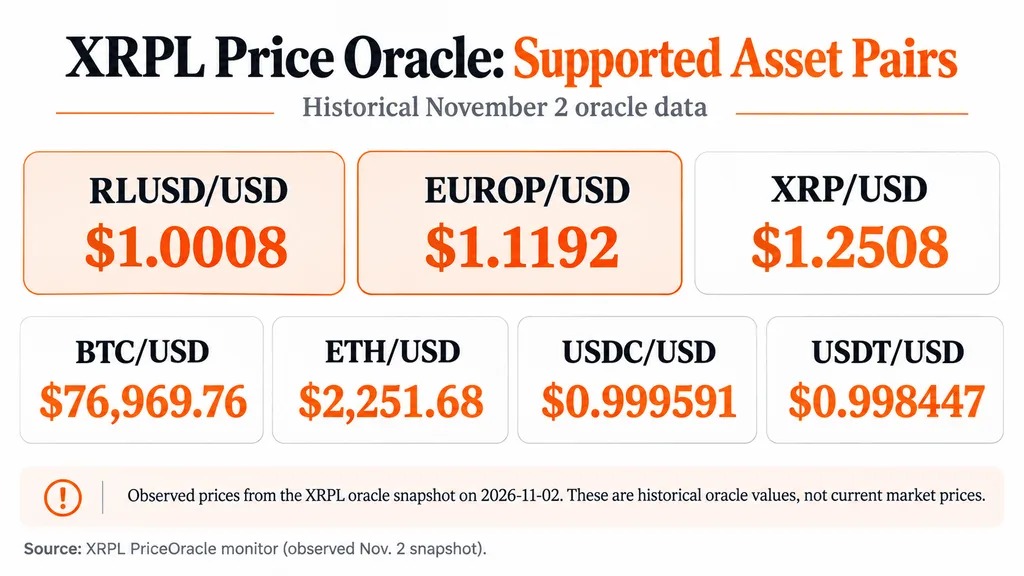
The monitored DIA predictor includes RLUSD / USD with a bid of $1.0008, EUROP / USD with a bid of $1.1192, and XRP / USD with a bid of $1.2508.
This also includes quotes for Bitcoin and Ethereum, as well as USDC and USDT, but these numbers represent historical observation values, not current market prices.
The emergence of euro-denominated stablecoin prices is particularly noteworthy, as XRPL has previously demonstrated the use of XRP as an intermediary between digital assets to facilitate EUROP transactions.
Institutional finance drives the demand for on-chain price data
Reliable market data can support applications such as tokenized asset valuation, collateral valuation, and automated financial transactions.
The recent collaboration between Ripple and DriveWealth indicates that the market's interest in connecting the settlement of RLUSD with traditional financial infrastructure is on the rise.
At the same time, the company's collaboration with C2FO aims to introduce stablecoin settlement into commercial invoice financing.
However, neither of these two collaborations can prove that their applications are currently using the chain price data source of DIA.
This is very important, because storing market information on the blockchain does not automatically mean that it is ready for commercial use, nor does it necessarily meet the reliability requirements of financial institutions.
Oracle data obsolescence raises doubts about readiness
The last update time for a monitored DIA object was in February 2025, while for a more recent object, the price as of November 2nd was already several hours behind the current time when it was checked.
For applications that require accurate market prices, expired quotes may pose valuation risks, especially when cryptocurrency prices fluctuate rapidly.
However, the native lending system proposed in XRPL has not yet been approved, and its initial design relies on off-chain underwriting rather than automatic collateral liquidation.
This limits the ability of outsiders to immediately infer the lending risk exposure based on the outdated prices of the oracle.
Nevertheless, Ripple's broader institutional credit programs still indicate that reliable blockchain financial data may become increasingly valuable in the future.
Marcus Hale
Marcus Hale is an author who focuses on cryptocurrency and financial markets, with his reporting covering Bitcoin, Ethereum, digital assets, regulation, ETF, and institutional adoption. His writing focuses on developments that may drive market changes, investor trends, as well as the broader forces that shape the crypto economy.