On Friday (October 30), the Chinese stock market continued its historic decline. As the global retreat from investments in artificial intelligence continued to intensify, China's blue-chip benchmark index briefly approached a one-year low.
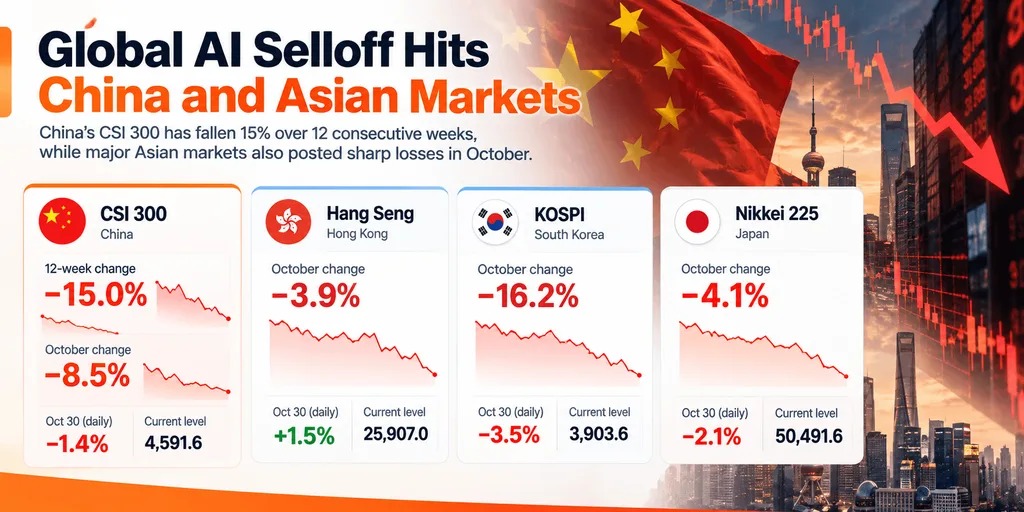
The CSI 300 index fell 1.4% on the day, bringing its decline for October to around 8.5%, marking the worst single-month performance in over a decade. Over the past 12 weeks, this benchmark index has fallen by a total of 15%.
CSI Hits a Record for Longest Consecutive Weekly Declines with 300 Losses
Tracing the CSI 300 index of major listed companies in Shanghai and Shenzhen, it has recorded the longest consecutive weekly decline since its launch in 2005.
The Shanghai Composite Index also fell by 1.4% on Friday, while the Shenzhen GEM Index tumbled by 4.1%, indicating that growth-oriented companies have faced particularly severe pressure.
This round of decline continues China's broader stock market adjustment; CSI The 300 index entered bear market territory earlier this month.
Technology companies remain one of the sectors that have been hit the hardest. The STAR 50 index has already fallen by about 40% from its summer highs, and during this decline, its market value has evaporated by approximately $480 billion.
Optical module manufacturer Zhongji Xuchuang ( Eoptolink Tech ) fell by about 14% on Friday, bringing its cumulative decline in October to around 50%. The CSI 5G communications index also fell by 6.2%.
Despite reports that Chinese authorities are attempting to stabilize the stock market, selling pressure continues.
Earlier this week, investors with suspected national backgrounds bought as much as $25.5 billion worth of stocks, but this did not reverse the overall downward trend.
Global AI spending concerns spread from Wall Street to Asia
The broader question is whether expenditures on chips, cloud computing, and data centers can generate sufficiently strong returns.
This uncertainty stems from the recent wave of AI sell-offs on Wall Street, with market attention increasingly shifting from the growth in AI demand itself to cash flow pressures.
On Friday, Asian chip manufacturers also faced similar pressures.
South Korea's SK Hynix fell by more than 7%, Japan's Nikkei 225 index closed down 2.1%, with tech stocks dragging down the overall market.
The South Korean Composite Stock Price Index ( Kospi ) fell by about 3.5%, with the cumulative decline in October expanding to 16.2%.
This simultaneous decline indicates that concerns regarding the valuation of AI have spread to related companies throughout the global computing industry chain.
Despite a sharp decline in the Chinese mainland market, the Hong Kong stock market still rebounded.
Not all Chinese stock markets are moving in the same direction.
The Hang Seng Index in Hong Kong rose by about 1.5% on Friday, while the mainland benchmark index recorded a significant decline. Such divergent performance indicates that investors are becoming more selective, rather than indiscriminately abandoning Chinese assets.
Despite previous pressures, Hong Kong-listed technology companies have also seen a rebound.
UBS analyst Kenneth Fong believes that some Chinese internet stocks may have already reflected exceptionally pessimistic expectations regarding future AI spending and profitability.
However, just because the valuation is cheaper does not mean that the market will immediately rebound.
China's domestic economy still faces issues such as weak consumer demand, difficulties in the real estate industry, and corporate profits falling short of expectations.