Key Points
- Bernstein is said to have set an Ethereum target price of $5,500
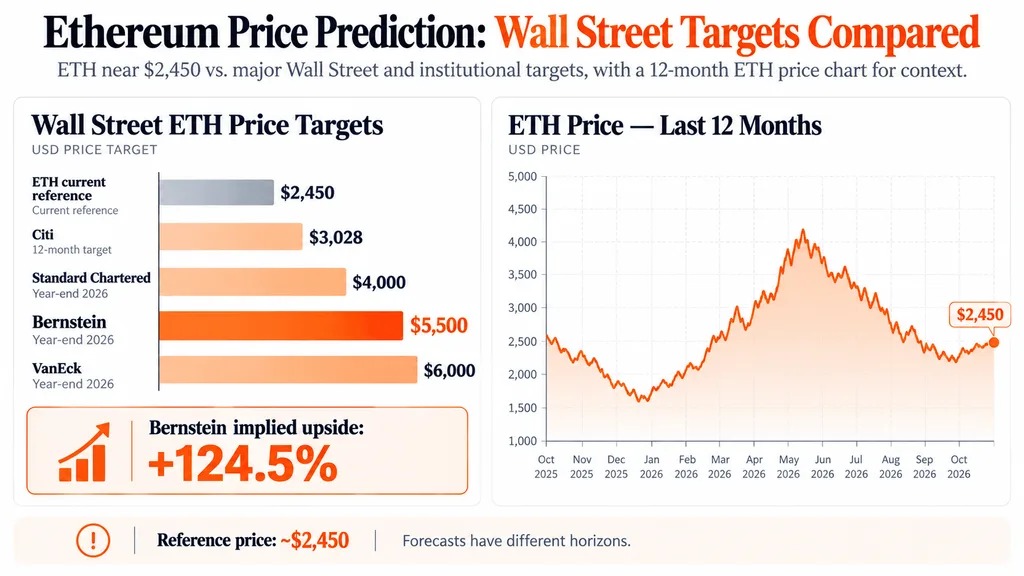
- If it rises from around $2,450 to $5,500, ETH would require a gain of approximately 124%.
- ETF Capital outflows are threatening Ethereum's fragile price recovery
According to the price target referenced in a institutional forecast comparison on October 7th (Bernstein), Ethereum could see a rise of about 124% by the end of 2026, reaching $5,500; nonetheless, this cryptocurrency is still striving to recover from the recent round of market sell-offs.
On October 16th, ETH rebounded to around $2,450, after having fallen to approximately $2,325 within the past 24 hours. This recovery occurred amidst further volatility in the cryptocurrency market, due to unexpectedly strong inflation data from the United States that sparked concerns about the Federal Reserve's potential for further interest rate hikes.
The $5,500 Ethereum forecast for Bernstein implies a 124% upside potential.
The $5,500 target set by Bernstein is one of the more optimistic institutional Ethereum forecasts as of the end of 2026.
According to an analysis on October 7th, this forecast is significantly higher than Citibank's target of $3,028, as well as Standard Chartered Bank's expectation of $4,000.
Calculated based on Ethereum's reference price of $2,450 on October 16th, a rise to $5,500 would require an increase of about $3,050, which corresponds to a gain of 124.5%.
Such a significant difference indicates that, despite Ethereum having established itself in the fields of decentralized finance, stablecoins, and tokenized assets, its valuation remains full of uncertainties.
Citi recently raised its Ethereum forecast from $2,240 to $3,028, reflecting expectations for improved institutional participation and a rebound in digital asset activity.
A higher target price of Bernstein implies a stronger rebound, which may need to be supported by reinflowing investment funds and an improvement in the overall market environment.
ETH rebounded 5% from its lows, but faces resistance at $2,500
Ethereum's current market condition is still significantly weaker than the levels implied by these optimistic forecasts.
On October 16th, ETH rebounded from a low of $2,324.97 to around $2,445 to $2,450. This rebound was accompanied by a wave of derivative liquidations, which included approximately $45.46 million in short positions being liquidated.
However, this cryptocurrency still struggles to establish a sustained rebound above $2,500, and this psychological barrier may determine whether buyers can regain short-term momentum.
Recently, the pressure on Ethereum has also been related to the turmoil in global stock markets, and investors facing losses may reduce their exposure to other risky assets.
If it can clearly break through $2,500, it may improve short-term sentiment and open the possibility of testing higher resistance levels around $2,600. On the contrary, if it falls back below $2,400, the recent low of $2,325 could be challenged.
Ethereum ETF capital outflows pose a challenge to bullish forecasts
Institutional demand is another obstacle to achieving the target price of Bernstein on Ethereum.
US spot Ethereum ETF recorded a net outflow of approximately $129.5 million on October 14, reversing the rebound from the previous trading day, due to investors reducing their exposure to cryptocurrencies.
Inflation is also exacerbating the uncertainty of the outlook. In September, producer prices in the United States rose by 6.3% year-on-year, reinforcing market doubts about the Federal Reserve's next policy decisions.
Higher interest rates will increase the attractiveness of interest-bearing investments relative to speculative assets, which may thereby limit the demand for Ethereum.
Author: Elara Voss
A journalist who covers the cryptocurrency market, blockchain innovation, and global digital asset regulation. She has a background in financial research and technology reporting, focusing on market fluctuations, emerging protocols, institutional adoption, and the changing role of cryptocurrencies in the global economy.