Key Points
- AI Expenditures Go Far Beyond NVIDIA and Chip Manufacturers
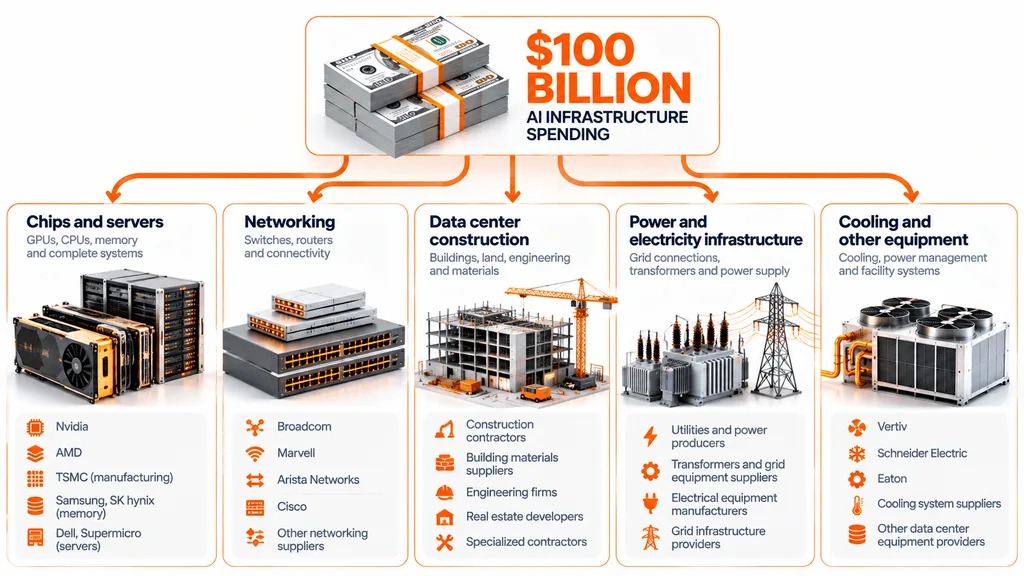
- Data centers require construction, power supply, network connectivity, and cooling systems.
- Suppliers may generate revenue before the investment in AI becomes profitable.
When Microsoft, Google, or Meta announce investments of $100 billion in artificial intelligence, that money does not simply flow towards NVIDIA. The funds move along a vast industrial supply chain, involving semiconductor manufacturers, data center developers, power suppliers, and equipment providers.
Some companies receive payments during the infrastructure construction phase, while others earn recurring revenue once the facilities begin to operate. Understanding this difference helps to explain who truly benefits from the AI investment boom.
Advanced computing hardware is one of the main areas of investment for AI.
However, designing a processor does not equate to manufacturing one. Taiwan Semiconductor Manufacturing Company ( TSMC ) produces advanced chips for large technology customers, while suppliers of high-bandwidth memory and semiconductor equipment support the subsequent production stages.
When companies develop custom AI chips, the supply chain becomes more complex. Google, Amazon, and Microsoft are increasingly designing their own accelerators, which reduces their dependence on specific suppliers, but it does not eliminate manufacturing costs.
Microsoft provided an exceptionally clear breakdown in its third-quarter financial results for the fiscal year 2026.
Of its $31.9 billion in capital expenditures, approximately two-thirds were used for assets with a shorter lifespan, mainly GPU and CPU. The remaining investment was used for infrastructure with a longer lifespan.
Who would get paid outside of NVIDIA?
Once a company purchases computing hardware, it also needs a place to operate these devices.
Data center construction will bring business to engineering contractors, building materials suppliers, electrical equipment manufacturers, and infrastructure developers.
Companies such as Vertiv provide cooling and power management equipment, while Schneider Electric and Eaton offer power distribution technology. Arista Networks and other network equipment experts are responsible for connecting large processor clusters.
Electricity has introduced another layer of expenditure.
AI facilities require connection to the power grid, transformers, and a long-term power supply. Even if the demand for additional GPU begins to slow down, these requirements may still create opportunities for utility companies and equipment suppliers.
This distinction is very important, as power bottlenecks can delay projects that have already been completed.
A AI company may already own servers, but before putting them into use, it still needs to make payments to contractors, utility companies, and infrastructure providers.
Who makes money after the data center opens?
Once the infrastructure begins to operate, the economic logic will change.
Electricity suppliers charge based on the amount of electricity used, while maintenance contractors and equipment suppliers may earn steady service revenues. Data center owners may also collect rent according to long-term agreements.
Subsequently, cloud service providers such as Microsoft Azure, Amazon Web Services, and Google Cloud will attempt to recoup their investments by selling computing power to customers.
In the end, the AI developers and enterprises that use these services will need to generate sufficient revenue in order to prove that the infrastructure costs are reasonable.
This also explains why the company that provides financing for the AI facility is not necessarily the one that receives the largest payment first.
It is worth noting that the announced $100 billion in capital expenditures does not necessarily mean that $10 billion will be immediately transferred to suppliers. The budget may include equipment delivery, construction projects, and financial leasing, which will be recognized at different times.