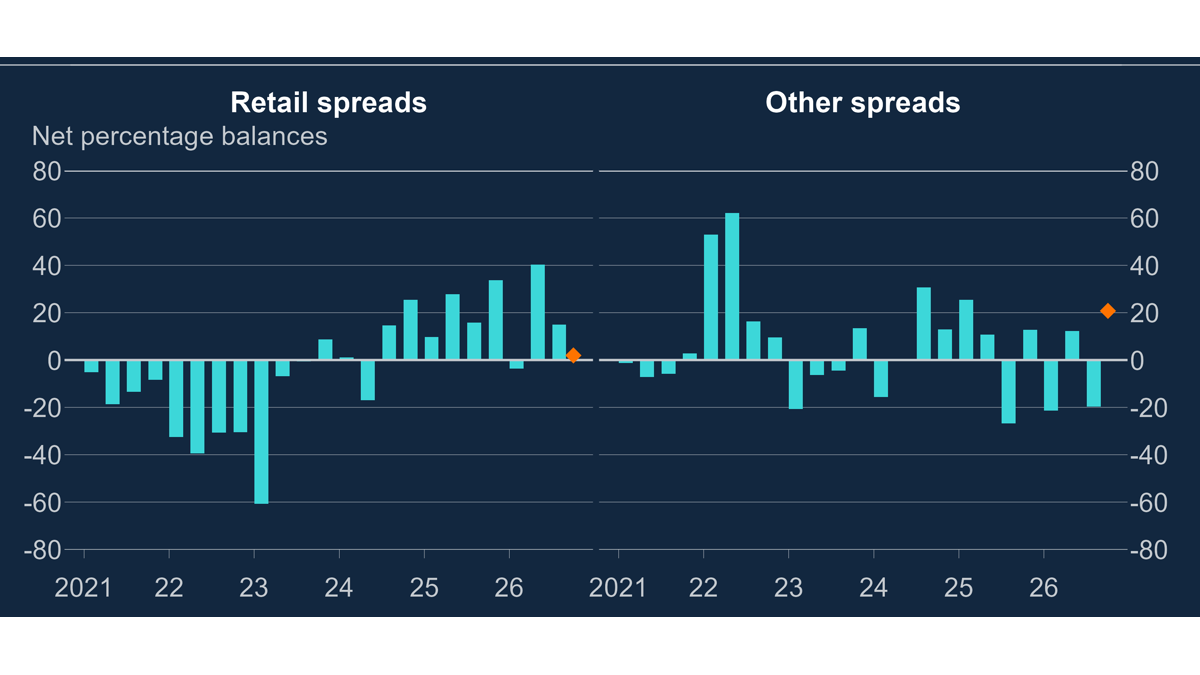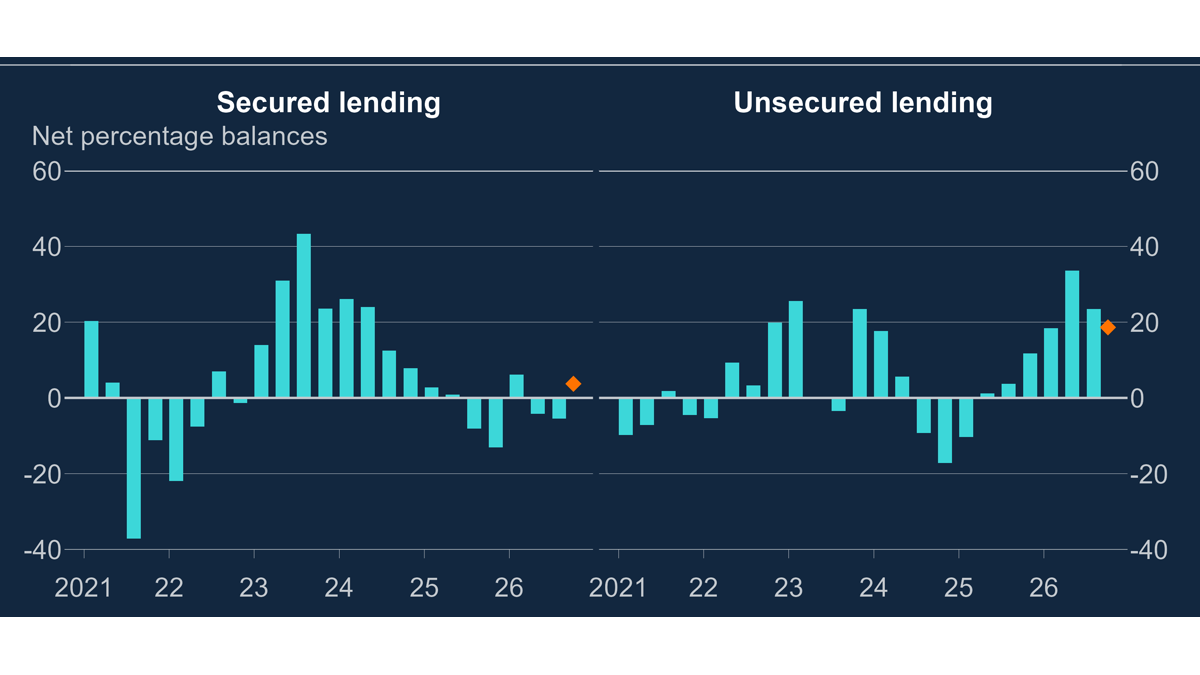


Also on October 8th, the Bank of England released another report that can easily be confused with credit surveys: the 'Bank Lending Survey' for the third quarter of 2026. This report examines where banks obtain funds, what costs they incur, and whether they are able to continue raising capital, rather than whether residents or businesses can obtain loans. The surveyed banks indicated that overall financing volumes increased in the third quarter and expect this trend to continue in the fourth quarter; however, retail deposits, corporate deposits, and other sources of financing did not all move in the same direction. When discussing a bank's lending capacity, it is often more relevant to look at the liability side first than to focus solely on loan interest rates, as this provides a closer approximation of the actual constraints faced by banks.
The observation window of this questionnaire is similar to that of the "Credit Conditions Survey," but they are two different reports with different questions. An increase in financing volume can provide banks with more sources of funds, yet it does not necessarily translate mechanically into more loans. Banks also need to consider factors such as the duration of funds, pricing, capital occupation, borrower risk, and regulatory requirements. To conclude that "credit will immediately become more lenient" just because there is more financing, one overlooks the most important decision-making aspect in the balance sheet.
Behind the overall increase is the readjustment of prices from various sources.
The survey shows that retail deposits and "other" financing volumes of the surveyed institutions increased in the third quarter. Retail deposits are usually a relatively stable source of funds for banks, but stability does not equate to cost-free; banks reported an increase in the relative cost of retail deposits, while the relative cost from "other" sources decreased. The coexistence of these two trends indicates changes in the financing structure and competitive environment. Even though the total volume has expanded, the ultimate marginal cost of funds for banks still depends on the proportion of each channel, rather than inferring the industry-wide interest margin from a single price point.
It is reported that the supply of household deposits has increased slightly, while the supply of deposits from private non-financial enterprises has decreased. Corporate deposits are affected by cash flows, capital expenditures, wage payments, and tax arrangements, and their fluctuations may be greater than those of household savings. The survey provides some directional clues, but it does not tell us which specific factor is primarily responsible for the decline in corporate deposits, nor can we conclude from this that British businesses are generally running out of cash. To test this inference, it is necessary to consider the actual balances of bank deposits, corporate cash flows, and sectoral financial data.
Another change is the increase in the proportion of medium- and long-term funds in wholesale financing. Longer-term debt may alleviate short-term refinancing pressures, but it usually comes with different pricing and issuance conditions as well. Respondents reported that the demand for bank wholesale debt from both British and non-British investors has remained largely unchanged. Therefore, it would be inappropriate to interpret this increase in the long-term proportion as "a massive influx of overseas funds" or "the market having completely eliminated financing risks." Banks may proactively adjust their maturity structures, and such changes can occur even if there is no significant increase in overall investor demand.
The cost indicators of the survey need to be read carefully. Relative costs describe the price variations between different financing channels; they do not equal the absolute interest rates paid by each bank, nor are they a direct predictor of household time deposit rates. If one bank relies more on expensive retail deposits, while another uses other channels with lower costs more extensively, the resulting net interest margin may differ. For depositors, questionnaires cannot replace specific account quotes; for investors in bank stocks, looking solely at the amount of financing is not enough to infer future profits; one must also consider asset returns, credit losses, and hedging arrangements.
Improvements on the liability side may support lending, but they are not a commitment to lend.
Whether a bank can convert funds into loans first depends on whether the loan application is sufficient and whether the risk-return ratio is appropriate. The "Credit Conditions Survey" released by the Bank of England on the same day showed that the availability of household loans decreased in the third quarter, and small and medium-sized enterprises also faced credit pressures. By comparing these two surveys side by side, a seemingly contradictory situation becomes apparent: banks claim that the amount of funds raised has increased, yet they have not generally relaxed their lending policies. This contradiction does not necessarily have to be interpreted as a statistical error; it may reflect that banks are more cautious regarding defaults, funding costs, or loan demand. Neither survey alone can identify which factor is the most important.
The financing volume continued to increase in the fourth quarter, which was merely the expectation of the respondents at the time of the survey. However, if market interest rates, deposit competition, and bond issuance conditions change subsequently, the actual results may deviate from these expectations. The Bank of England has also made it clear that the survey responses represent the judgments of the institutions themselves and do not reflect the central bank's views, nor do they constitute a certification by regulatory authorities regarding the safety of banks' financing. Especially when discussing financial stability, the net balance from the survey cannot replace hard indicators such as liquidity coverage ratios, capital ratios, and stress tests.
The most important aspects to monitor in the next phase are whether actual deposit data confirm the differentiation between households and businesses, whether retail deposit costs continue to rise, and whether banks can maintain their long-term proportion of wholesale funds without significantly increasing overall costs. If financing volumes continue to improve but credit does not pick up, the focus should shift to loan demand and risk appetite; if financing costs rise again, this may in turn constrain loan pricing. This report describes changes in the way banks obtain funds, not an announcement that the UK economy has entered a new round of credit expansion. It is essential to clarify this boundary so that readers can truly understand the value of the data on the liability side.
There are still differences regarding bank liabilities in terms of "whether the amount is sufficient" and "whether the maturity is appropriate." Short-term funds can meet current liquidity needs, while long-term funds help to cover loans and investments with longer maturities; however, extending the maturity often changes the cost. Survey records show an increase in the proportion of long-term wholesale financing, which is not yet sufficient to determine that each bank's asset-liability maturities are perfectly matched. If readers wish to assess stability, they should continue to examine the maturity structure disclosed by banks, their liquidity buffers, and the concentration of deposits, rather than relying on a single questionnaire to replace a comprehensive analysis.
Similarly, a decline in corporate deposit supply does not mean that companies immediately run out of funds. Companies may be using their funds to pay for goods, increase inventory, repay debts, or shift their funds to other higher-yielding investments; the questionnaire does not distinguish between these motives. What is truly concerning is when multiple data sources simultaneously indicate a decrease in corporate cash balances, an increase in financing costs, and restrictions on loans. The current evidence only supports the conclusion that "surveyed banks have noticed a reduction in corporate deposit supply." Clarifying the level of evidence does not diminish the news value; rather, it helps to avoid misinterpreting normal capital allocation as systemic pressure.