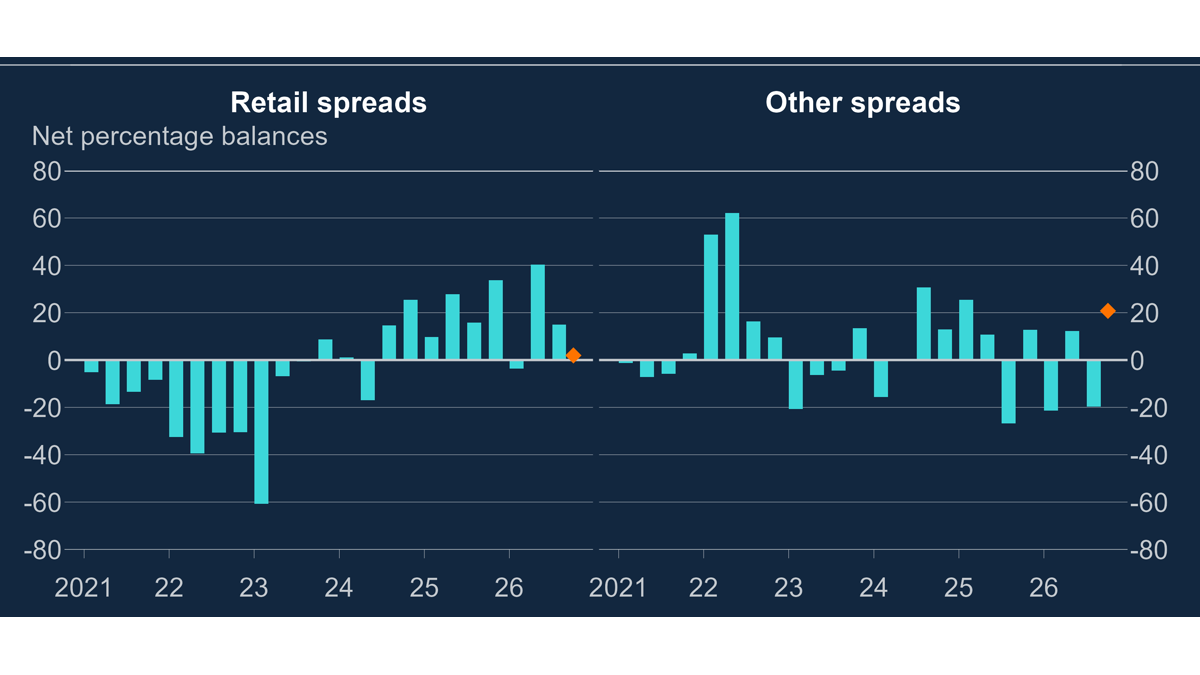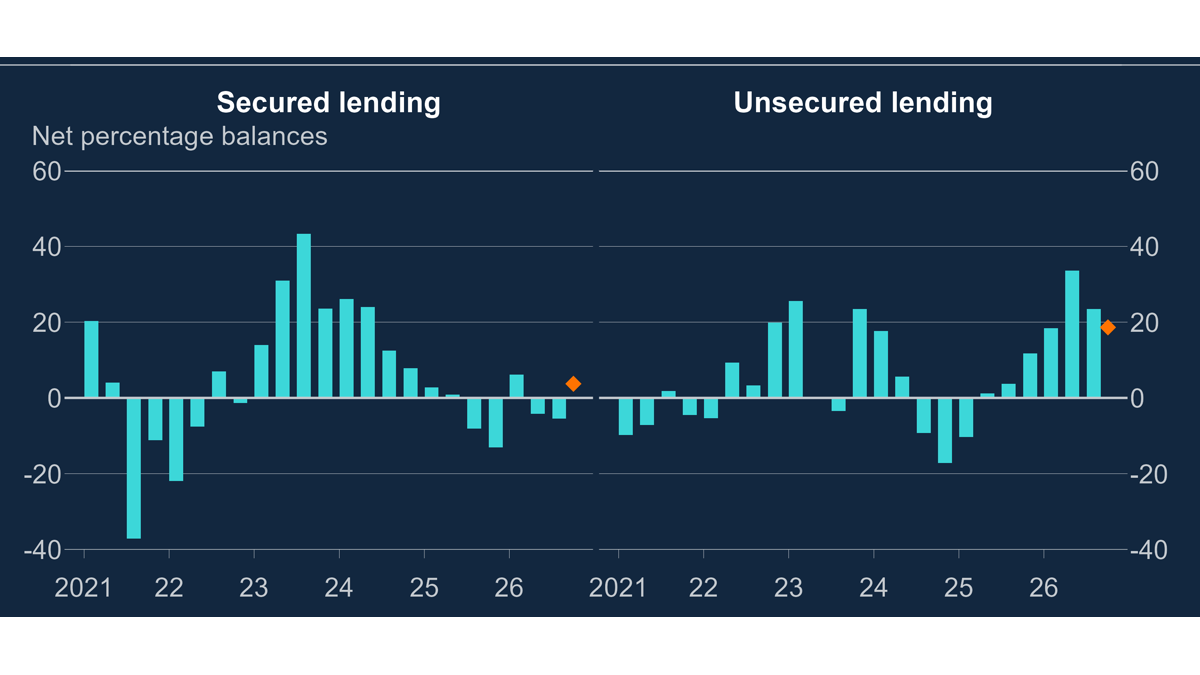


The Bank of England's "Credit Conditions Survey" for the third quarter of 2026, released on October 8th, does not present a simple story of "easing" or "tightening" monetary policy. Loan institutions surveyed reported that during the just-passed quarter, the availability of both mortgaged and unsecured loans to households declined; they also expect that by the fourth quarter, these two types of credit supply will improve slightly. These two statements are not contradictory, as the former describes a period that has already occurred, while the latter is merely the institutions' forecast for the next phase. If these forecasts were to be interpreted as having already materialized, it would lead to premature conclusions about the market situation.
This survey collected responses from August 17 to September 4, reviewing the changes over the three months ending at the end of August compared to the previous three months, and also asking for judgments regarding the three months ending at the end of November. Therefore, the release date in October does not coincide with the data observation period. When readers see "third quarter," they should think more about how banks adjusted their approval processes, pricing, and credit limits during that time, rather than interpreting it as the total amount of loans issued in October. The net balance reflected in the survey indicates the direction and strength of the responses, but it is not equal to the actual amount of loans disbursed.
Tighter supply on the household side does not mean that all loan demands are increasing.
Respondents reported that the availability of mortgages and consumer credit for households declined in the third quarter. In the mortgage market, demand for new home loans and refinancing also weakened; this means that changes in transactions cannot be attributed solely to "banks becoming more cautious," as borrowers' intentions are also changing. For households, affordability, interest rate expectations, housing prices, and income uncertainties can all affect their willingness to borrow; for banks, asset quality and capital utilization influence the amounts and terms they are willing to offer. Surveys can record the trends, but they cannot assign causal weights to each individual change.
The default rate for unsecured loans has been reported to be on the rise, and surveyed banks also expect it to continue to increase in the fourth quarter. This trend deserves more attention than just the number of applications in a single quarter: credit cards and other unsecured loans are generally more sensitive to household cash flow pressures. However, an increase in the default rate does not necessarily indicate a systemic crisis in the entire household sector, nor can it be directly translated into the amount of bad debts that banks will face in the future. Default statistics are affected by product structure, lending standards set earlier on, and the composition of sampled banks. To determine whether the risk is continuing to spread, it is also necessary to consider official data on delinquencies, bank financial reports, as well as changes in employment and income.
The expectation of a "slight increase" in supply in the fourth quarter also needs to be tempered. Banks expressing a willingness to lend more in future surveys does not necessarily mean that borrowers will meet the approval criteria, nor does it imply that loan rates will definitely decrease. If interest rates, funding costs, or default expectations change later on, banks are fully capable of adjusting their original plans. For homebuyers, the most relevant information is the actual mortgage products available, down payment requirements, and the approval rates; for consumers using consumer loans, they should focus on the total cost of the contract, rather than relying on survey expectations to increase leverage.
The landscape on the corporate side also has its stratifications. Surveys indicate that the overall availability of corporate credit has remained largely unchanged, but the supply to small and medium-sized enterprises (SMEs) has decreased, while for large enterprises, it has remained relatively stable. The loan demand from small and medium-sized enterprises has also declined. If one only writes "corporate loans are stable," this would overlook the differences in scale; whereas if one only mentions "SMEs face tight financing," it might overlook the weakening of demand. SMEs often rely more on bank credit lines and lack alternative channels in the capital market. Therefore, when both supply and demand weaken simultaneously, the actual impact on investment and working capital deserves continued observation. However, this still requires cross-validation with subsequent loan balances and enterprise surveys.
What can a questionnaire tell us, and what can't it tell us?
The Bank of England clearly stated that the survey results represent the views of the loan institutions interviewed and do not necessarily reflect the central bank's own opinions. The method of calculating net balances also gives a different weight to the responses of a few large banks compared to smaller banks; when comparing changes across quarters, it is best to refer to the same series and the same criteria. The survey is adept at capturing banks' perceptions of marginal changes, especially during time periods when the publicly available total loan data is not yet comprehensive; however, it is not well-suited for answering quantitative questions such as "how many additional pounds of loans were issued" or "which type of borrowers were rejected the most."
When placing this report within the context of the UK macroeconomy, it is also necessary to guard against narratives based on a single indicator. Tightening of loan supply may suppress consumption and housing activities, while weakening demand could also reflect businesses and households voluntarily delaying their spending. These two factors have different implications for growth. If future supply prospects improve but actual demand remains weak, banks may be willing to lend while customers are reluctant to do so, resulting in little increase in loan volumes; if demand recovers but defaults continue to rise, banks may raise their lending standards again. The transmission of policy effects will not be immediate just because of a single indicator in a survey.
Banks, investors, and borrowers should next verify three sets of information: whether the new surveys for the fourth quarter reflect an improvement in supply; whether there is a synchronous change in the flow of mortgages, consumer loans, and business loans; and whether defaults on unsecured loans have spread to more products. For small and medium-sized enterprises (SMEs), it is also necessary to separately observe the available credit lines and financing costs, as the relatively stable situation of large enterprises cannot be used to represent their circumstances. The reliable conclusions drawn from this survey are that by the end of summer, there was a tightening of credit conditions on the household side and a divergence on the corporate side in the UK, while banks have expectations of a slight improvement in supply by the end of the year. It does not declare that the credit cycle has turned around, nor does it turn future predictions into facts.
This combination of "already occurring tightening" and "possible future improvement" precisely illustrates the need to clarify the tense in news headlines. If readers only see the second half of the sentence, they might mistakenly assume that financing constraints have been lifted; if they only see the first half, they will miss the fact that banks are adjusting their expectations. When comparing adjacent quarters, it is also important to pay attention to whether the institutions covered by the surveys and the wording of the questions are consistent, and to compare the survey results with the actual monetary and credit data published by the Bank of England. Only when there is a gradual consistency in direction, quantity, and price can we speak more confidently about a turning point in credit.