TSMC will release its third-quarter financial report on Thursday. Bank of America Merrill Lynch expects TSMC's revenue for the third quarter to exceed expectations, with the strong progress of its 2nm manufacturing process being a key driving force. On the eve of the financial report release, they have raised their target price and maintained a 'buy' rating.
According to ZuiFeng Trading Desk, in a research report released by Bank of America Merrill Lynch on October 12, analyst Haas Liu raised the target price for TSMC's US stock (TSM) from $590 to $620 (and the target price for TSMC's Taiwanese stock from NT$3100 to NT$3260), and also increased the earnings forecast per share for 2026 to 2028 by 2% to 9%.
The core logic behind this increase is as follows: The acceleration in the adoption of 2nm manufacturing processes has driven demand for Apple's mobile SoC and AMD servers CPU beyond expectations. Coupled with the migration of multiple GPU and ASIC products to 3nm, this has led to third-quarter revenue exceeding the upper end of the forecast range and laid a foundation for sales growth in the fourth quarter.
Bank of America expects TSMC's revenue in the fourth quarter to grow by 10% to 15% year-on-year, and it is expected to achieve a year-over-year increase of over 40% for the whole year, in line with the company's previous guidance. At the same time, despite the cost pressures brought about by the ramp-up of 2nm production capacity and the expansion of overseas wafer factories, Bank of America expects the gross margin to remain at 67.0% and 67.8% in the third and fourth quarters, respectively, which is lower than the market's recent optimistic expectations of 67% to 69%. However, the overall profitability remains resilient. TSMC's stock price in the US market has risen by more than 48% so far this year, and Bank of America's latest target price still implies a potential upside of about 37% compared to the current stock price.
Third-quarter revenue is expected to exceed expectations, with the 2nm ramp-up being the key driving factor.
According to a research report by Bank of America Merrill Lynch, TSMC's revenue in the third quarter is expected to grow by 18% year-on-year when calculated in New Taiwan Dollars, which is higher than the 14% and 13% forecasts of Bank of America and the market respectively. Converted at an average exchange rate of NT$31.99 per US dollar, TSMC's US dollar revenue in the third quarter could reach $46.67 billion, exceeding the company's guidance range of $44.6 billion to $45.8 billion.
Bank of America believes that the core driver of this outperformance came from the rapid increase in 2nm manufacturing capacity. The bank estimates that the contribution of 2nm technology to revenue in the third quarter has risen from 3% in the second quarter to approximately 11%, mainly due to mobile device inventory buildup ahead of Apple's new product releases, as well as strong demand for AMD Venice servers and CPU. At the same time, incremental inventory buildup for flagship smartphones SoC by Mediatek and Qualcomm also provided additional support, although the scale of inventory buildup was lower than seasonal levels due to weak Android demand.
At the 5nm and 3nm nodes, Bank of America expects that capacity utilization will continue to remain above 100%, mainly driven by demand for high-performance computing and AI. This includes strong demand for a variety of accelerator products such as Nvidia Rubin GPU, AMD MI400, AWS Trainium3, as well as the continuous growth of server CPU and network switching chips.
Fourth Quarter Outlook: Rising average mix price drives sales, but gross margin falls short of market expectations
Bank of America expects TSMC's revenue in the fourth quarter to grow by about 11% month-on-month, which is better than the seasonal average of 7% over the past decade. The main driving factor comes from the continuous shift in the product portfolio towards more advanced manufacturing processes: the revenue contribution from 5nm and below processes is expected to increase from 71% in the third quarter to 75%, and the contribution from 2nm is expected to rise to 18%. The pricing for these wafers is more than 15% higher than that of 3nm.
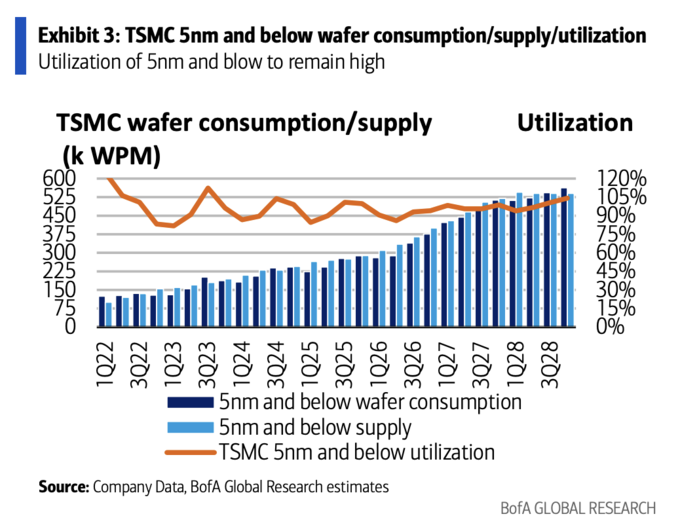
However, Bank of America's forecast for gross margin in the fourth quarter is more conservative than the market's expectations. The bank expects the gross margin for the fourth quarter to be around 67.8%, which is lower than the market's recent forecasts of 68% to 69%. The main factors contributing to this are: an increase in depreciation of 25% to 30% on a quarter-on-quarter basis due to the expansion of overseas wafer factories and 2nm production capacity in the second half of 2026; and as the contribution from 2nm revenue expands, the dilution effect on gross margin caused by the improvement in yield may be more significant in the fourth quarter, with an expected impact of 3 to 4 percentage points.
Bank of America's profit forecasts for 2026 to 2028 are overall 5% to 15% higher than market consensus, mainly based on assumptions of higher sales growth. Bank of America expects TSMC's earnings per share for 2026, 2027, and 2028 to be NT$112, NT$161, and NT$203 respectively.
Capital expenditure continues to expand, with the potential to exceed $83 billion by 2027.
Against the backdrop of stable demand prospects, Bank of America expects TSMC's capital expenditure in 2026 to reach approximately $63 billion, which is at the upper end of the company's guidance range of $60 billion to $64 billion. The expenditure will focus on advanced front-end manufacturing, including an expansion of 3nm production capacity by about 55,000 to 60,000 wafers per month, a ramp-up of 2nm production capacity by about 60,000 wafers per month, and the initial installation of A16 production capacity by about 3,000 to 5,000 wafers per month.
Looking ahead to 2027, Bank of America expects capital expenditures to further rise to approximately $83 billion, to be used for the continued expansion of N3, N2, A16, and CoWoS-L, as well as the preliminary mass production preparations for new technologies such as CoPoS and CPO. Bank of America estimates that TSMC's compound annual growth rate of capital expenditures from 2026 to 2028 will be around 20%.
It is worth noting that equipment suppliers plan to increase prices for front-end manufacturing equipment by 10% to 15% and for back-end packaging equipment by 5% to 10% starting from 2027, which could lead to TSMC incurring an additional approximately 10% increase in capital expenditures. Bank of America believes that, given TSMC's relatively strong bargaining power in the supply chain, these costs can be passed on to customers through wafer foundry pricing when the equipment is delivered and put into production in the second half of 2027. The bank also expects TSMC to raise prices for advanced process wafers by 5% to 10% in the first quarter of 2027.
Despite a significant increase in capital expenditures, Bank of America estimates that the growth rate of depreciation will be lower than the compound annual growth rate of revenue, at 21% compared to 32%, which should support gross margin expansion to between 68% and 69% by 2028.
Technological leadership continues to expand, and the competitive landscape remains stable.
Bank of America believes that TSMC's technological lead in advanced manufacturing processes is further consolidating. Referring to transistor density, TSMC's N3 / N3E leads by about 30% over Intel at 3/18A; looking ahead, Bank of America estimates that TSMC's transistor density advantage at its A16 / A12 nodes over the Intel 18A-P/14A will further expand to around 50% to 60%.
In the field of backend packaging, TSMC is advancing with the CoWoS technology upgrade. The 5.5x mask size version has been mass-produced in 2026 with a yield rate of over 98%, and there are plans to push the technology to the 9.5x to 14x mask limit between 2027 and 2028. Bank of America expects that the supply in the CoWoS-R /L industry will need to grow at a compound annual growth rate of 52% to meet the demand from 2026 to 2028. TSMC will continue to dominate the complex GPU and ASIC packaging markets.
Regarding the potential competitive threat from Musk's Terafab that the market is concerned about, Bank of America believes the risk is overestimated. The bank's analysis indicates that based on a $119 billion ten-year investment plan, Terafab will only be able to establish a production capacity of about 96,000 wafers per month using advanced manufacturing processes by 2036, which is far lower than TSMC's scale. Moreover, Terafab is recently facing issues such as delays in obtaining 18A external customer certifications from Intel. Bank of America judges that SpaceX may instead become an important anchor customer for TSMC, consuming approximately 20% of TSMC's advanced manufacturing capacity in 2029.
Bank of America maintains its buy rating on TSMC, with a target price based on a projected price-earnings ratio of 20 times for 2027. Haas Liu notes that TSMC's current stock price corresponds to a projected price-earnings ratio of about 16 times for 2027, which is at the middle level of its historical valuation range of 11 to 21 times. Considering the company's leading position in advanced manufacturing processes, the current valuation “is not harsh.”

Bank of America analysis shows that the current price-earnings ratios of TSMC’s main customers are about 45% higher than TSMC’s own ratio, which is already 22% above the long-term average; the premium for HPC customers is even higher, at 100% to 150%, far exceeding the historical average of 53%. Bank of America believes that TSMC’s stock price increase over the past two years has been mainly driven by upward earnings revisions, and there has been limited expansion in valuation multiples. In the future, as TSMC’s technological leadership further strengthens, there is room for its stock price to be revalued to a price-earnings ratio of at least 20 times NTM.