
















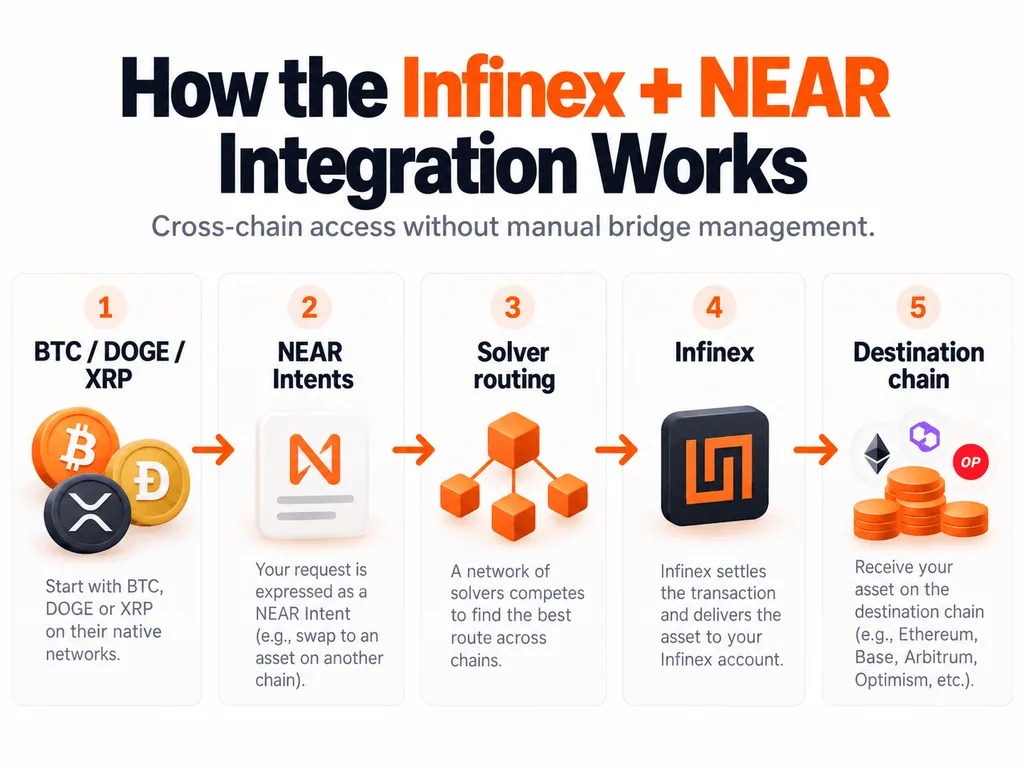
Infinex has integrated NEAR Chain Signatures and NEAR Intents, expanding the platform's cross-chain access to assets such as Bitcoin, Dogecoin, and XRP, without the need for users to manually manage different bridges and wallets.
This integration has enabled Infinex to obtain the blockchain abstraction infrastructure support of NEAR, allowing applications to interact with assets on multiple blockchains through a single interface. NEAR indicates that Chain Signatures utilizes a multi-party computation network guaranteed by validators from NEAR to authorize transactions on external chains.
This means that users can access assets that do not natively exist on the same blockchain, while the underlying execution process is largely hidden from the users.
BTC, DOGE, and XRP can flow between multiple chains.
According to the documentation of the protocol itself, NEAR Intents currently connects to 31 chains and over 100 types of assets, and cross-chain settlement usually takes about 30 seconds.
The system uses solver to compete and route user requests. Users do not need to manually select bridges, source chains, or execution paths; they only need to specify the desired outcome, and the protocol is responsible for handling the routing.
The bridging documentation for NEAR clearly lists examples such as from BTC to TON, from XRP to Arbitrum, and from DOGE to Base, demonstrating how assets within non-EVM networks can enter other ecosystems through the same routing layer.
This makes the integration of Infinex less about adding another bridge, and more about enabling assets such as BTC, DOGE, and XRP to be used in a wider range of blockchain applications.
NEAR is positioning itself as a cross-chain infrastructure.
What's more noteworthy is that NEAR is attempting to shift from being merely a Layer 1 to the execution layer.
Its Intents network currently reports a total historical trading volume of over $30 billion, covering 35 chains; the protocol describes itself as a universal liquidity layer for wallets, DeFi applications, and AI proxies.
This model also aligns with a broader shift towards cross-chain infrastructure, which is to reduce users' reliance on traditional bridging processes.