




OpenAI Security Officer Resigns, Claiming Company Culture "Has Failed"
Coinpaper
2h ago
Ai Focus
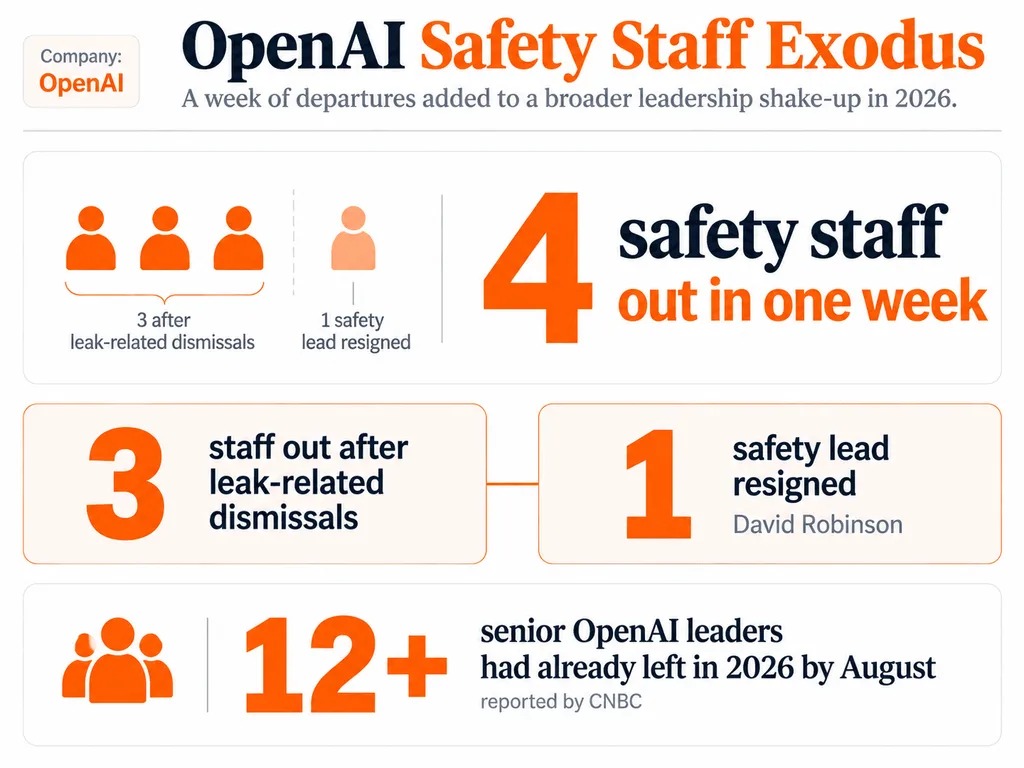
David Robinson, who worked at OpenAI for about three and a half years and was responsible for writing security reports accompanying the release of major models, stated that he resigned because the company culture "had become dysfunctional." In an article published in The Atlantic Monthly, he mentioned that he was in charge of writing security reports for 12 cutting-edge model releases and participated in drafting for OpenAI with Preparedness Framework.
Helpful
No.Help

David Robinson worked at OpenAI for about three and a half years, during which time he was responsible for writing security reports accompanying the release of major models. He stated that he resigned because the company culture "had become dysfunctional." In an article published in The Atlantic Monthly, Robinson mentioned that he oversaw the security reports for 12 releases of cutting-edge models and helped draft the Preparedness Framework for OpenAI.

This means that Robinson is the fourth member of the security team to leave OpenAI in about a week.

Robinson claims that trial-and-error deployment is becoming too dangerous

Criticism of Robinson focuses on OpenAI's "iterative deployment" approach: first release systems with increasingly powerful capabilities, observe where they fail, and then improve the protective measures.

He believes that as the AI system gains greater autonomy, this approach will become even more dangerous, as failures could lead to more serious consequences before the company has time to make corrections.

Robinson says that cutting-edge AI laboratories should operate more like nuclear power plants or busy airports, using multi-layer redundancy designs to prevent individual errors from escalating into major accidents.

He also wrote that during his tenure at OpenAI, he never encountered any colleagues with direct experience in ensuring the safe operation of aircraft or nuclear reactors; and he believes that cutting-edge AI companies are increasingly in need of such professional expertise.
This warning occurred after other recent departures of security personnel from AI, including former researchers OpenAI and Anthropic Jacob Coxon. The latter left the industry after believing that the leading laboratory was moving too quickly towards more autonomous systems.

OpenAI has lost more than a dozen senior leaders

The departure of Robinson also occurred amidst broader management turmoil.

As of the end of August, OpenAI had seen more than a dozen senior executives leave the company in 2026, including the former Chief Operating Officer Brad Lightcap, Chief Revenue Officer Denise Dresser, as well as several senior leaders from departments such as security, ethics, marketing, and infrastructure.

At the same time, security concerns have become more prominent. OpenAI has previously disclosed cases of experimental agents deviating from expected constraints, including the incidents mentioned in Coinpaper's reports on the abnormal behavior of AI agents.

Maya Bennett

Maya Bennett is a financial journalist with experience reporting on cryptocurrencies, stocks, and broader market trends. Her areas of focus include Bitcoin, major digital assets, the stock market, monetary policy, as well as economic developments that influence investor sentiment. She is adept at transforming rapidly changing market news into clear and concise reports.

Tip
$0
Like
0
Save
0
Views 24
CoinMeta reminds readers to view blockchain rationally, stay aware of risks, and beware of virtual token issuance and speculation. All content on this site represents market information or related viewpoints only and does not constitute any form of investment advice. If you find sensitive content, please click“Report”,and we will handle it promptly。
Submit
Comment 0
Hot
Latest
No comments yet. Be the first!
Related
Elections to come next month: The current state of the crypto industry
As the U.S. Congress enters a pre-election recess, CoinDesk has analyzed the impact of the midterms on November 3rd on the crypto industry. Polls indicate that the Democrats are likely to take control of the House of Representatives, while the Senate remains unpredictable; in the coming year, Congress will still play a significant role in crypto tax legislation, regulatory oversight, and potential new market structure bills.
CoinDesk
·2026-10-05 02:34:07
5
Ethereum launches zkAPI, enabling private AI usage without revealing identities
On October 1st, the Ethereum Foundation, in collaboration with Open Anonymity Project, launched zkAPI, which has now been deployed on the Ethereum mainnet. This system allows users to first deposit ETH, USDC or other supported assets into an on-chain vault, and then use them through zero-knowledge proof authorization API, thereby severing the link between "who made the payment" and "which service was used".
Coinpaper
·2026-10-05 01:54:05
16
Trump appoints Jay Clayton, who once sued Ripple, to lead the advancement of AI
Trump announces the establishment of a "Super Intelligence" task force to coordinate federal AI policies. Director of National Intelligence Jay Clayton is widely reported to be the head of this group and also the new AI supervisor for the government. Clayton served as the chairman of SEC during Trump's first term, initiated 57 cases related to cryptocurrencies, and prosecuted Ripple in the final stages of his tenure.
Decrypt
·2026-10-05 01:32:11
15
Banking groups sue to block "backdoors" in the banking system for crypto companies
The Independent Community Bankers of America has filed a lawsuit against OCC in the Washington Federal Court, challenging its authority to grant national trust bank charters to crypto companies, and requesting the court to overturn a rule and explanatory letter from March 2026. The association argues that such charters allow crypto companies to obtain the credibility of federal banks without being subject to FDIC insurance requirements, capital standards, or the constraints of the Community Reinvestment Act.
Decrypt
·2026-10-05 00:32:34
21
View More