














In the newly released Swell 2026 agenda, Ripple listed "the first year of spot XRP ETF" as one of the core themes of its institutional agenda, alongside bank-grade digital asset infrastructure and the role of artificial intelligence in capital flows.
This event will attract approximately 1,500 attendees to New York, and for the first time, it will combine Swell with the Apex summit that focuses on XRP Ledger, as well as UBRI Connect.
This shift is worth noting, as XRP ETF has only recently become a regulated investment category in the United States. Ripple itself stated earlier this year that spot ETF has brought XRP out of over-the-counter trading and private placements into broader discussions about institutional allocation.
XRP ETF has established a sizable institutional foundation.
In the first year, a certain scale of regulated XRP exposures was already established.
It is stated that as of mid-September, the cumulative inflow of ETF reached approximately $1.7 billion, although at that time XRP was still far below its historical high. This divergence has made institutional demand one of the more important factors surrounding this asset.
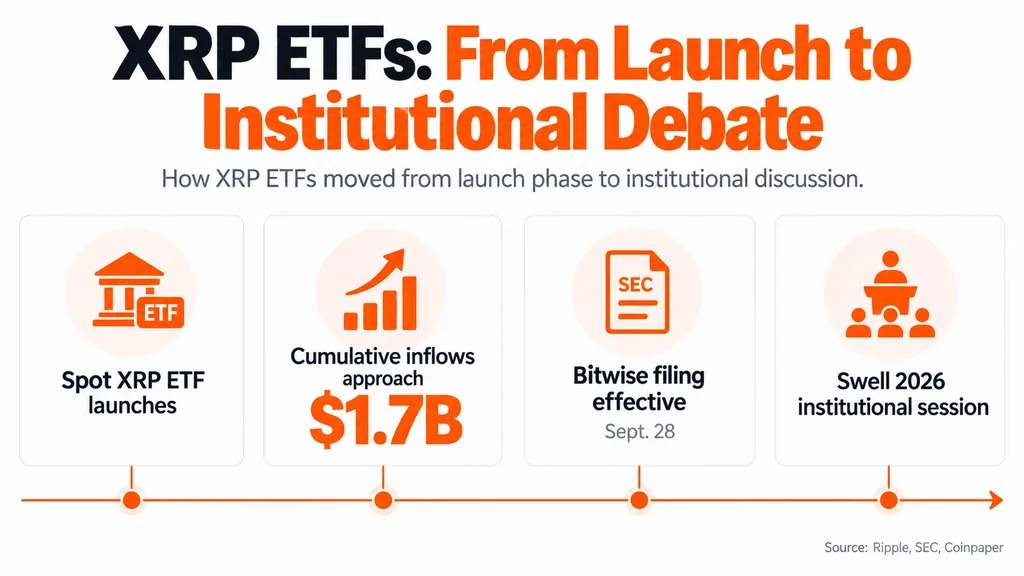
Recently, the U.S. Securities and Exchange Commission (SEC) announced on September 28th that an amendment to Bitwise XRP ETF that had come into effect officially took effect. This indicates that the product ecosystem is still evolving, rather than stabilizing shortly after its initial launch.
Swell It's starting to look more and more like a traditional financial conference.
Discussions regarding ETF will be placed within the framework of an event that is increasingly taking on traditional financial characteristics.
The speakers announced by Ripple included executives from Intercontinental Exchange, as well as representatives from banks, asset management companies, fintech firms, and crypto infrastructure companies. This means that XRP ETF will be discussed in conjunction with tokenized collateral, bank-grade crypto infrastructure, and institutional market infrastructure, rather than being viewed as a standalone crypto product.
The importance of such an institutionalized framework lies in the fact that the demands of ETF often deviate from the trend of the spot prices of XRP. In late August, XRP ETF recorded its strongest single-week performance since 2026, with inflows reaching $110.49 million, while at that time XRP itself was on the decline. This divergence between ETF and prices indicates that regulated demand alone is not sufficient to determine short-term price trends.
Marcus Hale
Marcus Hale is an author who focuses on cryptocurrency and financial markets, with his reporting covering Bitcoin, Ethereum, digital assets, regulation, ETF, and the adoption by institutions. His work focuses on developments that may drive market changes, investor trends, and the broader forces that shape the crypto economy.