
















Key Points
- As the crypto market as a whole declined, LINK rose by about 6%, expanding its reported 30-day gain to 30.3%.
- Chainlink's CCIP 2.0 allows institutions to join their own cross-chain transaction verifiers.
- LINK encountered resistance near $15, and the attached chart analysis suggests that $12 to $13 may be a support range.
During the trading period described in the attached analysis, the LINK token of Chainlink performed better than the broader market in the weaker crypto environment, due to the launch of its cross-chain interoperability protocol (CCIP) 2.0.
The token rose by about 6% on that day, bringing its 30-day increase to 30.3%, and the return since the beginning of the year has also turned positive.
This upgrade gives financial institutions more control when transmitting data or assets across blockchains.
Traders seem to have welcomed this announcement, but as LINK approached $15, the recent rebound also faced technical challenges.
CCIP 2.0 Adding Verifiers for Institutional Operations
Cross-chain transfers require a mechanism to first confirm that a certain operation has occurred on one blockchain, and then to complete the corresponding operation on another blockchain. CCIP provides precisely this layer of communication capability.
In version 2.0, institutions and asset issuers can add cross-chain verifiers ( Cross - Chain Verifiers ) to add their own checks outside of the default verification network of Chainlink. Chainlink indicates that the entry-level kit will allow users to run these verifiers on infrastructure that includes Amazon Web Services and Google Cloud.
Adding this check can be very important for companies with internal security or compliance requirements. For example, a issuer may want transfers to proceed only after approval by their own validators.
CCIP 2.0 also provides configurable compliance controls, fees, and execution options, allowing users to choose how transactions are checked and completed. These features are all optional; Chainlink indicates that its existing verification network is still the default setting.
Speed is also part of this upgrade. CCIP 2.0 supports faster transfers than the final confirmation, provided that the user's selected risk settings allow it.
Chainlink also indicates that efforts are being made to support Fast Confirmation Rule for Ethereum, and support will be provided once that feature is launched. Future integrations should not be regarded as an improvement in speed that makes all Ethereum transfers available immediately.
The attached market analysis states that after the release of the CCIP 2.0 announcement, the trading volume of LINK soared by 89%.
An increase in trading volume indicates that more tokens have changed hands during this market trend, but this alone does not necessarily mean that buyers will continue to hold the dominant position.
The same analysis also mentioned that the total locked value of Chainlink rebounded from approximately $43 billion in June to $57 billion in August. This indicator describes the value related to assets that use Chainlink services, which is different from the revenue of Chainlink or the market value of LINK tokens.
This product announcement provides traders with a reason to re-evaluate the role of Chainlink within institutional blockchain infrastructure. However, the network upgrade will not automatically generate an immediate demand for LINK. Adoption rates, usage patterns, and the trends in the broader market will all affect whether this upward trend can continue.
LINK Can it break through $15?
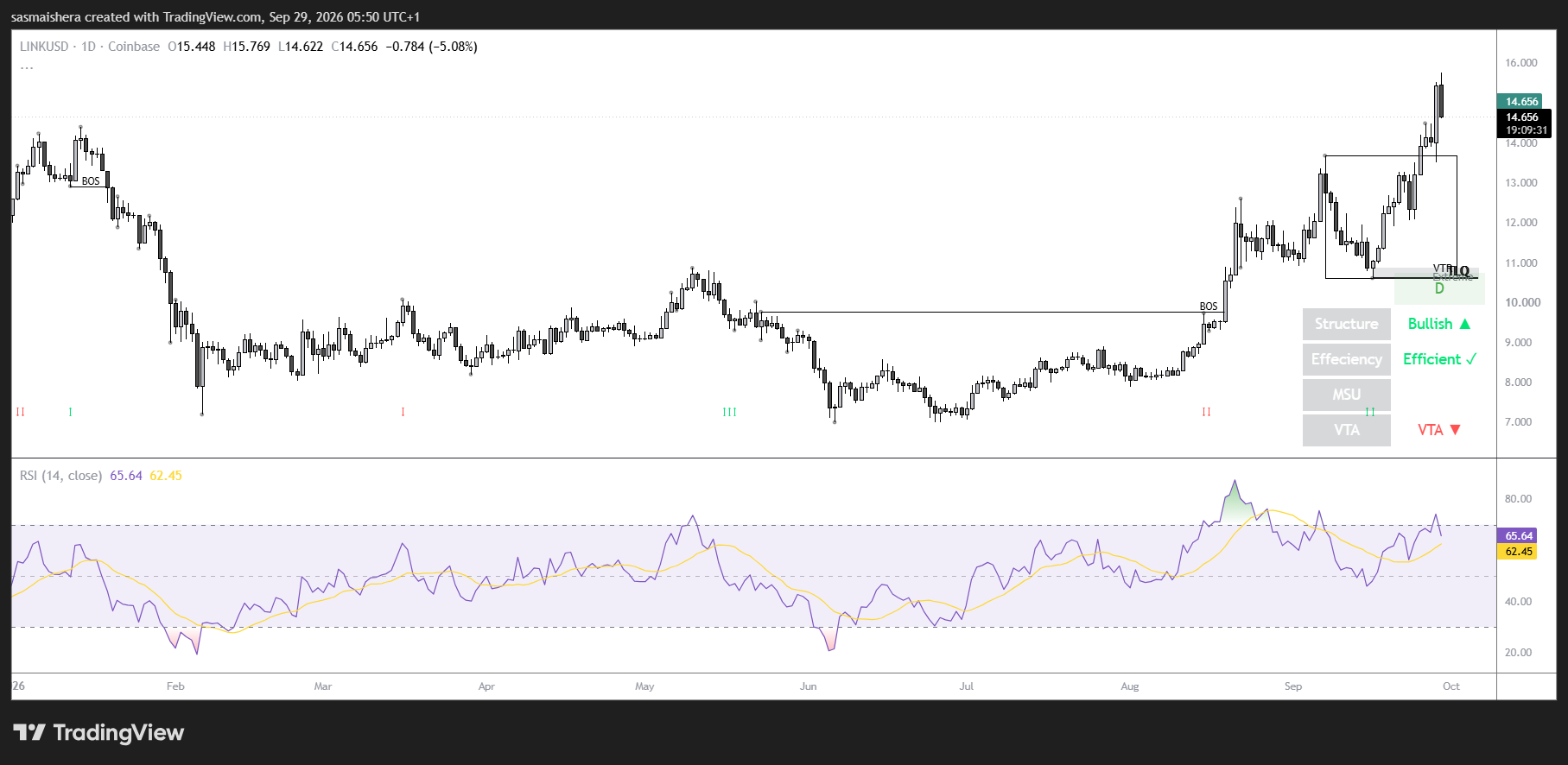
The rise of LINK encountered selling pressure around $15, and the attached daily chart analysis regards this level as an immediate resistance point.
The analysis also indicates a bearish divergence in the Relative Strength Index (RSI): the price is strengthening, while the momentum readings are weakening. Such signals may indicate a pause or pullback in the market trend, but they do not guarantee that a pullback will definitely occur.
If LINK falls back, analysts consider $12 to $13 to be a possible support range. Holding this range may indicate that a broader recovery is still intact; however, if it effectively breaks below this range, it would weaken the bullish outlook.
If it can remain above $15, market attention will shift to higher levels, including the scenario mentioned in the text of reaching $20. Rising from $12 to $20 is approximately a 67% increase, but this percentage describes hypothetical entry and exit prices, not expected returns.
The most immediate test at present is: while the broader crypto market remains under pressure, whether LINK will be able to absorb the selling pressure around $15 and maintain stability above the support level.