

18 months after President Trump signed Executive Order 14233, the United States' strategic Bitcoin reserves still mainly consist of Bitcoins obtained through federal confiscation procedures, and Congress has not yet authorized a separate large-scale market buying plan.
This executive order establishes a strategic Bitcoin reserve, requiring the Treasury Department to set up an office responsible for managing its custodial accounts, prohibiting the sale of Bitcoin deposited in the reserve, and instructing both the Treasury Department and the Department of Commerce to develop budget-neutral strategies to acquire more Bitcoin.
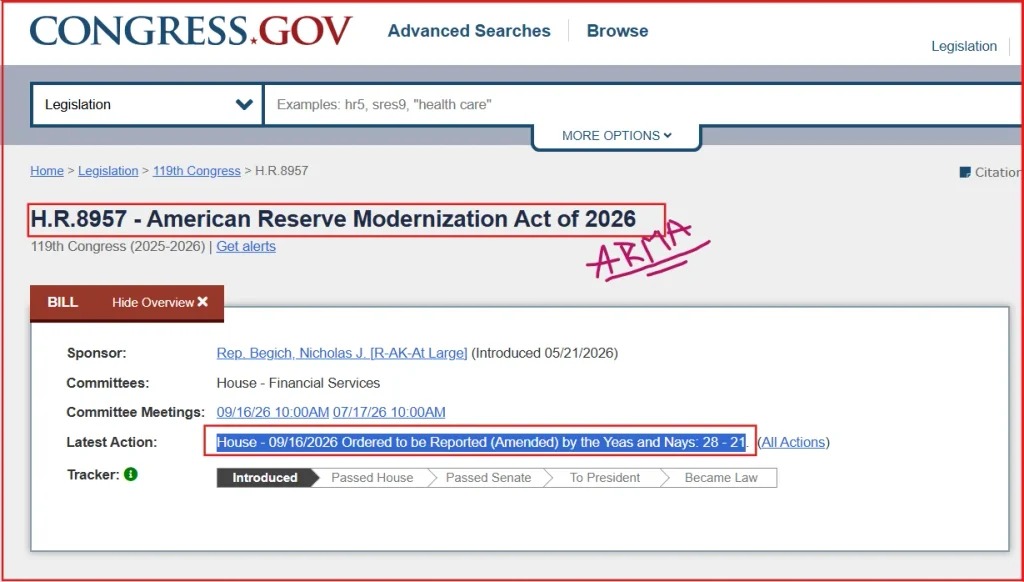
A key development in 2026 occurred on September 16th. The U.S. House Financial Services Committee advanced the "American Reserve Modernization Act," referred to as ARMA, with 28 votes in favor and 21 against. This act will formalize the Treasury Department's custodial system, set a minimum holding period of at least 20 years for eligible government-owned Bitcoin, and require the public disclosure of reserve reports with cryptographic proof. However, it does not authorize purchases in the open market.
Current Bitcoin holdings in the United States come from confiscations.
The Bitcoin held by the government was accumulated through law enforcement actions before the introduction of the reserve policy.
The main cases include: approximately 94,000 BTC coins under investigation in case Bitfinex, 50,676 BTC coins confiscated from James Zhong, and about 69,370 BTC coins related to the "Silk Road" Individual X case. The total number of coins involved in these three cases is approximately 214,000 BTC.
But this scenario underwent substantial changes in October 2025.
The United States Department of Justice filed a civil forfeiture complaint involving approximately 127,271 BTC, which are related to Chen Zhi, the founder of Prince Group. The DOJ described this as the largest forfeiture action in its history and stated that these bitcoins are now in the custody of the U.S. government. The related charges are still under legal proceedings.
In the current calculations regarding the U.S. government's stance on Bitcoin, this case should be taken into account, as its scale exceeds that of any of the three major confiscation cases traditionally cited in the discussions regarding reserves.
Before the reserve policy was introduced, the confiscated bitcoins might have been sold through the government's confiscation procedures. Executive Order No. 14233 changed the way qualified bitcoins were handled, establishing a policy that such bitcoins placed in reserves would not be sold.
What exactly was established by Administrative Order No. 14233?
The executive order dated March 6, 2025, is not merely an announcement of a policy preference.
It instructs the Minister of Finance to establish an office responsible for managing and controlling custodial accounts collectively referred to as Strategic Bitcoin Reserves. It also requires federal agencies to review their authority to transfer government Bitcoin into these reserves and orders each agency to provide the Ministry of Finance with a complete list of the government's digital assets.
This corrects a common misconception that the executive order “did not establish a governance framework.” In fact, it did indeed establish a federal administrative structure.
The issues that have not yet been clarified are: to what extent are these holdings integrated, verified, and publicly reported within the framework of a single institution?
The White House's digital assets report for July 2025 confirmed that the Treasury Department will manage reserves and inventory, while continuing to coordinate on implementation issues. The report also stated that the Treasury Department has submitted its considerations regarding the establishment and management of reserves to the White House.
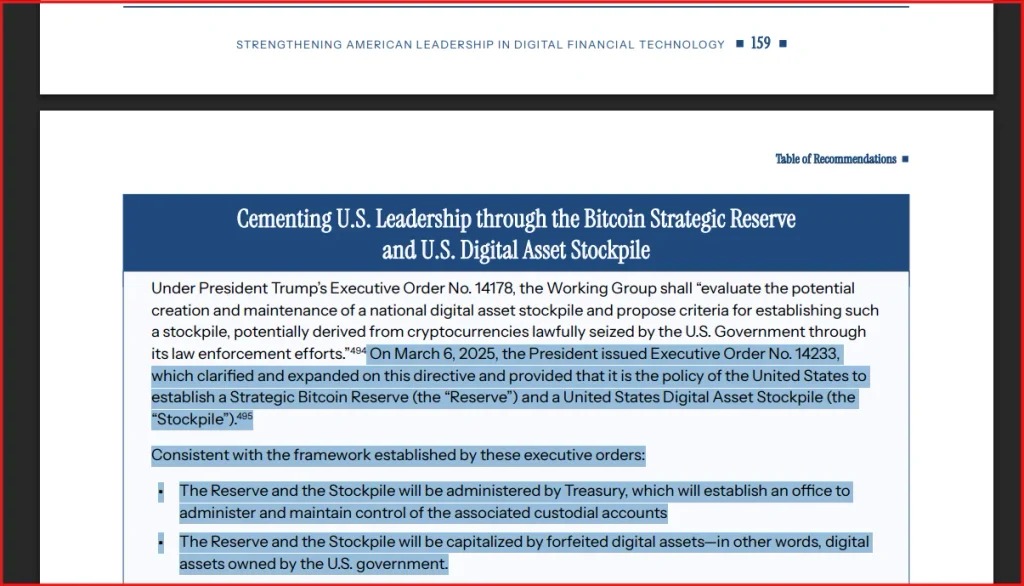
The executive order also does not authorize a traditional Bitcoin purchase program funded by taxpayers. The order requires the Treasury Department and the Department of Commerce to study budget-neutral acquisition strategies. This distinction explains why reserves can exist, while confirmed public market purchases remain at zero.
BITCOIN Act and ARMA are not the same act.
Two main federal proposals target different aspects of the reserve issue.
The BITCOIN bill will establish a plan to purchase 200,000 BTC units per year for a period of five years, with the ultimate goal of reaching 1 million BTC units. The text of the bill clearly outlines this purchasing plan.
ARMA takes a different approach. Its revised version requires the Ministry of Finance to establish a secure Bitcoin storage facility within 180 days after the bill comes into effect, and to set up a separate inventory for digital assets. It also requires that reserve information accompanied by cryptographic proofs be publicly released on a quarterly basis.
ARMA will also request the Ministry of Finance and the Ministry of Commerce to study ways to obtain more Bitcoin without borrowing, without increasing taxes, and without excessively expanding deficit spending. This is a research requirement, not an authorization to immediately purchase in the market.
The ARMA vote on September 16th advanced the discussion on custody issues.
H.R was proposed on May 21, 2026. On September 16, the House Financial Services Committee passed the revised bill with a vote of 28 to 21 and requested a report, but it has not yet become law.
The revised bill retains the requirement that eligible governments must hold Bitcoin for at least 20 years and mandates that the Treasury Department continuously publish information proving their reserves. It also protects legitimate private holdings and self-hosting rights under the terms of the bill.
This distinction is very important, because actions at the committee level do not mean that the federal government has locked 328,372 BTC for 20 years.
It will depend on whether the bill becomes law, and which government-owned bitcoins ultimately meet the qualifications for reserves according to their legal definition.
The number 328,372 BTC requires additional clarification.
This headline figure is of reference value, but it should not be presented as an audited reserve balance.
As of now, the US government holds 328,372 BTC, which is approximately 1.56% of Bitcoin's maximum supply of 21 million coins.
However, government-owned bitcoins may have a different legal status. Before they become permanent reserve assets, some of these assets may still be subject to confiscation procedures, victim claims, legal requirements, or other restrictions.
The Prince Group case in October 2025 illustrates the importance of this point. The Ministry of Justice stated that these 127,271 BTC are now in government custody, but the confiscation action itself is still part of the legal process.
Therefore, the most cautious statement at present should be that "the U.S. government estimates to hold 328,372 BTC", rather than "strategic Bitcoin reserves hold 328,372 BTC".
What will happen next?
As of September 28, 2026, ARMA is still in the stage of the House of Representatives committee. Official records from the U.S. House of Representatives show that the bill was requested to be reported in its revised form on September 16, but further congressional action is still required before it can become federal law.
BITCOIN The bill represents another approach, as it will create a real purchase plan for 1 million BTC. In contrast, ARMA focuses on managed, reported, long-term holding, and acquisition methods that are neutral in terms of research budget.
This results in three distinctly different levels in the U.S. reserve policy:
- An executive order has established the policy and the administrative framework of the Ministry of Finance.
- It is estimated that the government holds 328,372 Bitcoins BTC, which mainly come from confiscation actions.
- Congress has not yet passed the legislation proposed for 2026, which aims to establish a stronger framework for custody and access.
Therefore, the core issue is no longer whether the United States has announced the establishment of a strategic Bitcoin reserve—since it has already done so. A more important question is how much of the estimated government Bitcoin holdings will ultimately qualify as reserves, how the Treasury Department will verify and report these holdings, and whether Congress will authorize a broader plan for accessing assets beyond those that have been confiscated.