

Foreign media analysis suggests that the Uniswap token UNI has seen a surge followed by a decline this week, and is now facing greater volatility in the short term. The article argues that the price has encountered resistance near the $11.5 level, and the weekly momentum has also entered an overbought zone. The market is now focusing on whether the liquidity and support levels below can hold.
Resistance appears around $11.5
UNI once rose to around $10.95, before falling back to around $9.11. The article points out that this rebound approached the 0.786 Fibonacci retracement level of $11.51, which is considered an important upper target after breaking through the previous long-term downward trend line.
However, the price failed to effectively hold above this level, and the weekly chart also showed a clear upper shadow, indicating an increase in selling pressure at higher levels. The article suggests that if UNI cannot re-establish the range of $10.95 to $11.51, the market may regard this upward movement as an unfinished attempt at a breakout, rather than the starting point for a new round of sustained gains.
Weekly chart: RSI rises into the overbought zone
The article mentions that UNI and RSI have risen to around 73, which is above the commonly referred to overbought level of 70. Although being overbought does not necessarily mean that prices will fall immediately, after several rounds of rapid upward movement, UNI often experiences consolidation or a correction that can last for several weeks.
In this context, the first support level mentioned in the article is the 200-week moving average, which is around $7.83. If the price falls from around $9.21 to this level, the decline would be approximately 15%. If the range between $7.80 and $7.85 is also lost, the next lower support level would be around the 100-week moving average, which is $6.91.
However, the article also mentions that the medium- to long-term chart for UNI has shown improvement since earlier in the year. The current price is still above several important weekly moving averages, and the long-term downward resistance line has also been broken through. Therefore, if it falls back to $7.83, it is more likely to be seen as a support retest, rather than necessarily indicating a weaker trend on a larger scale.
Long liquidations concentrated around $8.87
In addition to technical aspects, the distribution of derivative positions is also considered to have increased short-term downward pressure. CoinGlass data shows that the Binance UNI / USDT market has accumulated a large number of leveraged long positions around $8.87.
It is mentioned in the text that there is approximately $5.16 million in liquidation leverage concentrated around this price level. If UNI falls to this area, the cumulative size of long liquidations could expand to about $10.35 million. When forced liquidations occur, the exchange will automatically close related positions, which may amplify selling pressure in a short period of time and trigger a chain of liquidations at even lower levels.
The article therefore considers $8.87 to be a liquidity level that deserves attention. If the price merely falls back to this level moderately, it could also lead to a faster decline due to passive liquidations.
However, the liquidity heat map for clearing also shows that there is short-term liquidity above the current price level. This means that if the market continues to rise unexpectedly, it could also trigger a short covering movement. But looking at the position distribution, the more concentrated long positions below the price level represent a more direct source of pressure in the short term.
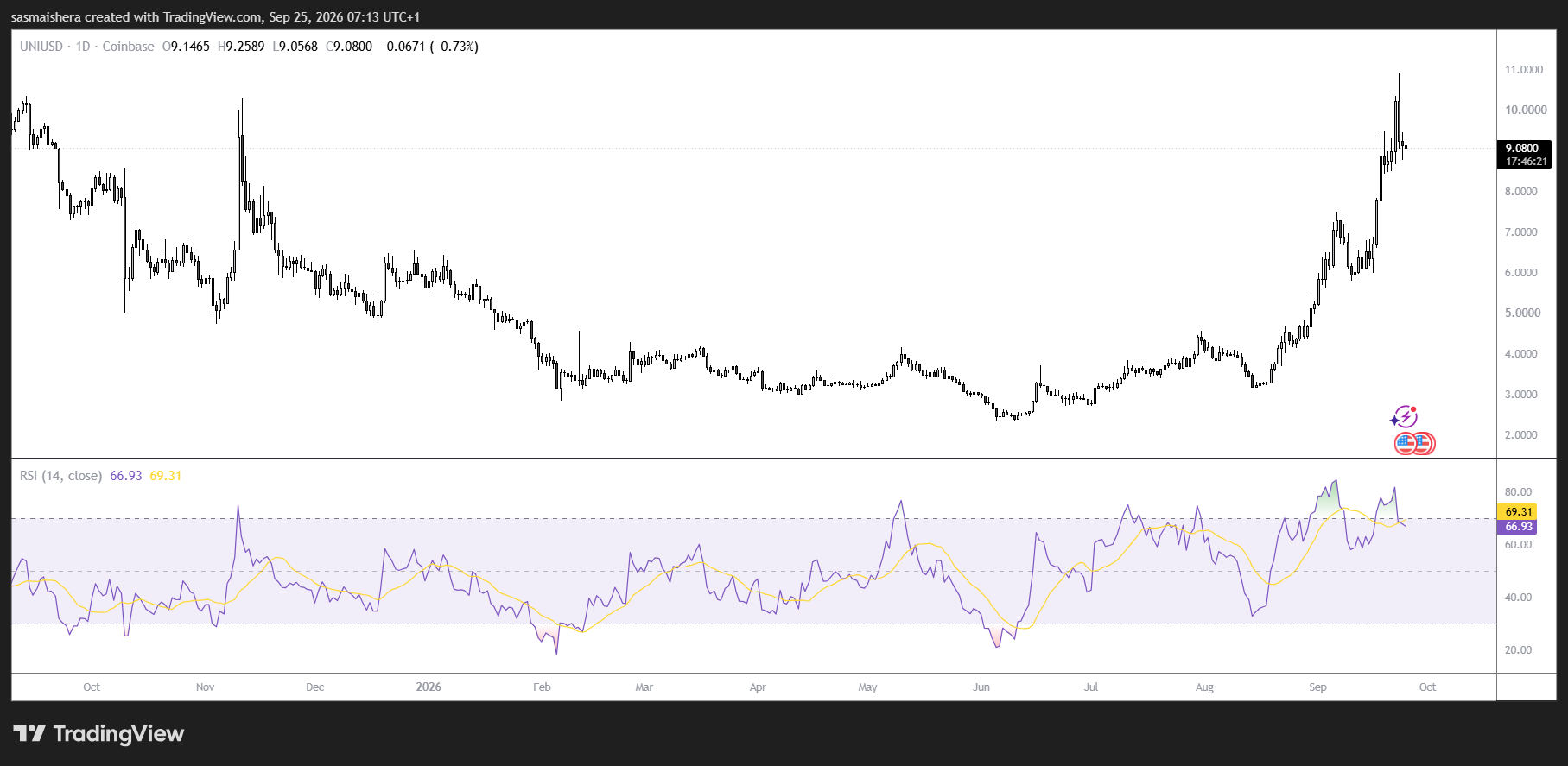
Overall, the article suggests that the weekly structure of UNI has not yet been disrupted. However, against the backdrop of overbought conditions, resistance at high levels, and a concentration of long positions with leverage, the likelihood of a short-term pullback is increasing. In the coming days, the market will focus on observing the liquidity area around $8.87, as well as whether the $7.83 range can provide support.