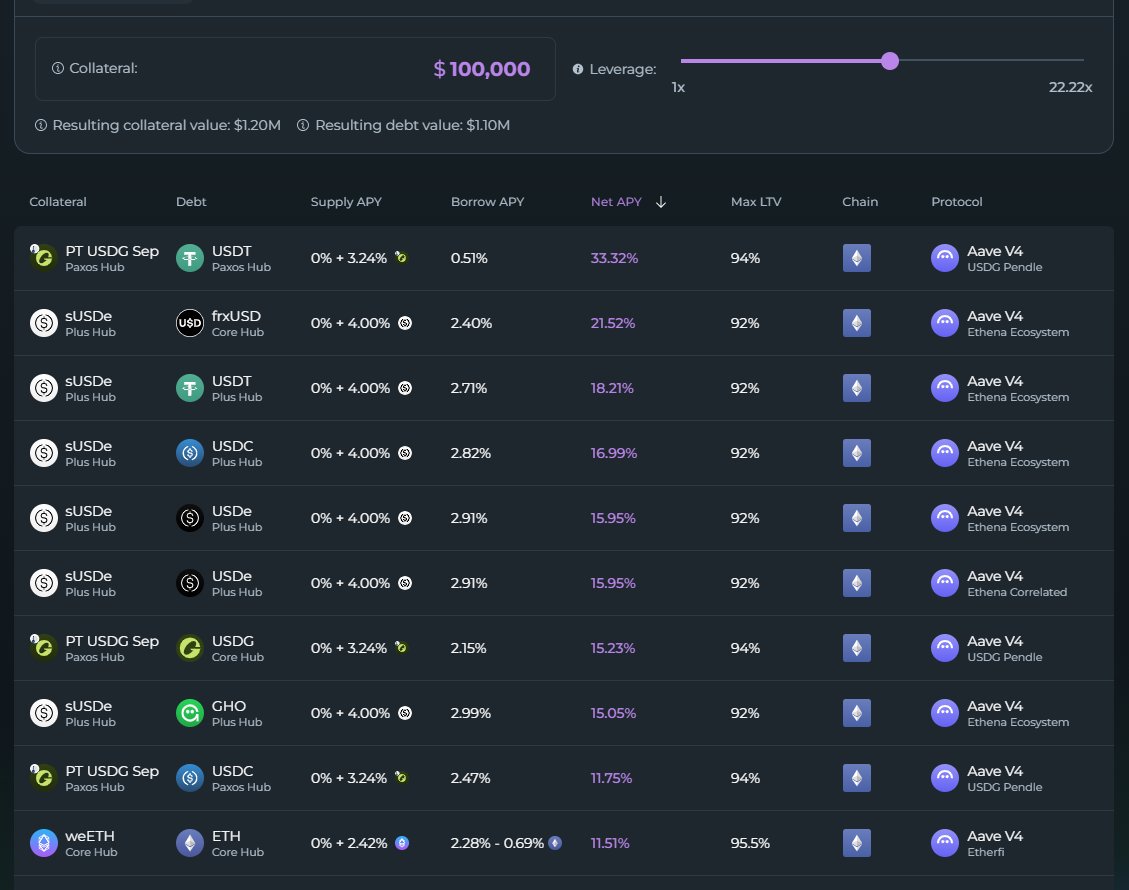
As @aave V4 continues to develop, yield farming opportunities are increasing.
Currently, the following projects offer double-digit annualized yields (APY):
-> PT-USDG-24SEP2026 @global_dollar revolving library
-> sUSDe @ethena revolving library
-> weETH @EtherFi revolving library
The following data is based on 12x leverage.
You can find (and access) all of these projects through the DFS Discover page.
👉
495
0
0
43
Anndy Lian
06-27 11:42
フォロー
Cryptocurrencies, like nested Russian nesting dolls, will only continue to harm us. Here's why:
- Yield stacking or leverage loops, such as Terra
- Cross-chain yield farming, such as rsETH
- Leveraged entities use capital to purchase debt from other leveraged entities, each layer relying on the exact same underlying Bitcoin asset, such as Saylor's strategy
- RWA Treasury loops are another problem. See below for details:
• Core Nesting Doll: Institutional providers purchase physical US Treasury bonds and tokenize them into on-chain Treasury tokens (e.g., obtaining a base yield of approximately 5%).
• Second Nesting Doll: Secondary platforms encapsulate these Treasury tokens into "yielded synthetic dollars" (e.g., Ethena's sUSDe or similar assets). They mix Treasury yields with short-term perpetual financing rates, boosting the yield to 15%.
• Third Layer: Investors deposit these synthetic dollars into money market protocols (e.g., Spark or Morpho) and use them as collateral to borrow ordinary stablecoins (USDC/USDT).
• Circular Reaction: Borrowed stablecoins are used to purchase more synthetic dollars, which are then deposited back into the platform.
• Pitfall: While the underlying layer is backed by US Treasury bonds, the upper layers are vulnerable to smart contract code vulnerabilities, cross-protocol oracle failures, and sudden fluctuations in the crypto finance market.
370
0
0
37
Anndy Lian
06-27 11:26
フォロー
Cryptocurrencies, like nested Russian nesting dolls, will only continue to harm us. Here's why:
- Yield stacking or leverage loops, such as Terra
- Cross-chain yield farming, such as rsETH
- Leveraged entities use capital to purchase debt from other leveraged entities, each layer relying on the exact same underlying Bitcoin asset, such as Saylor's strategy
- RWA Treasury loops are another problem. See below for details:
• Core Nesting Doll: Institutional providers purchase physical US Treasury bonds and tokenize them into on-chain Treasury tokens (e.g., obtaining a base yield of approximately 5%).
• Second Nesting Doll: Secondary platforms encapsulate these Treasury tokens into "yielded synthetic dollars" (e.g., Ethena's sUSDe or similar assets). They mix Treasury yields with short-term perpetual financing rates, boosting the yield to 15%.
• Third Layer: Investors deposit these synthetic dollars into money market protocols (e.g., Spark or Morpho) and use them as collateral to borrow ordinary stablecoins (USDC/USDT).
• Circular Reaction: Borrowed stablecoins are used to purchase more synthetic dollars, which are then deposited back into the platform.
• Pitfall: While the underlying layer is backed by US Treasury bonds, the upper layers are vulnerable to smart contract code vulnerabilities, cross-protocol oracle failures, and sudden fluctuations in the crypto finance market.
421
0
0
35
Dune
05-28 21:00
フォロー
Two months after launch: @tempo, an L1 gateway focused on payments, uses stablecoins to pay gas fees and has settled 3.9 million transactions across 177,000 addresses since its mainnet launch on March 18th.
Current data is as follows:
Network Activity:
• Yesterday's transaction volume was 58,000, up from approximately 36,000 a few weeks ago.
• There were 10,573 unique senders in the past 24 hours, one-third of whom were new users.
• A total of 76,443 contracts have been deployed in the past two months.
Stablecoin. @tempo's TIP-20 standard makes it the protocol's native currency (based on pre-compiled, not ERC-20 contracts). Issuers can set programmable policies (transfer rules, allowed lists, fee logic) at the chain level.
The circulating supply has exceeded $25 million, and the issuer mix is more diversified: pathUSD is the on-chain pegged token ($8.2 million), while USDB, USDT0, and USDC.e and EURC.e (bridged via Stargate) all have circulating supplies between $4.5 million and $5.5 million.
Yield tokens, such as @ethena's sUSDe and USDe, @fraxfinance's USD,
@CapApp's cUSD/stcUSD, and @maplefinance's syrupUSDC, collectively constitute the circulating supply.
Machine Payments (MPP). MPP, a standard jointly developed by @stripe and @tempo, integrates payment functionality into the HTTP protocol, enabling software to conduct payments through API calls, proxy operations, and inference.
Nearly 700,000 tagged transfers have been completed, with a cumulative transaction value slightly exceeding $100,000, averaging $0.15 per transaction. Although the amounts are small, the transaction volume is high. This illustrates the distribution of proxy traffic.
@tempo is fully listed on Dune, alongside all major blockchains, and maintains a stablecoin dataset that standardizes supply, transaction volume, and holders across issuers and networks.
In the same query, you can compare the floating prices of Tempo's TIP-20 stablecoin with those of Tron USDT, Solana USDC, or Ethereum stablecoins.
Learn more about @tempo MPP and how to use it on Dune.
392
0
0
23
Token Terminal 📊
05-23 04:06
フォロー
The top-performing DeFi protocols in this cycle share a common thread:
They didn't stop at a single product.
@OndoFinance: Tokenized Treasury Bonds → Tokenized Stocks → Exchanges and Platforms. Total Value Locked (TVL) grew from $200 million to $2.9 billion in three years.
@MorphoLabs: Interest Rate Optimizer → Lending Infrastructure → Coinbase Bitcoin Collateralized Loans, running on the Morpho backend.
@SkyEcosystem: Single Collateral DAI → Multi-Agent Yields → sUSDS surpassed sUSDe on December 1st to become the largest on-chain tokenized fund.
@ether_fi: ETH Staking → Liquidity Restaking → DeFi Bank Accounts. Monthly Active Users grew from 1,500 to 33,500 in 12 months.
One protocol represents one product. Four protocols constitute one business model.
Data Source: @tokenterminal
459
0
0
41
Token Terminal 📊
05-21 20:16
フォロー
Ethena tops Token Terminal's revenue cost rankings, spending a staggering $355 million over the past year—four times that of the second-ranked protocol.
Revenue cost tracks the fees a protocol pays to third parties to maintain its operations.
For Lido, this refers to fees paid to node operators; for L2 service providers, it refers to gas fees required for settlement on Ethereum; and for @ethena, it refers to the returns paid to sUSDe holders.
It works like this: Ethena holds spot ETH and BTC, then shorts an equal amount of perpetual futures contracts. When perpetual contract traders hold a net long position, the longs pay a funding rate to the shorts.
Ethena collects this funding rate, adds stETH staking rewards and some Treasury bond rewards, and all the returns are paid to users who stake USDe.
Therefore, Ethena's top ranking doesn't necessarily indicate inefficiency, but rather that many people have profited from it.
386
0
0
49
Solana
05-15 00:04
フォロー
Big news: $ENA from @ethena is now available on Solana via @sunrisedefi.
Ethena is a synthetic dollar protocol that provides a crypto-native currency solution, USDe, and a globally accepted dollar savings asset, sUSDe.
Please verify the address on @tokens:
$ENA can be used in your favorite Solana applications, such as:
@tryfomo, @dflow, @Titan_Exchange, @phantom, @JupiterExchange, @solflare, @kamino_swap, @mayan, and more.
363
0
0
22
Stephen | DeFi Dojo
05-14 13:52
フォロー
When bored late at night, why not write an article about the Solana stablecoin?
7 Best Stablecoin Investments on Solana (To My Knowledge)
If I've missed anything, please recommend it in the comments.
(I am not responsible for dilution risk)
► @kamino is currently a popular platform for yielding money, and there are some ongoing promotions with even higher yields.
1) sUSDe/USDG Revolving Credit (Borrowing up to $13 million)
• 10x Leverage: 29%
Learn More:
2) For some reason, lending activity on the main board market is currently very active.
• USDC: 16% annualized return
• Cash: 11% annualized return
3) PT-eUSX/USX (@solsticefi)
• 5x leverage: 28.5% annualized return
4) PRIME/PYUSD (@HastraFi)
• 8.3x leverage: 18.61% annualized return
► @ExponentFinance also has some noteworthy yields
5) @onrefinance ONyc PT: Fixed return 13%
6) @reflectmoney USDC+ PT: Fixed return 13.7%
7) @onrefinance ONyc LP: 13.4% annualized return + 8x pips
So, my fellow Solana users, is there anything I've missed?
494
0
0
32
Dune
05-11 01:58
フォロー
We just published an in-depth analysis exploring what we call the “Pendle Effect,” the surge in demand for @pendle_fi's token when it launched the PT/YT trading market.
Key findings: Holders are stickier than supply or deposits, and this stickiness is significantly enhanced.
For smaller assets (USR, USDai): USR holders are 2300 times larger than before Pendle's launch. Liquidity is high, but addresses remain active for a long time.
For distributed assets (USDG): Pendle's SY contract became the largest holder of USDG on Ethereum within 7 weeks—approximately 1 in 4 tokens. Meanwhile, supply also increased. This represents net new demand.
For mature assets (sUSDe): PT-sUSDe deposits peaked at $2.81 billion on Aave and Morpho—more than 50% of the total supply at the time.
Pendle is not a single tool, but three different tools, depending on the stage you are in during the distribution process.
All data is built on @Dune's stablecoin dataset—covering over 200 stablecoins and encompassing all major blockchains.
392
0
0
40
Dune
05-06 19:23
フォロー
The way stablecoins are distributed is quietly changing.
Traditional path: Exchange listing, centralized finance (CeFi) integration, and marketing investment.
Emerging path: Using the composability of decentralized finance (DeFi) as the distribution layer, with the acceptance of Pendle and lending protocols as the core technology stack.
- USDe + sUSDe reached a peak of $7.2 billion in PT deposits on @aave and @Morpho. PT-sUSDe alone accounted for more than 50% of the total supply in the lending market.
- USR: The number of holders grew from 30 to 69,806. Despite an 86% reduction in supply, USR remained virtually unchanged.
- USDG's Pendle SY contract became the largest single-holder trading venue on Ethereum in just 7 weeks.
For anyone building stablecoins, DeFi's composability is increasingly becoming a distribution pathway.
Data from @Dune (covering over 200 stablecoins and all major blockchains):