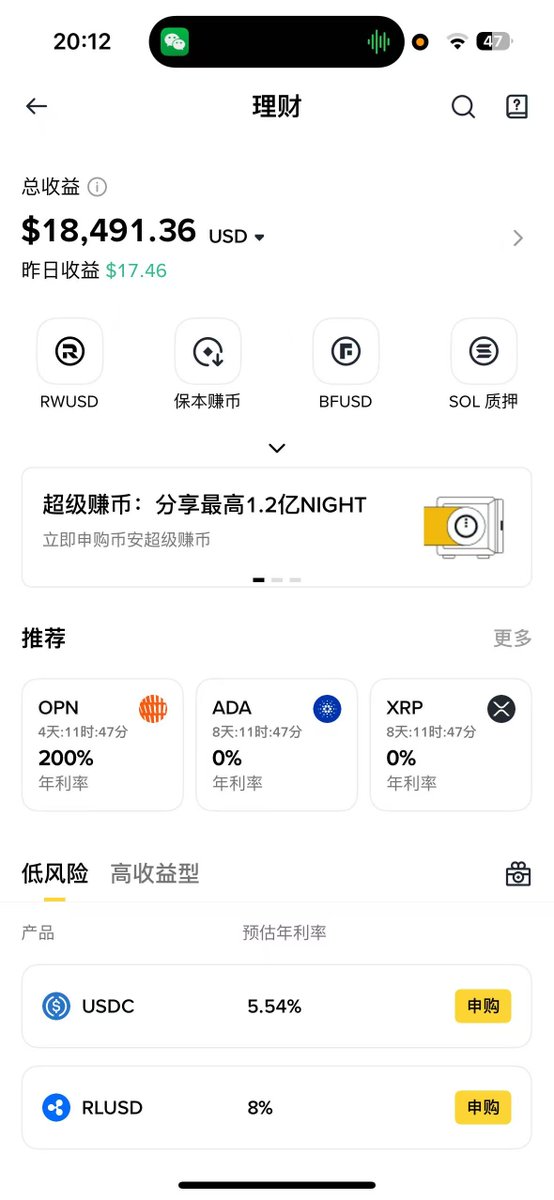
Last chance! Participate in the Super Earn event and win up to 120 million $NIGHT tokens using WBETH, BNSOL, ADA, and XRP tokens.
The $NIGHT airdrop is coming soon. Details will be announced after the event ends.
Don't miss out 👉
440
0
0
49
Binance
03-18 08:19
フォロー
Subscribe to your cryptocurrency now to unlock exclusive rewards with @MidnightNtwrk on Binance Super Earn.
BTC and BNB mining pools are sold out - thank you for your support! Last chance to join remaining pools: WBETH, BNSOL, XRP, ADA.
Subscribe now 👉
What is Super Earn?
Key features:
Get started now 👉
496
0
0
35
蜡币小鑫
03-17 12:21
フォロー
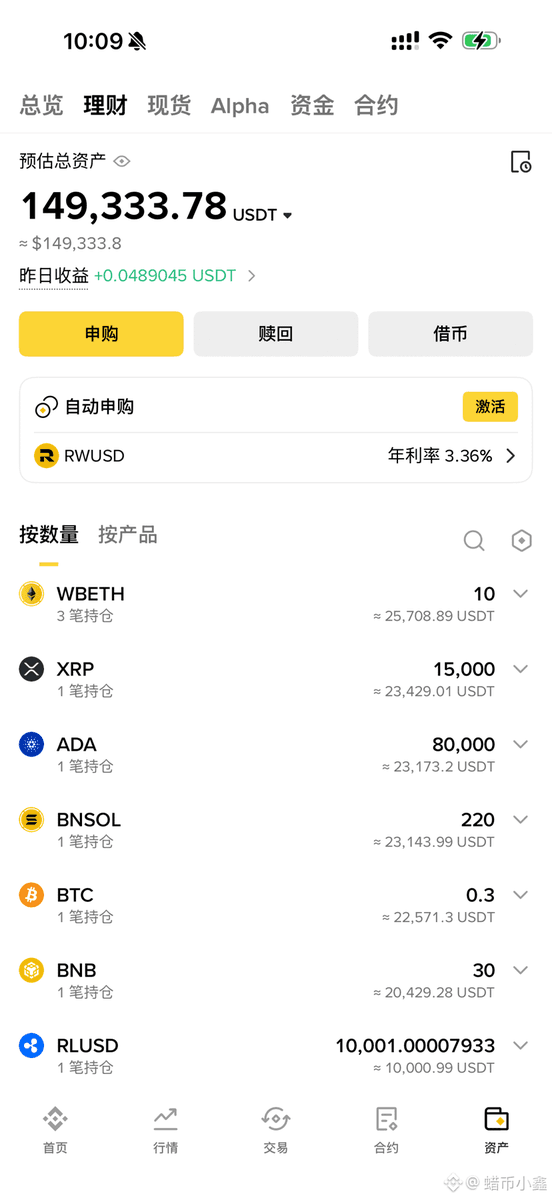
I participated in @binancezh's Super Earn Crypto event last night at 8 PM.
I felt the market was showing signs of a rebound recently, so I bought all my spot holdings to participate.
I bought a total of $135,500 worth of spot holdings and maxed out every subscription.
Today, I checked and my profit is already $5,000.
Let's see how much the interest plus the holding yield will be after the event ends.
Currently, the $BNB and $BTC prize pools are sold out.
There are still $WBETH, $BNSOL, $XRP, and $ADA pools available for subscription.
If you have spot holdings and aren't in a hurry to sell, you can participate in the subscriptions to earn returns.
381
0
0
34
Niner 🍡九儿🔶
03-16 21:59
フォロー
Binance's Super Wealth Management program, which mines Night, should offer an annualized return of over 20%, but it has a hard cap: a limit of 0.3 BTC and 30 BNB. BNSOL and Weth also have quotas available.
Path: Assets, Wealth Management, Subscription, and the banner in the image.
474
0
0
20
Binance
03-16 20:00
フォロー
It's midnight somewhere 🌙
@MidnightNtwrk's Super Yield Program is now open, supporting BTC, BNB, WBETH, BNSOL, XRP, and ADA token pools.
Participate to share in $120 million $NIGHT rewards, and eligible users will also receive an additional $12 million $NIGHT Glacier airdrop.
Subscribe now 👉
382
0
0
45
吴说区块链
02-01 15:34
フォロー
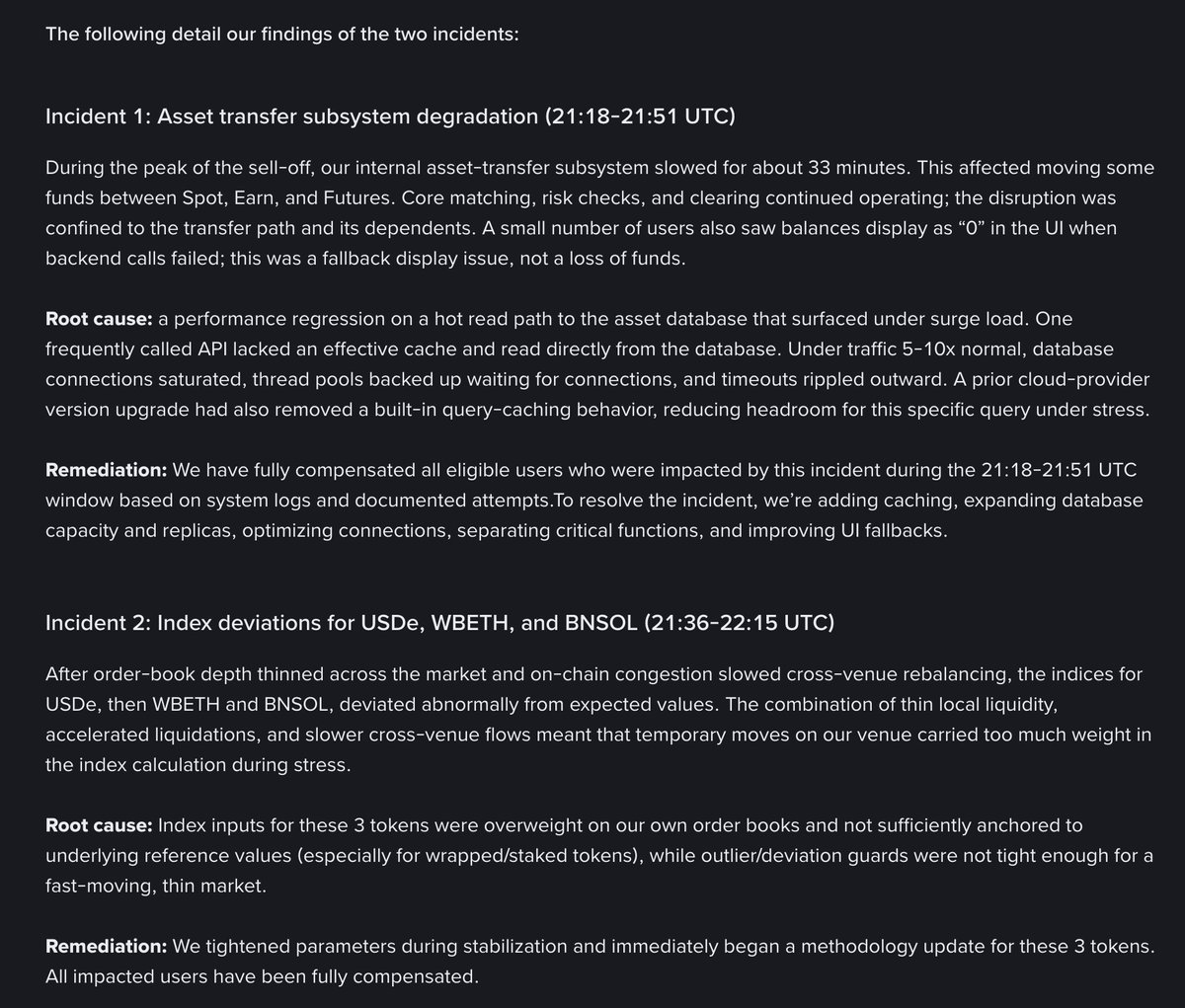
Binance Releases Detailed Report on 1011: What Information Does It Reveal? (Editor | Wu Shuo Blockchain) Binance released a detailed report on the 1011 incident on January 31st, confirming two technical issues that occurred that day: Under extreme market conditions, the asset transfer subsystem experienced a brief performance degradation, affecting fund transfers between some accounts but causing no asset loss; simultaneously, against the backdrop of significantly thinner liquidity and on-chain congestion, the prices of USDe, WBETH, and BNSOL indices deviated at one point. Binance stated that the incident was mainly caused by macroeconomic shocks and the risk-averse effects of high leverage, and that the system has been repaired and affected users have received full compensation. Read the full article:
384
0
0
25
Carl Moon 🌙
02-01 05:37
フォロー
There was nothing complicated about it, nor was it unexpected.
The 10/10 incident was caused by irresponsible marketing campaigns by certain companies.
On October 10th, hundreds of billions of dollars worth of cryptocurrency were liquidated. As the CEO of OKX, we clearly observed that the microstructure of the cryptocurrency market underwent a fundamental change afterward.
Many industry insiders believe that the losses caused by this incident were more severe than the FTX crash. Since then, there has been extensive discussion about the causes of the incident and how to prevent it from happening again. The root cause is not difficult to find.
⸻
The Incident's Course
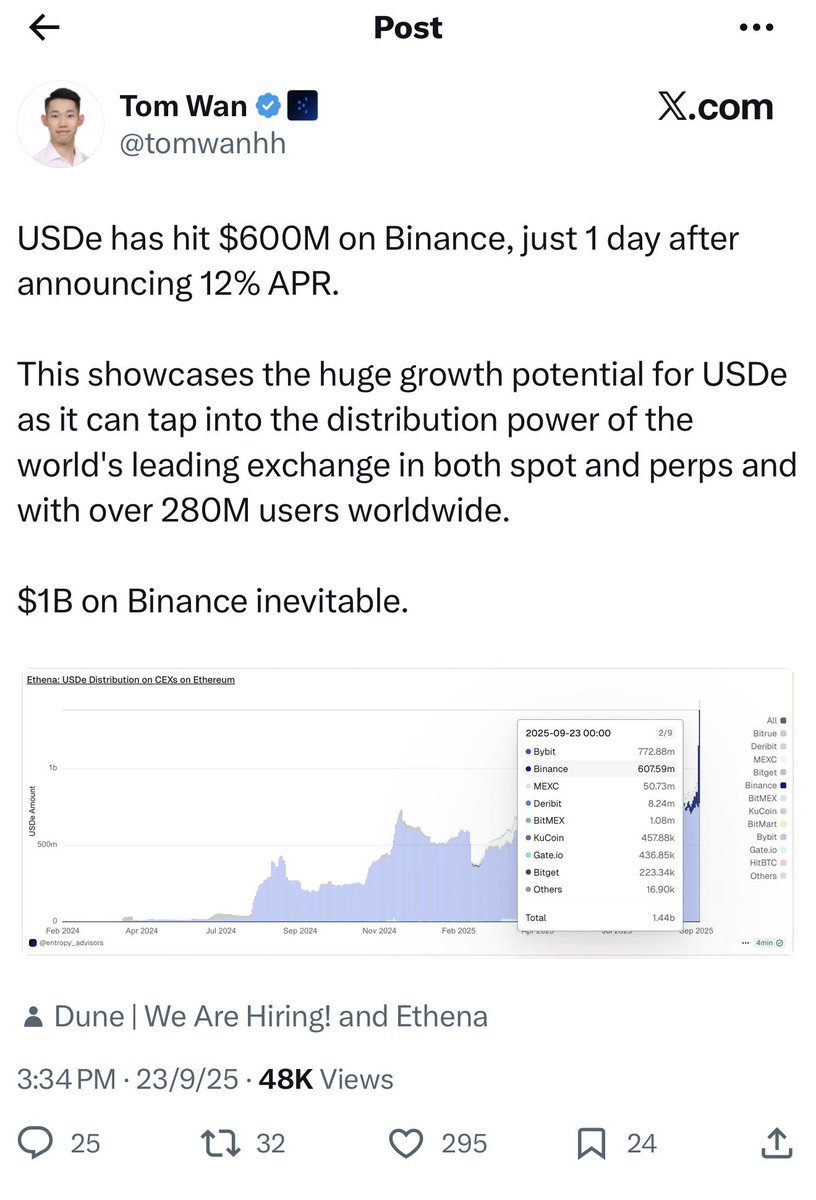
1. Binance launched a limited-time user acquisition campaign, offering a 12% annualized yield on USDe, while allowing USDe to be used as collateral, treated the same as USDT and USDC, with no effective limits.
2. USDe is a tokenized hedge fund product.
Ethena raised funds through so-called "stablecoins," invested them in index arbitrage and algorithmic trading strategies, and tokenized the resulting funds. Users could then deposit these tokens into exchanges to earn returns.
3. USDe is fundamentally different from products like BlackRock BUIDL and Franklin Templeton BENJI, which are low-risk tokenized money market funds.
In contrast, USDe carries hedge fund-level risk. This difference is structural, not superficial.
4. Binance encourages users to exchange USDT and USDC for USDe to earn attractive returns, but it doesn't adequately emphasize the potential risks. From a user's perspective, trading USDe is no different from trading traditional stablecoins, but the actual risk is much higher.
5. The risk is further amplified when users perform the following actions:
• Exchange USDT/USDC for USDe,
• Borrow USDT using USDe as collateral,
• Exchange the borrowed USDT back for USDe,
• Repeat the above cycle.
This leveraged cycle artificially creates annualized returns of 24%, 36%, or even over 70%, which are widely considered "low-risk" because they are offered by large platforms. Systemic risks have accumulated rapidly in the global cryptocurrency market. Even minor market shocks have been enough to trigger a crash.
Following increased volatility, USDe quickly decoupled from the US dollar. This was followed by a chain of liquidations, and deficiencies in risk management of assets like WETH and BNSOL further exacerbated the collapse. Some tokens were brought close to zero at one point.
The losses suffered by users and companies worldwide (including OKX users) have been severe, and recovery will take time.
⸻
Why this is crucial
I am discussing the root causes here, not blaming or attacking Binance. Openly discussing systemic risks can sometimes be uncomfortable, but it is necessary if the industry is to mature responsibly.
I anticipate a significant amount of misinformation and organized panic targeting OKX in the near future. Even so, speaking openly about systemic risks remains the right thing to do—and we will continue to do so.
As the world's largest platform and an industry leader, Binance wields enormous influence and bears corresponding responsibility. Long-term trust in cryptocurrencies cannot be built on short-term profit speculation, excessive leverage, or marketing tactics that conceal risks.
The industry needs leaders who prioritize market stability and transparency.
489
0
0
27
Star_OKX
01-31 20:00
フォロー
There was nothing complicated about it, nor was it unexpected.
The 10/10 incident was caused by irresponsible marketing campaigns by certain companies.
On October 10th, hundreds of billions of dollars worth of cryptocurrency were liquidated. As the CEO of OKX, we clearly observed that the microstructure of the cryptocurrency market underwent a fundamental change afterward.
Many industry insiders believe that the losses caused by this incident were more severe than the FTX crash. Since then, there has been extensive discussion about the causes of the incident and how to prevent it from happening again. The root cause is not difficult to find.
⸻
The Incident's Course
1. Binance launched a limited-time user acquisition campaign, offering a 12% annualized yield on USDe, while allowing USDe to be used as collateral, treated the same as USDT and USDC, with no effective limits.
2. USDe is a tokenized hedge fund product.
Ethena raised funds through so-called "stablecoins," invested them in index arbitrage and algorithmic trading strategies, and tokenized the resulting funds. Users could then deposit these tokens into exchanges to earn returns.
3. USDe is fundamentally different from products like BlackRock BUIDL and Franklin Templeton BENJI, which are low-risk tokenized money market funds.
In contrast, USDe carries hedge fund-level risk. This difference is structural, not superficial.
4. Binance encourages users to exchange USDT and USDC for USDe to earn attractive returns, but it doesn't adequately emphasize the potential risks. From a user's perspective, trading USDe is no different from trading traditional stablecoins, but the actual risk is much higher.
5. The risk is further amplified when users perform the following actions:
• Exchange USDT/USDC for USDe,
• Borrow USDT using USDe as collateral,
• Exchange the borrowed USDT back for USDe,
• Repeat the above cycle.
This leveraged cycle artificially creates annualized returns of 24%, 36%, or even over 70%, which are widely considered "low-risk" because they are offered by large platforms. Systemic risks have accumulated rapidly in the global cryptocurrency market. Even minor market shocks have been enough to trigger a crash.
Following increased volatility, USDe quickly decoupled from the US dollar. This was followed by a chain of liquidations, and deficiencies in risk management of assets like WETH and BNSOL further exacerbated the collapse. Some tokens were brought close to zero at one point.
The losses suffered by users and companies worldwide (including OKX users) have been severe, and recovery will take time.
⸻
Why this is crucial
I am discussing the root causes here, not blaming or attacking Binance. Openly discussing systemic risks can sometimes be uncomfortable, but it is necessary if the industry is to mature responsibly.
I anticipate a significant amount of misinformation and organized panic targeting OKX in the near future. Even so, speaking openly about systemic risks remains the right thing to do—and we will continue to do so.
As the world's largest platform and an industry leader, Binance wields enormous influence and bears corresponding responsibility. Long-term trust in cryptocurrencies cannot be built on short-term profit speculation, excessive leverage, or marketing tactics that conceal risks.
The industry needs leaders who prioritize market stability and transparency.
328
0
0
20
Wu Blockchain
01-31 06:48
フォロー
On October 10, 2025, Binance released a detailed investigation report acknowledging two technical incidents: between 21:18 and 21:51 UTC, its asset transfer subsystem experienced a performance degradation of approximately 33 minutes during a concentrated sell-off; and between 21:36 and 22:15 UTC, the indices of USDe, WBETH, and BNSOL deviated abnormally due to insufficient liquidity and slow cross-venue rebalancing.
443
0
0
37
吴说区块链
01-31 06:42
フォロー
According to Wu, Binance released a detailed investigation report on October 11, 2025, acknowledging two technical glitches that occurred that day: First, during the period from 21:18 to 21:51 UTC, during a concentrated market sell-off, Binance's asset transfer subsystem experienced a performance degradation of approximately 33 minutes, affecting some users' fund transfers between spot, wealth management, and futures accounts. The matching, risk control, and clearing systems continued to operate normally. The fact that some users saw their balance displayed as "0" was due to a front-end rollback display issue and not an asset loss. Second, during the period from 21:36 to 22:15 UTC, with a decrease in market order book depth, on-chain congestion, and a slowdown in cross-platform rebalancing, the USDe, WBETH, and BNSOL indices showed abnormal deviations. The report stated that when liquidity was thin and cross-platform fund flows slowed, price fluctuations within the platform accounted for an excessively high proportion in the index calculation.