The AI computing power market has been hit by a dual impact within 24 hours: a slowdown in demand growth and an increase in supply. The GPU drastic revaluation of rental prices has sparked concerns among investors about a potential oversupply of infrastructure.
According to a report released by SemiAnalysis to institutional clients, SpaceX has lowered the spot rental price for the NVIDIA Blackwell GPU small cluster from approximately $15 to $15.5 per GPU hour to $10 to $12 per GPU hour, representing a reduction of 20% to 35%. At the same time, Anthropic will no longer renew the lease for a cluster consisting of about 50,000 H200. This batch of computing power is now being resold at a price of approximately $5 per GPU hour, with delivery scheduled for early 2027. Technology media outlet The Information reported on the core viewpoint of SemiAnalysis under the headline "The Biggest Concern of AI Investors: Chip Overcapacity."
While there is a loosening on the supply side, demand from enterprises also shows signs of fatigue. Just a few hours before the news about the supply side emerged, payment company Ramp and its co-CEO Eric Glyman stated that the "Jevons' Paradox" that has persisted over the past two months with AI has been broken – the price of Token has continued to fall, but the increase in usage is not sufficient to compensate for the revenue losses caused by the price reductions.
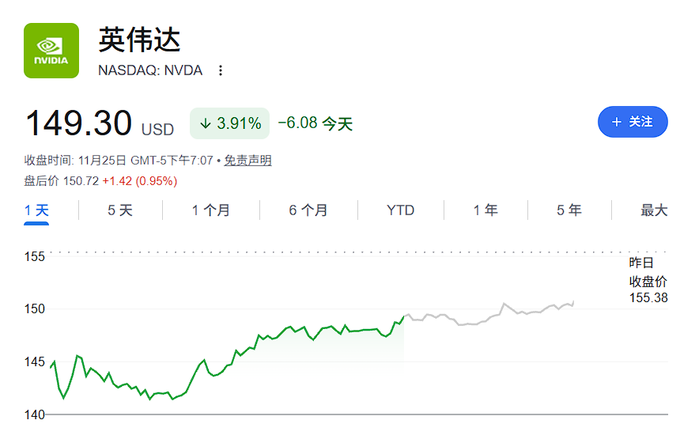
The market reacted quickly and violently. On Tuesday, NVIDIA's stock price fell by nearly 6%, reversing some of the 31.5% gain from Monday; CoreWeave and Nebius each tumbled by 11%. On Wednesday, NVIDIA's stock price fell by nearly another 4%.
But not everyone agrees with the narrative of a "crash." NewStreet subsequently issued a statement in response, clearly stating, "We do not consider this to be a price crash." They believe that SpaceX merely canceled the premium for smaller clusters, aligning the pricing with that offered to larger clients such as Anthropic and Google. The commercialization of computing power is seen as a "return to normal, not a collapse." The disagreement between bulls and bears revolves around the same set of numbers.
SpaceX Price Reduction List: From $15 to $10
According to SemiAnalysis, SpaceX has lowered the spot pricing for its small-scale Blackwell clusters from approximately $15 to $15.5 per GPU per hour to $10 to $12 per GPU per hour, representing a reduction of 20% to 35%. This new pricing level brings the prices of these small clusters in line with those offered to its largest customers, such as Anthropic and Google. This price cut occurs just a few weeks after the last AI cloud TCO update by SemiAnalysis; at that time, rental prices were still on the rise.
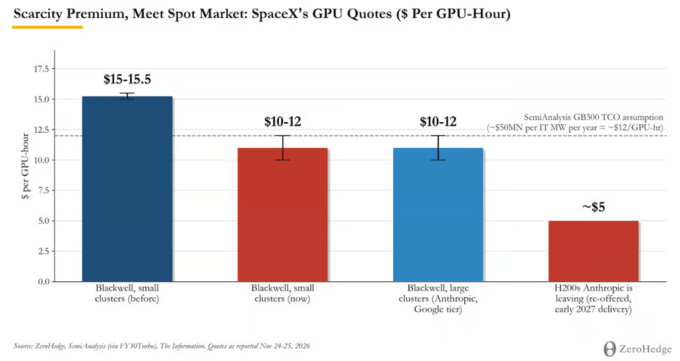
What is more significant is the second change: Anthropic will no longer renew the lease for approximately 50,000 H200 instances from SpaceX. SpaceX is now offering this computing power again at a price of about $5 per GPU per hour, with delivery scheduled for early 2027. The second-hand cloud leasing transaction index for Ornn shows that the transaction price on Monday was $6.53 per GPU per hour, which is about 23% lower than the spot market price. Calculated based on 50,000 instances and a full load of $5 per hour, the annual rent for this cluster would be approximately $2.2 billion.
SemiAnalysis also pointed out that the new regulations issued last week by the Bureau of Industry and Security ( BIS ) of the US Department of Commerce regarding remote access to American chips are expected to further drive down spot rental prices in 2027.
Anthropic Why "Lease Termination": A Contract That Allows for Immediate Exit
This was not without any signs. According to the S-1 document from Anthropic, the company committed to paying up to $120.5 billion in NVIDIA GPU computing power fees to a SpaceX subsidiary by 2029, which amounts to approximately $3.1 billion per month after all capacity is delivered. However, the detailed terms of the document indicate that after the non-revocable periods ending in January and March 2027, either party could terminate the agreement with a 90-day notice period. This makes it the most flexible contract in the Anthropic contract list and also the one most likely to be renegotiated in terms of pricing. Two weeks later, analyst Jukan quoted the content of a meeting between Anthropic and seller analysts, stating that the company would not extend the SpaceX computing power agreement beyond mid-2027, although neither party confirmed this.
According to Tom's Hardware, the SpaceX cluster in Memphis that was rented to Anthropic in May consists of approximately 150,000 H100, 50,000 H200, and 20,000 GB200. The number of 50,000 H200 matches almost perfectly with that of H200 (this is an inference). Now that Anthropic is a listed company and its stock price is lower than the issue price of IPO, there is every reason to stop paying for the computing power of the Hopper from two generations ago.
On the other side, SpaceX is this year transitioning from a "quasi-frontier laboratory" to one of the largest GPU landlords in the AI industry. According to technology media The Information, its AI department laid off about 60 people this month from the Grok Imagine team. Their preference is for spot rentals rather than long-term commitments, and the new platform they will promote next year is Vera Rubin. A landlord with a large number of new data center spaces and short-term leases on old equipment is precisely the type of landlord that reduces rents first.
Price data: The trading index has turned around.
The divergence between the quoted index and the transaction index is noteworthy. The B200 rental index of Silicon Data stagnated at $7.10 on November 17, returned to the same level on November 20, and then remained at $6.94 for four consecutive days thereafter. However, the Ornn index, which tracks the actual transaction prices of second-hand clouds, has already shown a shift:
- The B200 index fell 8.8% from its high on November 8th, dropping from $9.94 to $9.07.
- The H200 index has fallen 16% from its high on November 11th, dropping from $7.75 to $6.53.
- Blackwell Ultra B300 has fallen 24% from its mid-October high, dropping from $14.23 to $10.87.
B300 The current trading price happens to fall within the $10 to $12 range quoted by the SpaceX sub-cluster Blackwell.
What is more noteworthy is the inverse trend between rent and the price of Token. Since the end of August, the rent on the Ornn index has increased by 48%, while the Token price index of Anthropic has plummeted from $1.46 per million Token to nearly $0.75. The cost of renting machinery has risen by about 50%, while the selling price of its output has fallen by about 50%. This only holds true if the throughput of a single GPU increases more rapidly, or if the Jevons' Paradox leads to sufficient growth in demand.
Demand side: "The breakdown of the Jevons Paradox" in the data of Ramp.
Ramp, the co-CEO together with Eric Glyman, have access to data regarding the actual payments made by tens of thousands of American companies to OpenAI and Anthropic. His statement was straightforward:
"In the past two months, the Jevons Paradox has been resolved."
Data supports this judgment (as of October): Token on Ramp saw a 42% increase in spending in July, only a 1.5% increase in August and September combined, and a 1.65% increase in October. Meanwhile, the top 1% of enterprises, which account for 80% of all AI spending, were among the first to experience a slowdown. The chief economist of Ramp, Ara Kharazian, stated, "Many assumptions about the spending trajectory of AI are beginning to crumble." Anthropic itself mentioned in a document that its price cuts reduced revenue by about $600 million – although usage continues to rise, it is not enough to offset the cost of the price cuts.
Glyman's explanation for the slowdown may be what worries the bulls in capital spending the most: many of the tasks completed by enterprises purchasing AI do not require smarter models, so cheaper intelligence that is "good enough" will not create much additional demand.
However, the latest week's data shows some improvement: as of the week of November 15th, Token expenditures increased by 12% month-on-month, usage increased by 27.2%, and the blended price dropped by 11.2% to 0.45 US dollars per million Token. This is exactly the scenario described when the Jevons Paradox takes effect. In August, after the Token price plummeted by 40%, corporate expenditures rose by 50%, and the market briefly believed that the Jevons Paradox had been initiated. Nevertheless, one week's data is not sufficient to establish a trend.
Opposition view: NewStreet states that "returning to normal is by no means a collapse"
In response to the sell-off triggered by the report on SemiAnalysis, NewStreet published an article titled "The Rental Price of SpaceX Returns to Normal – Our Viewpoint". The article first acknowledged the fact of the price drop but reached a completely different conclusion.
NewStreet believes that SpaceX merely eliminated the premium for smaller clusters, aligning their pricing with that of the larger clusters obtained by Anthropic and Google. Calculated at $10 to $12 per GPU per hour, the annual income per gigawatt of computing power under full load could reach $50 billion. Compared to the approximate investment cost of $8 billion per gigawatt, the return is still considerable. Similarly, if H200 is priced at $5 per gigawatt, the annual income under full load would be about $30 billion per gigawatt, which is higher than the $25 billion per gigawatt revenue benchmark estimated by NewStreet for SpaceX, and also significantly higher than its cost of $6.5 billion per gigawatt.
NewStreet also listed other price signals indicating a still tight market: On October 1st, Nebius raised the on-demand rental price of B300 by 20% to $9.5 per GPU per hour; on November 17th, it was reported that NVIDIA Hopper's renewal quote reached up to twice the original multi-year contract price.
For 2027, NewStreet expects the SpaceX's XPU capital expenditure to nearly double. New computing power will be gradually put into operation, and this, combined with the additional computing power released due to restrictions on Southeast Asia and the flow back to the US market, will drive prices further towards normalization. However, even while still maintaining decent returns, there is room for price adjustments. In the long term, it is anticipated that the gross profit margin of its SpaceX's AI cloud business will remain between 40% and 50%. The conclusion is that this signal is merely a healthy return to prices resulting from the renewal of existing computing power contracts, and there is currently no evidence to suggest that supply will exceed demand.
SemiAnalysis itself has not indicated a peak yet. By maintaining the assumption that GB300 generates approximately $50 million per megawatt per year (which is $5 billion per gigawatt, equivalent to $12 per GPU per hour), it is pointed out that the new quote for SpaceX is still within this range. The pricing for Vera Rubin will be significantly higher than Blackwell, and the return on the new Blackwell project remains attractive. Therefore, it is not expected that price reductions will slow down the construction pace of SpaceX in 2027.
The crux of the disagreement: Who is leveraging the $15 rent?
There is actually no disagreement between the bulls and bears on one point: it is still worthwhile to launch new projects at a price of $10 to $12, but the rents from existing assets have begun to decline. This is where the problem lies for those who provide loans secured by these rents.
According to experts from Goldman Sachs, TMT, CoreWeave bonds have fallen to historic lows. HPE financial services are explicitly avoiding second-hand cloud and high-risk financing. Although their financing departments support a broader range of AI applications, they do not provide credit to specialized, capital-intensive AI cloud startups. On top of this, lending institutions have reduced the down payment requirement from 80% to 50%, putting medium-sized second-hand cloud vendors under dual pressure of declining collateral values and tightened financing. A GPU that used to earn $15 per hour in rent last month is now only worth $10 to $12, which correspondingly reduces the amount of debt it can support.
There has also been a response from the bulls. On Tuesday evening, Dell raised its full-year earnings per share guidance by 16% due to the AI server performance exceeding expectations. The Chief Operating Officer, Jeff Clarke, told analysts, "We believe that in 2027, the demand will lead supply more than it did in 2026." CoreWeave's Michael Intrator still insists that the growth rate of computing power demand is faster than the industry's construction speed. However, it should be noted that while Dell sells servers, CoreWeave rents servers, and SemiAnalysis sells TCO models – those who sell the "shovels" have never announced the end of the gold rush.
The person in charge of Goldman Sachs Delta-One previously wrote in the “GS Basics” report that excess supply, rather than power or approval issues, remains a key medium-term risk; on the surface, GPU spot rents are supported by physical scarcity, but optimizations and smaller dedicated models are rapidly reducing per Token inference costs. “The reason for being bearish is no longer that computing power cannot be generated, but rather that efficiency improvements may outpace demand growth.”
Goldman Sachs experts Johnstone listed the unresolved issues in various sectors, including "the risk that excess supply and improved inference efficiency reduce the demand for computing power." They stated that continued re-evaluation requires a better interest rate, credit, and financing environment, as well as the ability to deploy data center capacity. Moreover, they pointed out that the fourth quarter—especially for companies with fundamental models—proves that revenue growth is sufficient to support capital expenditures.
The reaction in the credit market has confirmed these concerns. CoreWeave bonds have hit record lows, and HPE Financial Services has also made it clear that it will avoid financing high-risk AI cloud startups. For those emerging cloud service providers ( Neoclouds ) that borrow against a collateral of $15 per hour, a drop in the value of the collateral to $10 to $12 would significantly weaken their debt sustainability, and private credit funds may re-evaluate the risks in this sector.
A coincidental timing point
On Wednesday (November 25th), the Bureau of Economic Analysis (BEA) significantly revised the third-quarter GDP growth rate upward to 4.3%, driven by the largest wave of AI capital expenditure-driven investment since the pandemic. Funds for building new capacity continue to flow in, while rents for the previous wave of capacity have begun to decline. This is a textbook example of overbuilding: capacity ordered at the peak of scarcity is delivered just as that scarcity disappears.
Goldman Sachs' Tony Pasquariello mentioned in their "Market/Macroeconomics" report before Thanksgiving that the semiconductor market's performance over the past year is "only suitable for those with a strong heart," and stated, "My guess is that upon reflection, we will regard the second quarter as some sort of small bubble."
Optimists would say that a landlord reducing the price is just one data point, and a $10 Blackwell is still a profitable Blackwell. However, the current situation is as follows: one of the largest GPU landlords has brought its wholesale prices to the retail market, the largest AI laboratory has returned 50,000 GPU, the rental transaction index has turned downward, and corporate card data shows that cheaper Token no longer generates proportionate demand.
ZeroHedge's judgment is that this marks the beginning of excess, not noise, and it will be the second-hand cloud service providers that leverage a rent of $15, along with the private equity credit funds behind them, who will feel the impact first. NewStreet's judgment, on the other hand, is that this is merely a healthy price rebound brought about by the renewal of existing contracts, as supply has not yet exceeded demand.
Both parties are looking at the same set of numbers, but the disagreement lies in whether it represents the starting point of a cycle or the midway of a regression.