

There was once a company with a very high market value, at the forefront of an industry that depended on the entire economy, and it maintained close ties with the White House. Subsequently, signs of financial violations emerged on a scandalous scale.
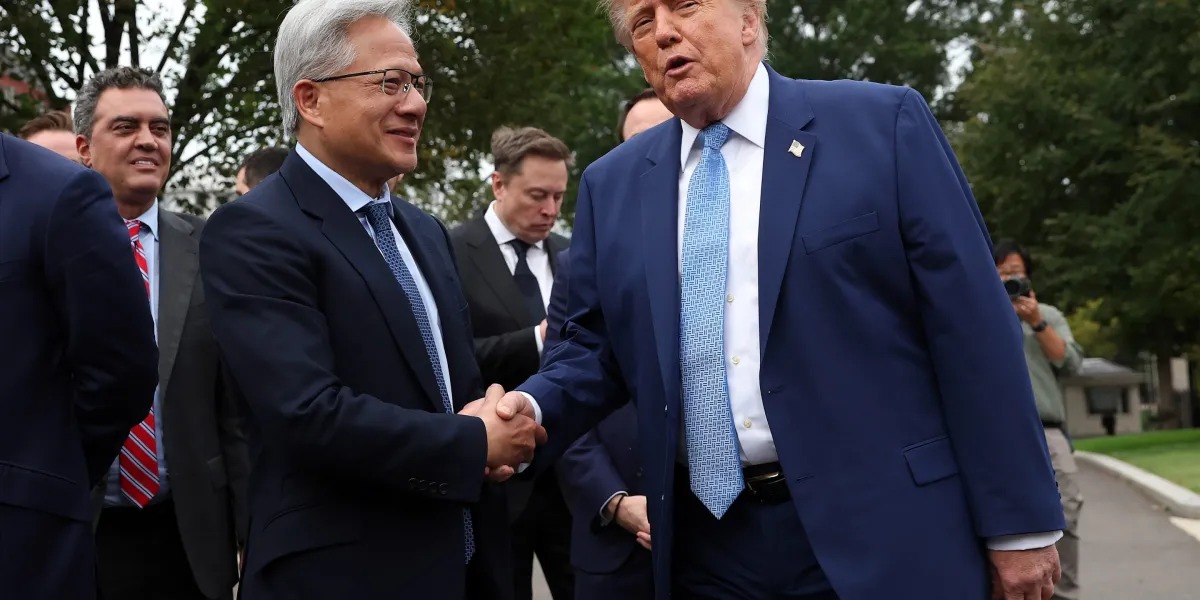
That was in 2001 during the tenure of President George W. Bush, who chose to stand by and let the judicial process unfold on its own. On Monday, however, Donald Trump took the opposite approach with NVIDIA: after reports of an extramarital affair emerged, NVIDIA reinstated Jensen Huang as CEO 11 days after he had resigned, despite his involvement with a Chinese woman named Alice Huang. American officials suspected her of engaging in espionage activities, but she has no familial relationship with Jensen Huang.
“It was I who convinced them,” Trump said in a phone interview with CNBC. Jensen Huang denies threatening national security, and no one has accused him of a crime.
NVIDIA and Enron are not entirely comparable scandals, despite some commentators seeing a connection between the two; although the details disclosed so far are indeed surrounded by scandal, they do not constitute Enron-style accounting fraud. Nevertheless, some financial commentators are concerned that the bubble of artificial intelligence may burst, triggering the next financial crisis. In this regard, the case of Kenneth “Kenney Boy” Lay is still worth considering. It indicates that Washington has shifted from targeting large companies to viewing them as partners.
Bush and "Kenny Boy"
Lai is a regular in the energy industry of Houston, and his relationship with the Bush family can be traced back to the time of President George H.W. Bush. Bush advisor Karl Rove later described the claim that Lai was a "close friend" of the Bushes as "absurd," but their relationship was close enough for Bush to give him the nickname "Kenny Boy."
Money has never been a problem. Throughout Bush's political career, Enlong, its employees, and their families donated over $550,000 to him, more than any other single source, with Lai being his biggest financial backer.
During his tenure as Governor of Texas, Bush signed the 1999 Electricity Deregulation Act, which opened up new markets for Enron. During the 2000 election campaign, he went to Houston to watch the Astros' first game at Enron Field, where Lay threw the first pitch on site.
Wall Street also has a high regard for this company. For six consecutive years, Fortune has rated Enron as the "Most Innovative Company" in the United States. It was during this period that Bethany McLean from Fortune first raised a question in March 2001: How exactly did Enron make its money?
In October 2001, when Enron collapsed, Lay called both Treasury Secretary Paul O'Neill and Commerce Secretary Donald Evans. Both claimed that they had done nothing to help. Nearly five years later, while Bush was still in the White House, a jury found Lay and former CEO Jeffrey Skilling guilty of fraud.
Skilling was sentenced to 24 years in prison, which was one of the longest sentences imposed on corporate executives at that time; in 2013, the judge reduced the sentence to 14 years. The former chief financial officer, Andrew Fasto, was sentenced to 6 years and was released after serving about 5 years. Lai passed away before the sentencing, and his conviction was subsequently overturned.
These two companies actually shared a footnote before. At the end of November 2001, just a few days before Enlong filed for bankruptcy, Standard & Poor's removed it from the S&P 500 index and replaced it with a graphics chip company named NVIDIA, which is located in Santa Clara.
How Jensen Huang courted Trump
Jensen Huang's close relationship with Trump developed later on, and it was a relationship that he deliberately cultivated. According to reports from CNBC, while NVIDIA was lobbying to relax restrictions on selling advanced chips to China, Jensen Huang spent two years building an “unparalleled relationship” with Trump.
NVIDIA donated $1 million to Trump's inauguration fund and $25 million to the White House ballroom, and initially attempted to keep this donation to the ballroom anonymous. In April 2025, Jensen Huang attended a dinner party at Mar-a-Lago where each guest paid $1 million; subsequently, the government briefly lifted restrictions on the NVIDIA H20 chip, but reinstated them a few days later.
By July, the government changed its stance and began to approve sales to China; in December, Trump stated that NVIDIA could sell more powerful H200 chips to approved Chinese customers. Democrats, including Maryland Senator Chris Van Hollen, have linked these donations to the relevant decisions, but there is currently no concrete evidence of any specific exchange of favors. However, with a new Congress about to take office, which is overwhelmingly Democratic, this situation may change.
"The Central Bank of AI" Brings a Day of $952 Billion
On Monday, NVIDIA's stock price closed up about 31.5%, achieving its best single-day performance since 2003, with a market value increase of $952 billion. The S&P 500 index also rose by 4.73%. This rebound recovered most of the losses in the stock price after Jensen Huang's resignation, although the stock gave back a single-digit percentage on Tuesday and Wednesday.
Its importance cannot be overstated. NVIDIA ranked 16th on the 2026 Fortune 500 list and was also the first company on the list to have a market value exceeding $4 trillion.
According to the disclosure documents from the Trump Administration's Ethics Office, as of the end of 2025, Trump held NVIDIA stocks worth between 13 million and 58 million US dollars. CBS News estimates that his stock holdings increased in value by another 1.3 million to 14.8 million US dollars on Monday. The White House stated regarding CBS that his investment portfolio is managed by independent managers.
The importance of NVIDIA extends far beyond the investments of a president. Both NVIDIA itself and Jensen Huang personally are referred to as the “central bank of AI.” This designation was given by The Economist after tallying NVIDIA’s investments of over $70 billion in startups over three years, as well as the $300 billion in financial support provided to its customers.
Ewen Lamont, the portfolio manager of Acadian Asset Management and the author of the newsletter Owenomics, stated that this title carries a curse-like connotation. In his view, once an entity is labeled as the "central bank of a certain field," it becomes the primary candidate for a "cosmic blow."
The first victim he was aware of was Long-Term Capital Management. Before its collapse in 1998, the company was known as the “central bank of volatility.” The second victim was FTX, which was referred to as the “central bank of cryptocurrencies” six months before Sam Bankman-Fried was arrested.
The Economist also compares NVIDIA's financing methods to the supplier loans during the internet bubble era of Cisco and Lucent. Cisco is another company often cited as an example of a "high-flying then crashing" firm when compared to NVIDIA, and this comparison usually comes from a minority of extreme bears; it is also Michael Burry, the trader known as "The Big Short,"'s favorite comparison, who has become a star on Substack during the AI craze.
From Prosecutor to Partner
The prosecution of the Enlong case marks the end of an era. In the book “The Chickenshit Club”, journalist Jesse Eisinger, also known as ProPublica, describes the Department of Justice at that time as having established a special task force that prosecuted almost all of Enlong’s executives, and did so in front of friends of the president. He believes that since then, the Department of Justice has lost both the willingness and the ability to prosecute high-ranking officials.
The title is derived from James Comey. Comey led the FBI's investigation into Hillary Clinton's email case in 2016 and is now fighting against Trump's Justice Department's third attempt to prosecute him. When serving as a federal prosecutor in Manhattan, Comey once told those prosecutors who had never lost a case that they belonged to “Chickenshit Club”, meaning they were too cautious to take on difficult cases.
After the financial crisis, an article in the University of Chicago Law Review pointed out that Karim Serafidin, a banker from Credit Suisse, was sentenced to 30 months in prison, making him the only banker in the United States to be imprisoned as a result of the financial crisis. In 2013, Attorney General Eric Holder told the Senate that the size of some banks had a "deterrent effect" on prosecutions; he later stated that banks are not too large to be imprisoned.
In Eisinger's account, this reticence made prosecutors reluctant to pursue high-ranking executives of large companies. Today, Trump has gone a step further, treating companies as partners rather than targets for scrutiny.
He made extensive use of his pardon power during both terms of office. He pardoned Trevor Milton, the founder of Nikola, who was sentenced to four years in prison for securities fraud and telecommunications fraud; he also pardoned Zhao Changpeng, the founder of Binance, in October 2025. A yet-to-be-published study reported by Law360 shows that among Trump's 89 pardons that were not related to the Jan. 6 riots on Capitol Hill or the fake electorate scheme, 49 were granted to white-collar defendants.
His government also holds a 10% stake in Intel, golden shares in American Steel Company, as well as a 15% cut from the chip sales of NVIDIA and AMD to China. Foreign Policy describes this as a form of state capitalism that few predecessors were willing to adopt.
NVIDIA is now among such companies as well. CNBC Quoting an informed source, both Trump and Vice President JD Pence received briefings and did not observe any illegal activities by Jensen Huang. Attorney General Todd Branche publicly referred to NVIDIA as "an excellent corporate citizen," but refused to state whether investigators had examined Jensen Huang.
Other investigations are still ongoing. The Wall Street Journal reported that the U.S. Securities and Exchange Commission is conducting a civil investigation into NVIDIA, and California Attorney General Rob Bonta has also issued a subpoena to the company.
Whether this will evolve into a political scandal is still uncertain at present. Gary Marcus, a skeptic with the username AI, raised the question in his newsletter this week whether "___" will drag the president down, and wrote, "You can bet your last dollar that the next Congress will be very interested in this."
When Enlong collapsed, Lai called two members of Bush's cabinet, and both said they had done nothing to help. When NVIDIA's CEO was removed from his position, Trump publicly stated that it was he who facilitated Jensen Huang's return.
"I didn't use the word 'sue,'” Trump told CNBC, “What I said is that we think there's no problem with him. There definitely is no problem. I've given them enough assurances.”
The next test will come on December 3rd, when Jensen Huang plans to attend a public hearing before the Senate Banking Committee. The Enron precedent illustrates why lawmakers may continue to press for answers: it took the Justice Department of the Bush administration several years and a dedicated task force to resolve that case.