On Wednesday, November 25th, Standard & Poor's Global Ratings placed NVIDIA's credit rating on the "Negative Credit Watch" list, indicating that this chip giant, currently rated as " AA ", may face a downgrade within 90 days. The reason is the increased risks associated with the company's management and governance, which serves as a warning to investors at the credit level.
This is a direct manifestation of NVIDIA's governance issues spreading from the board of directors to the credit market. This week, the board announced that it would seek a successor for Jensen Huang, and then reinstated his CEO position, while the independent directors' committee's investigation into him is still ongoing.
According to Reuters, Standard & Poor's clearly stated that this incident exposed the vulnerabilities in NVIDIA's management and governance framework, particularly the shortcomings in the structure, composition, and effectiveness of its board of directors.
Last Wednesday, Moody's downgraded its rating outlook for NVIDIA. According to Wall Street Insights, on November 18th, Moody's lowered NVIDIA's rating outlook from "positive" to "stable," while maintaining its Aa1 senior unsecured debt rating unchanged.
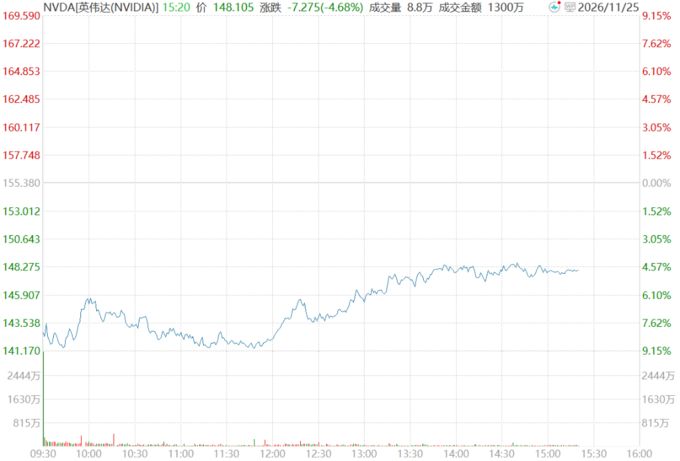
NVIDIA's stock price fell 4.7% on Wednesday, and has accumulated a decline of 38% since October 6th; the Nasdaq 100 index briefly approached the 20% mark from its recent high.
Time frame and extent of the reduction: 90 days, expected to be at level one.
Standard & Poor's provided clear time frames and range guidelines.
The institution stated that it may downgrade NVIDIA's rating within the next 90 days, but it is expected that any potential downgrade will be limited to one level, provided that the investigation and other disclosures do not harm the company's reputation or future business prospects.
NVIDIA is currently rated as “AA”, indicating that it has very strong debt-paying ability, with the highest rating being “AAA”.
Despite rating agencies adjusting their positions one after another, NVIDIA's credit fundamentals have not deteriorated substantially.
Previously, Moody's maintained its Aa1 rating, which is second only to the highest level of investment rating, and explicitly affirmed that the company's financial condition was still "extremely strong."