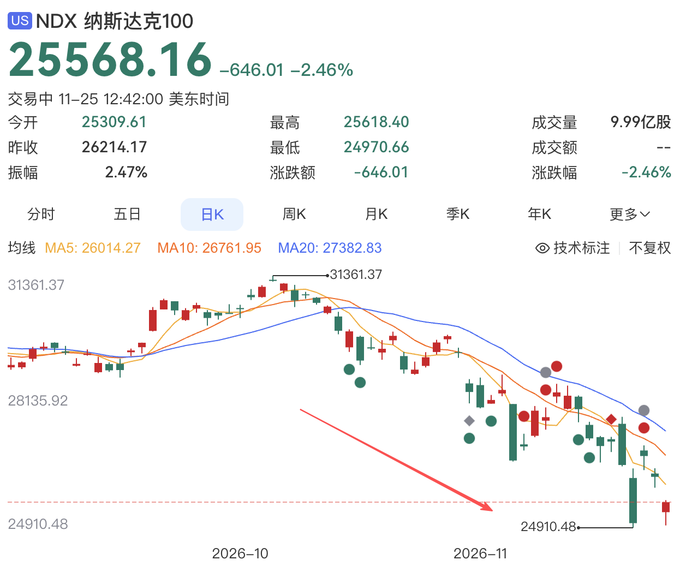
The Nasdaq 100 index tumbled for a second consecutive day, with its intraday high point falling by 20%, reaching the threshold of a bear market. Concerns over excessive investment in artificial intelligence erupted, and inflation data reinforced expectations for interest rate hikes, leading to widespread selling of tech stocks.
During Wednesday's trading in the U.S. stock market, the Nasdaq 100 fell by 4.5%, and the S&P 500 fell by 2.9%. The Volatility Index ( VIX ) broke above 33, and exchange-traded funds that track chip stocks lost more than 7%. The cumulative gain of the Nasdaq 100 has turned negative over the past year. The S&P 500 is on its way to having the worst November since the financial crisis of 2008.
“Sell first, then ask questions,” said The Wealth Alliance, President and Managing Director of Eric Diton.
This round of brutal selling was triggered by NVIDIA's instability, and it was further exacerbated by the Federal Reserve's interest rate hike cycle and concerns that the earnings growth of tech stocks has peaked. Lending institutions are feeling nervous as they question what the future investment returns of AI stocks will be. No one knows the answer.
NVIDIA leads the decline, with the "Big Seven" collectively weakening
On Wednesday, a basket of "Big Seven" ( Magnificent Seven ) stocks fell by nearly 4%, with NVIDIA leading the decline with a 7.8% drop, followed by Tesla, Microsoft, Meta , and Apple all seeing declines.
On Monday this week, Jensen Huang took back control of NVIDIA, which sparked a brief rebound in the market, but enthusiasm quickly faded. Investors realized that concerns regarding the risks, costs, and profit prospects of AI far outweighed the influence of any single "key figure."
AI All links in the industrial chain are under simultaneous pressure. NVIDIA's key contract manufacturer, TSMC, ADR, fell by 6.6%, and ADR Hynix fell by 7.1%. Anthropic PBC tumbled another 5.6% after breaking below its initial public offering price of $83 on the previous trading day; the stock had once soared to $115 on its first day of trading last week due to a AI craze.
Panmure Liberum Strategist Joachim Klement stated: "The market is still deeply concerned about the sustainability of the prosperity of AI."
Lack of liquidity has amplified volatility.
The United States welcomes a shortened trading week due to Thanksgiving holidays, resulting in lower market liquidity than usual. This may amplify volatility and also make investors reluctant to re-establish significant stock positions in the short term. The market will be closed on Thursday for Thanksgiving, and trading will conclude ahead of time on Friday at 1 p.m. New York time.
Investors' appetite for stocks related to AI remains fragile, and there are lingering concerns about whether financing will be sufficient to support the infrastructure construction of AI, and whether high capital expenditures will erode the profits of large enterprises.
Even so-called "quick money" cannot keep up with the pace of narrative shifts: Estimates compiled by the trading desks of Goldman Sachs Group show that commodity trading advisors ( CTA ) are expected to sell $68 billion in global stocks over the next five trading days, a volume comparable to that of the five trading days up until last Friday, which was the worst week for the stock market since the outbreak of the pandemic.
The models tracked by these systematic funds have not yet signaled a slowdown in selling.
The sell-off has not yet affected every corner of the market. Among the 11 sectors of the S&P 500 index, three closed higher on Wednesday, with the consumer staples sector leading the gains; the S&P 500 and other weighted indices fell by only about 1%.
Inflation remains stubborn, and expectations for interest rate hikes are rising.
Data released on Wednesday showed that the Fed's preferred core inflation indicator – the core PCE price index in October – rose 3.3% year-on-year, reaching its highest level since November 2023; the overall PCE price index rose 3.8% year-on-year, also the highest since May 2023, far exceeding the central bank's target of 2%.
"Fed officials have repeatedly expressed their determination to address stubborn inflation, which has sparked concerns about another potential interest rate hike in December," said Jed Ellerbroek, a portfolio manager at St. Louis Argent Capital Management.
"But as the stock market struggles, traders are now beginning to argue: Could this wave of selling already be doing some of the work for the Federal Reserve, and perhaps they can stop now?"
New tariff plans add further pressure
In addition to tech stocks, traders are also assessing the impact of the U.S. plan to impose new import tariffs on goods from more than a dozen economies, including the European Union.
The move is aimed at reinstating President Trump's comprehensive global tariff agenda, which was ruled unconstitutional by the Supreme Court. Traders are concerned that this could suppress growth and drive up inflation.
Former Merrill Lynch trader and founder of The Sevens Report, Tom Essaye, wrote: "Reports about the new US tariff plan have put further pressure on the market. After conducting investigations into industrial overcapacity, the Trump administration is preparing to impose new tariffs on imported goods from more than a dozen major trading partners, reigniting trade tensions."