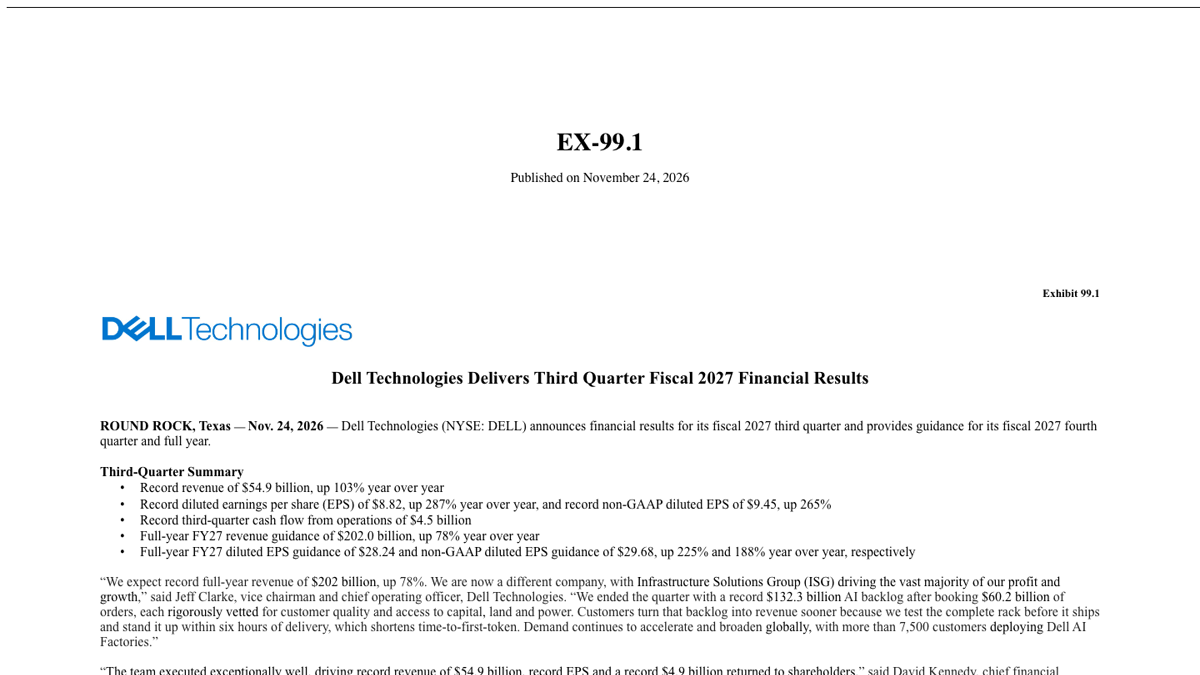


Dell announced its financial results on November 24: For the third fiscal quarter ending October 30, AI optimized server revenue by $22 billion. At the end of the period, management disclosed that AI backlogged orders had reached $132.3 billion.
In the same period, new orders for AI amounted to 60.2 billion US dollars, exceeding twice the AI server optimization revenue for that quarter. Each of these three figures represents a different aspect: new orders represent the demand signed up during that quarter, backlogged orders are those remaining at the end of the period, and server revenue is the sales amount already listed in the quarterly financial report. Even though they are all denominated in US dollars, they cannot be simply added together to form a single sales report.
From full-cabinet testing to financial report confirmation
Jeff Clark, Dell's Vice Chairman and Chief Operating Officer, said that when the company screens orders, it examines the quality of the customers, as well as whether the customers have access to funds, land, and electricity. There are three different constraints involved. Whether the equipment can be received at the construction site once it arrives, whether the power supply can support it, and whether the customers have the money to carry out the purchase – all these factors are related to whether the order can proceed to deployment. The financial reports do not disclose the delivery timelines for each backlogged order individually, and the total amount at the end of the period does not provide answers to these questions.
Clark also linked the delivery speed with the entire cabinet testing process. He stated that Dell would test the entire cabinet before shipment and be able to deploy it within six hours of delivery, thereby reducing the time it takes for customers to receive the first model output. These six hours are calculated from the time of delivery and do not account for the waiting period from order placement to the arrival of the equipment. The company also mentioned that there are over 7,500 customers deploying Dell’s AI factory, but the press release did not list the order amounts for these customers.
For readers who examine financial reports, in the next quarter, it would be advisable to track AI server revenue separately from the AI backlogged orders at the end of the period. The former reflects how much sales were confirmed during the current quarter, while the latter indicates the scale of demand that still needs to be converted by the end of the period. If the backlog continues to increase, this single indicator alone will not be sufficient to determine whether new orders are coming in faster or if deliveries are relatively slow. Only by considering both new orders and confirmed revenue together can we make a distinction between these two scenarios.
The balance sheet provides another reference point. As of October 30th, inventory amounted to approximately $29.4 billion, which is higher than the $10.4 billion on January 30th; during the same period, net accounts receivable increased from about $17.6 billion to $28.9 billion. Both figures represent the group as a whole and cannot be attributed to the AI business segment. After orders are converted into revenue, accounts receivable still need to be collected before they can be turned into cash, and tracking deliveries also requires referring to the balance sheet.
The money earned from infrastructure doesn't only come from AI cabinets.
In the third fiscal quarter, Dell's total revenue was approximately $54.9 billion, a year-over-year increase of 103%. The Infrastructure Solutions Group contributed $42 billion, with a year-over-year growth of 198%. Of this, AI optimized server revenue amounted to $22 billion, with a year-over-year increase of 291%; traditional server and network revenue was $15 billion, growing by 235%; and storage revenue was $4.9 billion, increasing by 24%. When investors attempt to infer AI equipment demand from the entire infrastructure segment, the $15 billion in revenue from traditional servers and networks cannot be directly attributed to AI equipment.
Profits also need to be broken down according to the level of disclosure. The operating profit of the Infrastructure Group was 7.1 billion US dollars, a year-on-year increase of 308%, while on the other hand, the Customer Solutions Group had revenue of 12.9 billion US dollars, a growth of 3%, and an operating profit of 704 million US dollars, a decrease of 6%. Both groups sell equipment, but their profit trends are not the same. The financial report lists the operating profit of the entire Infrastructure Group without separating the profits from the AI optimized servers into a separate income statement. If we divide 7.1 billion US dollars by 22 billion US dollars, it will include the profits from other businesses in the numerator of the AI server business as well.
The group reported an diluted earnings per share of $8.82 according to GAAP, and an adjusted earnings per share of $9.45. The operating cash flow for the quarter reached $4.5 billion, with a total of $10.8 billion from the beginning of the year to date. During the same quarter, the company spent $4.9 billion on share repurchases and dividend payments. The board of directors also increased the authorization for the existing Class C common stock repurchase program by another $25 billion. The amount returned represents actions from the past quarter, while the additional authorization is available for use in the future; the dates and purposes of the two are different.
The company has raised its total revenue guidance for this fiscal year from $192 billion to $202 billion, and the AI server optimization guidance has been increased from $74 billion to $78 billion. Subtracting these figures from each other, the additional $4 billion in server revenue is less than the $10 billion increase in total revenue guidance. The remaining change cannot be explained solely by the AI item. For the fourth fiscal quarter, the group's revenue guidance is $56.3 billion, and the full-year GAAP diluted earnings per share guidance has been raised to $28.24. While these guidelines are for the future, what shareholders can see in the financial reports for now is the $22 billion in server revenue that has been confirmed for this quarter, as well as the new revenue structure for which no separate profit figures are yet available.