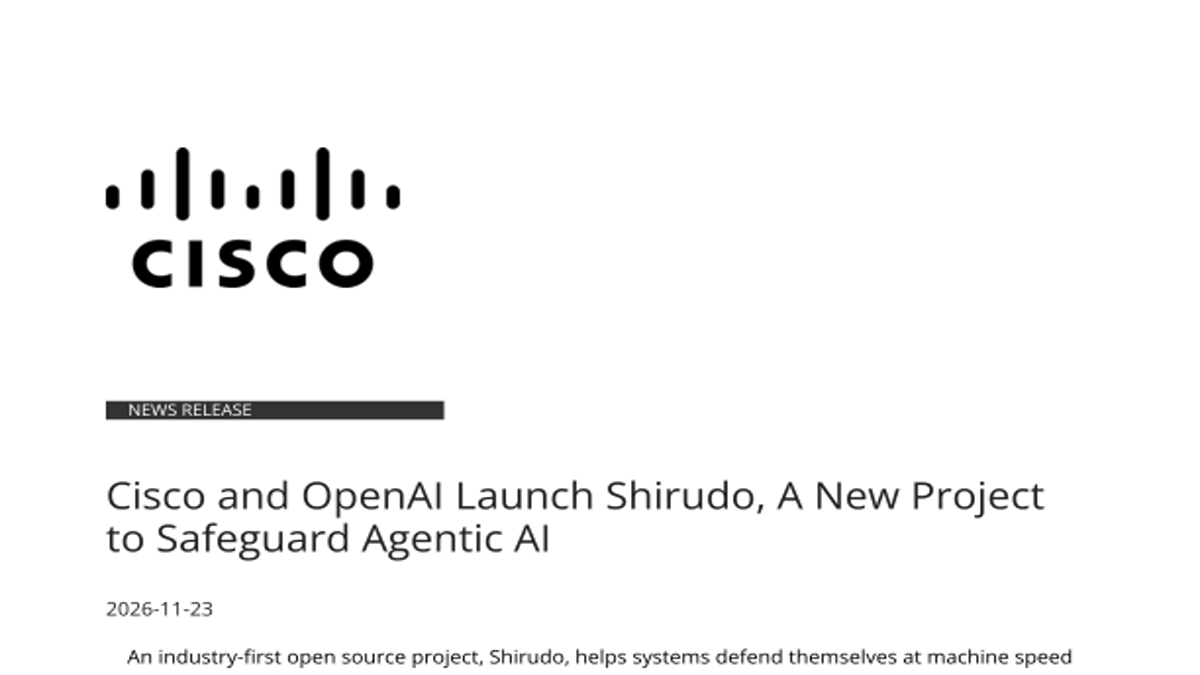


Cisco and OpenAI released the open-source project Shirudo on November 23, taking a step before the release of a permanent patch: they first implemented temporary protection for running Linux systems to allow services to continue running until the team completed the formal fix.
OpenAI Co-founder Greg Brockman explained in the announcement that there is often a period of time between discovering vulnerabilities and installing patches for all systems. This collaboration is aimed at addressing precisely this timeframe. Cisco's President and Chief Product Officer, Giitoo Patel, described the temporary protection as a buffer in terms of timeline, giving those responsible for fixing the issues the time to securely deploy the updates.
When protection can be lifted, an announcement sets two conditions.
Shirudo utilizes eBPF. This Linux technology allows mini-programs to run within the operating system kernel without the need to rewrite the kernel source code. The project uses it to add temporary protection to running hosts, and deploying this measure does not require a system restart. For services that cannot be stopped immediately, this provides an additional option to consider until the official patch is available.
Cisco describes the responsibilities of the AI proxy as identifying issues, generating protections, and verifying whether they prevent attacks, while also checking whether services will be interrupted. The announcement emphasizes that features will only be rolled out after evidence supports their security. While a rule can prevent abnormal behavior, it may also mistakenly affect legitimate traffic; both outcomes must be considered together. For businesses, effective blocking and business continuity are two key acceptance criteria, and the former cannot replace the latter.
The second requirement is signing. The announcement states that each protection measure is cryptographically signed, allowing the host to verify the source and integrity before operation. Cisco has made it a design goal that verification can still be performed even if the host administrator's privileges are compromised. The signature indicates whether what is received by the host has been authorized; however, it cannot predict whether new rules will mistakenly block legitimate traffic in real-world operations. Who authorizes the verification and the effectiveness of the verification process answer different questions.
The announcement also places human roles in the permission settings, where individuals retain the keys, thus establishing boundaries for automation. Agents are responsible for the tasks of searching and testing, but actual deployment is still subject to security evidence and host-side verification. If purchasers estimate benefits by reducing downtime, they should first check whether the currently used kernel can run protections and who holds the deployment authorization, before assessing whether there are alternative solutions for scenarios that originally required waiting for maintenance windows.
How much judgment can two test cases support?
The press release mentioned two recent severe vulnerability tests, involving Java and PHP respectively. Cisco stated that the protections generated in both use cases detected and blocked the attempted exploits. The announcement only provided conclusions for these cases, without reporting on the broader test coverage, false positive rates, performance overhead, or service performance in a production environment. These two tests indicate that the project achieved its intended objectives, but it is still not possible to determine how many interceptions or false blocks a company may encounter within their own systems.
Cisco also lists the ability to recover to a known reliable state after service disruptions as a longer-term goal. This open-source release focuses on temporary protection. The announcement does not state that the project has already delivered automatic recovery capabilities; additional evidence will be needed to incorporate the latter into an enterprise continuity plan.
Two companies are soliciting feedback from developers, researchers, and enterprises, including information on the performance of protective measures across different kernel versions and whether they block normal traffic. This solicitation adds a specific question to the evaluation project: whether the same temporary protection measures can maintain their effectiveness under the operating conditions of the enterprises themselves. The announcement does not provide a compatibility list applicable to all systems, and whether it is available on the host side still needs to be verified according to the environment.
For readers following Cisco's security business, it is confirmed that open-source collaboration has already begun with the release of this project. The announcement does not provide separate commercial pricing, payment product packaging schemes, or revenue guidelines; therefore, it is not possible to derive signing revenues from the mere opening of the project. The verifiable information will first come from the protection coverage provided by the maintainers, the systems that are supported, and whether participants can reproduce acceptable operating results in their own services.
Cisco announces an online seminar on December 15th to further introduce this project. Regarding the currently public design, enterprises were originally expected to wait for the official update window. However, a second measure has been taken: to first verify and deploy a temporary protection before arranging for the patch. To incorporate this measure into the maintenance plan, enterprises still need evidence that it can effectively block the targeted behavior without interrupting the services that need to be preserved.