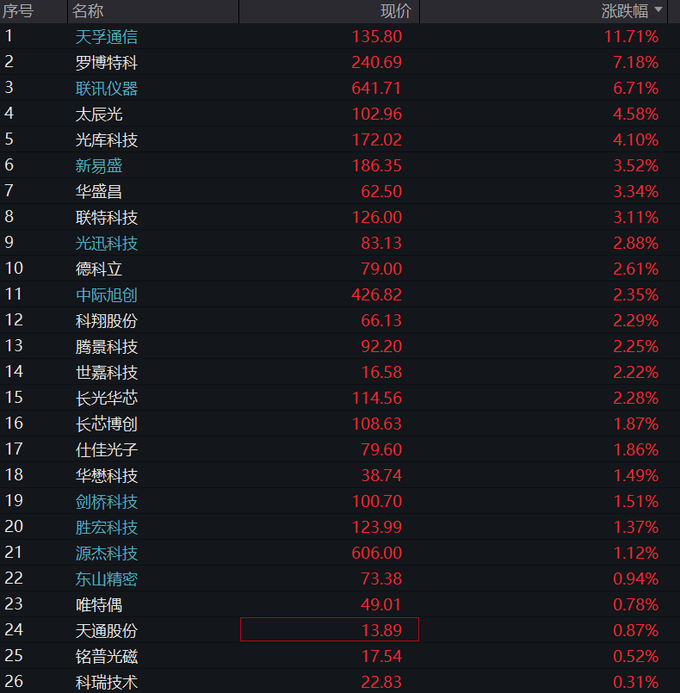
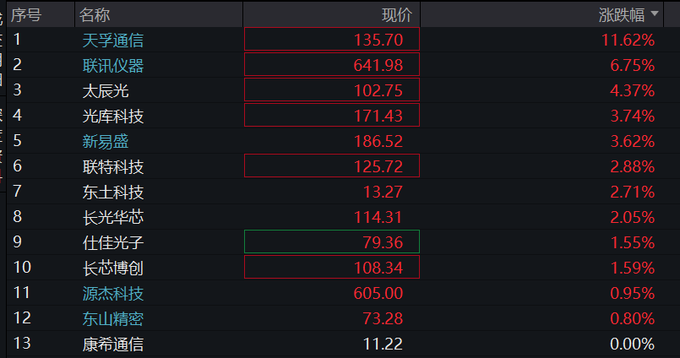
On November 25th, the A-share market opened lower in the morning session. The three major stock indices initially fluctuated before starting to rise, with the decline narrowing over time. Compute power hardware also started the day on a low note but then turned higher. Leading companies in the optical module sector, such as "Yizhongtian," saw their shares surge, with Tianfu Communication experiencing a gain of over 11%. Optical chips and optical circuit switches also showed upward trends in the early session. Major consumer sectors such as retail, catering, and tourism were active. However, the semiconductor industry chain entered a period of adjustment, with concept stocks related to GPU, advanced packaging, and lithography machines experiencing declines.
Hong Kong stocks opened higher in the morning session, with both the Hang Seng Index and the Hang Seng Tech Index rising. The Hang Seng Tech Index initially gained 1%, and most heavyweight tech stocks rebounded, with Xiaomi and JD.com rising by more than 5%, while Bilibili rose nearly 10%. Semiconductors declined, with Huahong Hongli falling by over 11%. Optical modules, optical fibers, and AI large model stocks all adjusted their prices. In the bond market, treasury bond futures generally fell. In the commodities sector, most domestic commodities declined, with precious metal futures leading the losses, following the overnight decline in international gold prices.
Core Market Trends:
- A-share market: As of press time, the Shanghai Composite Index fell by 0.76%, the Shenzhen Component Index fell by 0.78%, and the GEM Index fell by 1.19%.
- Hong Kong stocks: As of press time, the Hang Seng Index rose by 0.85%, and the Hang Seng Tech Index rose by 0.91%.
- Debt Market: Treasury bond futures fell across the board. As of press time, the main contract for 30-year bonds fell by 0.06%, the main contract for 10-year bonds fell by 0.03%, the main contract for 5-year bonds fell by 0.01%, and the main contract for 2-year bonds fell by 0.01%.
- Commodities: Domestic commodity futures generally saw increases. As of press time, coking coal prices rose by over 4%, coke and caustic soda by over 3%, the freight index and asphalt by 2%, pulp, crude oil, rebar, fuel oil, and hot-rolled coil plates by over 1%. Prices for glass, manganese silicon, alumina, iron ore, rubber, and industrial silicon also increased. In contrast, stainless steel, rapeseed, and soybean meal prices fell. Eggs, Shanghai nickel, Shanghai aluminum, polysilicon, and Shanghai gold all declined by over 1%, while platinum, palladium, Shanghai silver, Shanghai copper, Shanghai tin, and lithium carbonate prices dropped by over 3%.
09:49
CPO Concept rebounds with a shock; Tianfu Communication rises by over 11%, followed by Robotech, Xinyisheng, Qingshan Paper Industry, Guangxun Technology, and Zhongji Xuchuang.
09:46
The Hang Seng Technology Index once rose by more than 1% during the session, Bilibili rose by more than 10%, Alibaba Health rose by more than 7%, and JD Group and Xiaomi both rose by more than 6%.
09:45
Retail stocks strengthened, with Central Mall, Hangzhou Jiebai, and Liren Lizhuang hitting daily limit-ups, while Maoye Commercial, Guofang Group, and Baida Group also saw gains.
The A-share tourism sector saw a sudden surge, with Xiangyuan Culture and Tourism hitting the daily limit up. Dalian Shengya, Caesars Travel, Jiuhua Tourism, Three Gorges Tourism, and Junting Hotels also saw increases in their prices.
09:29
Computing power hardware stocks adjusted at the opening, Dongjing Electronics was close to hitting the daily limit down, while Sihui Fushi, Yihao New Materials, Shenghong Technology, Jingwang Electronics, Mankun Technology, and others all opened lower.
09:26
The Shanghai Composite Index opened lower by 0.73%, while the GEM Index fell by 2.01%. Sectors such as semiconductors, communication equipment, electronic components, and precious metals experienced significant pullbacks, whereas sectors like coal and banking managed to resist the decline relatively well.
09:21
The Hang Seng Index opened up 0.15%, while the Hang Seng Tech Index fell 0.41%. Pharmaceutical stocks performed brightly, with semiconductors, AI large models, and gold stocks leading the declines. Xiaomi Group rose more than 1% after releasing its earnings.
A Wall Street Journal article stated that Xiaomi's revenue in the third quarter was 107.24 billion yuan, slightly exceeding expectations. After adjustment, net profit decreased by 56.8% year-on-year, and the gross margin dropped to 20.2%. The main reasons were rising storage costs and increased investment in AI and automobiles. The high-end strategy for smartphones offset the decline in shipments, with AIoT devices exceeding 1.2 billion units, and although over 100,000 vehicles were delivered, losses expanded. Mass production of Xuanjie chips has also been launched.