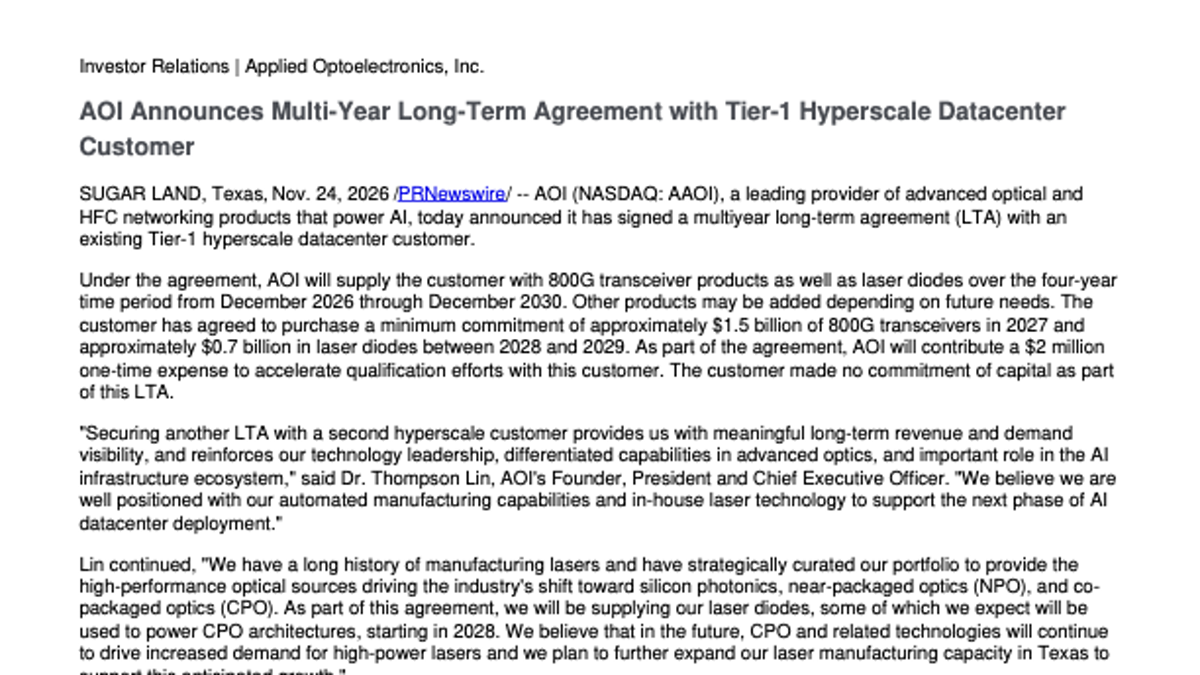


U.S. optical module manufacturer Applied Optoelectronics ( AOI ) announced a long-term supply contract with existing large data center customers on November 24th. The minimum purchase commitment specified in the contract amounts to approximately $2.2 billion, while the over $1 billion mentioned by management comes from customer demand forecasts.
The agreement covers the period from December 2026 to December 2030, with two types of products falling under different years. Customers have committed to purchasing approximately $1.5 billion worth of 800G optical modules in 2027, and about $700 million worth of laser diodes from 2028 to 2029. Other products can be added as needed, and the announcement does not set a separate minimum purchase commitment for 2030. If $2.2 billion is averaged over four years, it will miss the design phase of the agreement, which focuses most of the explicit commitments on the first round of optical module deliveries.
Pay for the modules in 2027 first.
800G refers to the data transmission specifications of the optical modules. The customer first committed to purchasing the entire set of high-speed optical modules, and only then did it come to the laser diodes that serve as the light sources. Together, these two components constitute the contract amount currently announced, of which about two-thirds come from the commitments for optical modules in 2027. AOI Founder and CEO Thompson Lin stated that this is a long-term agreement reached with the company's second ultra-large-scale data center customer. The name of the customer was not disclosed in this announcement.
The supply arrangement specifies the place of origin and timing. Chief Financial Officer Stefan Murray stated that the company is committed to delivering a predetermined quantity of products manufactured in the United States, with commencement in the first quarter of 2027, with gradual increases throughout the year. The announcement did not provide a specific quantity. To expedite customer product certification, AOI will also bear a one-time cost of $2 million. Customers agree to purchase the products, but no financial commitment is made under this agreement.
The funding arrangements are worth reading in conjunction with the company's third-quarter financial report dated November 5th. At that time, the company stated that its total manufacturing equipment capacity was close to 330,000 units per month. The expansion in the United States was affected by power supply access times and other construction issues, and it is expected to take longer to complete in 2027. The goal by the end of the year is to have installed enough equipment to support the production of over 500,000 units of 800G and 1.6T products per month, with a target of over 1 million related optical modules per month by the end of 2027. These two targets are part of the company's overall production capacity planning and were not specifically allocated to this contract.
Devices can be installed in advance, but the finished products still have to go through customer certification, quality testing, and delivery in sequence. AOI lists the ability to start production on time, the timely availability of components, the actual composition of the products sold, and pricing as potential risks. Even though the contract includes minimum commitments, announcements also indicate that changes in contract terms or purchase volumes may affect final sales. There are no detailed provisions regarding quarterly deliveries, unit prices, or related conditions made public.
Lasers are not expected to be available until 2028.
The CEO stated that a portion of the laser diodes the company expects to start supplying from 2028 will be used in co-packaged optical architectures. AOI also mentioned silicon photonics and near-packaged optics, but did not break down the $700 million commitment for lasers into different technical pathways. Readers can confirm that customers have made procurement commitments for the lasers, but the company has not yet provided a proportion of how much will ultimately be allocated for co-packaged optics.
Murray stated that the estimated demand over four years exceeds $10 billion. He listed two conditions for the incremental business: the company must have sufficient production capacity, and it also needs to obtain procurement commitments. The forward-looking statement in the announcement further distinguishes between three concepts: customer forecasts, purchase orders, and the company's revenue guidance. The estimated usage by customers may be adjusted, and amounts beyond the existing minimum commitments cannot be directly incorporated into the revenue model.
The third-quarter announcement provided a baseline for comparison. AOI reported revenue of $269.9 million for that quarter, an increase from $191.9 million in the previous quarter. GAAP The gross margin rose from 27.7% to 28.2%, and the net profit for that quarter was $6.3 million. The revenue forecast for the fourth quarter is between $385 million and $420 million, which is still on a company-wide basis. Using this as a reference, the amount for approximately the first year is sufficient to make the delivery pace for the following year a variable that requires separate attention. However, since the company did not disclose a separate gross margin for that period, it is not possible to directly calculate the profit from this contract using the consolidated gross margin.
Let's take a look at the traces left by the expansion on the financial statements. At the end of the third quarter, the company's inventory was $378 million, compared to $183.1 million at the end of last year. The net value of factories and equipment increased from $376.1 million to $1.044 billion. These two sets of figures represent the total inventory of the company before this disclosure and cannot be attributed to a single customer. To observe the initial increase in production, one can also look at the company's disclosed shipment progress for American products, consolidated inventory, and gross margin, and then determine in which quarter the equipment installation and revenue recognition occurred.
This announcement includes two items that in the past could only be inferred from demand forecasts as part of the agreed terms between both parties: the minimum procurement amount for optical modules in 2027, as well as the minimum procurement amount for laser diodes for the following two years. The first batch of products manufactured in the United States is scheduled to be delivered in the first quarter of 2027. How much actual shipment information the company can provide thereafter will determine how clearly the outside world can interpret this agreement.