The investor known for short-selling U.S. real estate in 2008, Michael Burry, has adjusted his investment portfolio during this round of tech stock selling frenzy. After clearing his short positions on NASDAQ 100 index put options, his overall holdings have shifted from short to slightly long, representing his most bullish stance in some time.
On Wednesday morning, Burry posted in his column “Cassandra Unchained” stating: “Globally, my investment portfolio is more diversified than it has been in some time, with fewer short positions.”
He added that, aside from the put options on Palantir and MetLife, he is currently “almost entirely long” for now. The reason it is described as “temporarily” is because he is still continuously evaluating opportunities to go short.
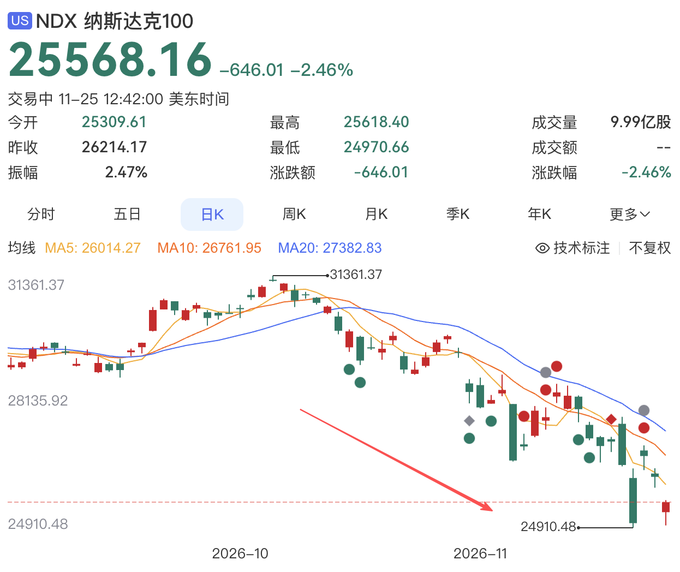
This statement comes at a time when investors are fleeing tech stocks due to concerns about the prospects of artificial intelligence trading. Over the past three years, it has been AI trading that has driven the rise in the broader market. During Wednesday's trading session, the Nasdaq 100 index fell 20% from its October high, reaching a level that marks the beginning of a bear market.
Cash accounts for about 25%, and I still hold the bullish options on NVIDIA that I bought last Friday.
Burry revealed that about 25% of his investment portfolio is in cash, and he is actively putting these funds into the market.
He also holds the Nvidia call options that he bought last Friday. “These options are far out of the money, and I only spent a few dollars on them. They have already doubled in value, and I haven’t decided yet what to do with them,” he said. “My plan is to go short again on Nvidia when the stock price approaches $200 per share during a period of increased market optimism. Now isn’t the right time.”
Major Holdings Exposed: Latin American E-commerce Companies and Chinese Concept Stocks Among Them
The larger positions disclosed by Burry include MercadoLibre Inc., Temple & Webster Group Ltd., and JD.com Inc.
He also holds shares in Adobe Inc, Birkenstock Holding Plc, Deckers Outdoor Corp, Molina Healthcare Inc, HCA Healthcare Inc, Lululemon Athletica Inc, Fiserv Inc, Veeva Systems Inc, PayPal Holdings Inc, and Build-A - Bear Workshop Inc.
In addition, Burry also holds subordinated preferred stocks of Fannie Mae and Freddie Mac, preferred stocks of QXO Inc, as well as multi-year LEAP call options of Sprouts Farmers Market Inc and Zoetis Inc.
Market Impact: AI Position Rebalancing Amid the Retreat of Trading
Burry explains the reasons why the put option strategy is ineffective in the current environment.
He pointed out that in a situation where the VIX index is rising and the market is falling, even the nominal prices of put options for stable companies that are barely related to AI construction are very expensive. "This makes direct short selling of common stocks the main tool for expressing bearish views at present."
"Despite the low cost, the asymmetric direction of short-selling stocks is incorrect," he wrote. His current long positions include "undervalued common stocks, LEAP call options, and preferred stocks."
The position adjustment of Burry occurred against the backdrop of a significant pullback in technology stocks. The Nasdaq 100 index touched the bear market threshold during trading, reflecting growing doubts in the market regarding the sustainability of the upward trend driven by AI.
For investors, the movements of Burry provide an opportunity to observe how professional investors reconfigure their risk management strategies during times of increased volatility: the high cost of put options undermines the efficiency of hedging, while direct short selling is not cost-effective under asymmetric risk conditions. This has prompted some funds to shift towards undervalued individual stocks and long-term options.
Burry clearly states that its current bearish stance is 'temporary', and the opportunities for short-selling are still under evaluation.
The reference price he suggested for taking another short position in NVIDIA is $200 per share, and he needs to wait for the market's optimism to rebound. This condition implies that he does not believe the current decline has ended, but rather he is waiting for a better timing to enter a short position.