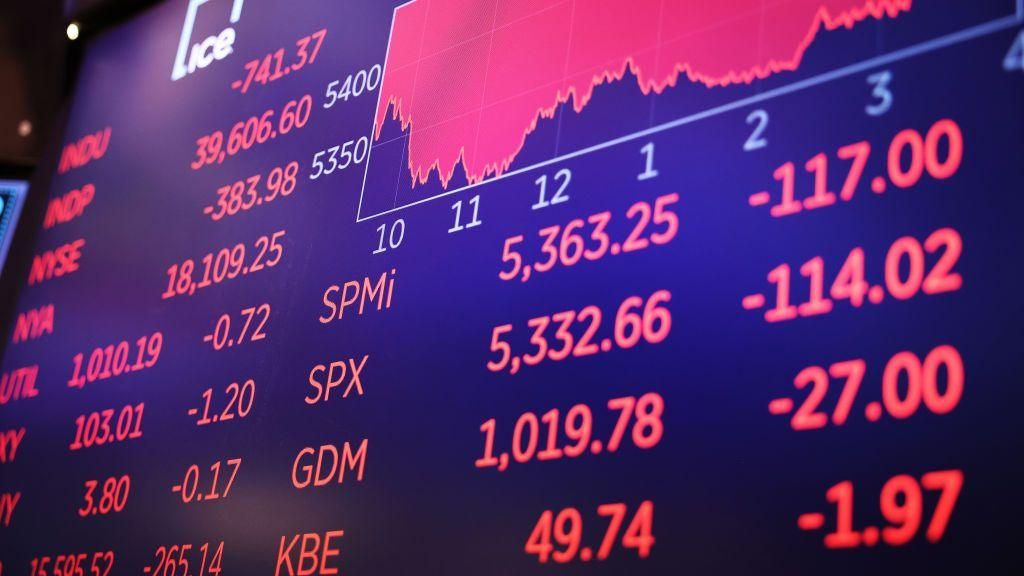
On Monday, U.S. stocks recorded the largest one-day gain in 19 months, with NVIDIA's stock price soaring by over 30%. However, professional traders remain skeptical about whether this rebound can continue. Rich Privorotsky, the head of trading at Goldman Sachs, stated that such drastic price fluctuations are typical characteristics of a bear market, rather than a sign of a bull market restart.
In his Tuesday morning report, Privorotsky wrote: “To be honest, this price trend is a bear market situation – the fluctuations are too intense for anyone to hold on to.” He pointed out that the performance of the credit market on Monday clearly lagged behind that of the stock market, confirming his previous judgment: this round of gains was mainly driven by bears being forced to close their positions, rather than bulls actively entering the market.
At the same time, Frank Flight of Citigroup Securities released an analysis report that compared the market trends for 2026 with those of 2018, reaching a similarly alarming conclusion.
Two reports point to the same issue: Although Jensen Huang's return drove a significant rebound for NVIDIA and the U.S. stock market, it failed to break the historical similarities with 2018. On the contrary, weak signals within the market are still accumulating, and the adjustment path of 2018 may be repeating itself.
The essence of a rebound: Shorts are forced out of the market, not bulls entering in.
Monday's market performance was quite strong. NVIDIA's stock price rose by more than 31.5%, the Nasdaq 100 index increased by 7%, and U.S. stocks recorded their best single-day performance since April 2025. CoreWeave also saw a 22% increase. Asian markets followed suit, with the South Korean Composite Index rising by 6.5%, with Samsung and SK Hynix leading the gains; the Nikkei index resumed trading after the holiday and also showed a significant upward trend.
However, Privorotsky has a different interpretation of this round of gains. He believes that the main driving force is investors who established large short positions over the weekend being forced to cover their positions, rather than new long funds actively entering the market. An important indication is that the performance of the credit market on Monday was significantly weaker than that of the stock market. As he said, "The credit market is a touchstone," and the divergence between the stock market and the credit market suggests that this rebound has not yet been confirmed by a broader range of funds.
In the view of Privorotsky, what the market urgently needs now is a “few days of calm” to allow the excessively high volatility premium to naturally subside, thereby creating room for systematic strategy funds to increase leverage again. At the same time, despite a significant rebound on Monday, all major stock indices still closed below their respective 200-day moving averages, and there are no clear technical signals of a reversal yet.
Citi Securities: The experiences of 2018 provided little comfort at all.
Citi Group Securities' Frank Flight systematically analyzed the similarities and differences between the markets in 2026 and 2018 in their report. They pointed out that during both periods, there was a divergence where the U.S. economy appeared resilient on the surface, yet financial markets became increasingly pessimistic. Cyclical stocks weakened before defensive stocks, ahead of the deterioration in overall economic data, accompanied by a strengthening U.S. dollar and a flattening of the Treasury yield curve.
Looking at specific indicators, the performance of cyclical stocks relative to defensive stocks has fallen from near their September highs back to par levels, almost replicating the trend seen from October to November 2018. By the end of that year, this indicator had further declined by more than 10%. The trend of the euro against the US dollar also closely followed the trajectory of 2018, indicating similar changes in the foreign exchange market as well.
The momentum factor has fallen from a high of around 130 in October this year to just above 100, whereas during the same period in 2018, this indicator was still above parity in November, ultimately closing at around 90. The simultaneous weakening of multiple market indicators suggests that the current adjustment may not be merely a short-term fluctuation at the stock index level.
Flight specifically warns that viewing recent adjustments as the market fully digesting the deterioration of economic prospects is hardly supported by the experience of 2018. Back then, weakness within the market occurred several months before the overall stock market adjustment, and the final correction was also much more significant than what the initial signals suggested.
Tech stocks: The last domino to fall last time as well
Flight further analyzed the market transmission path in 2018: the market first weakened internally, then the pressure spread to tech stocks and NASDAQ, ultimately dragging down the S&P 500 index to experience a significant adjustment at the end of the year. He believes that the market trend in 2026 is showing a similar pattern, and tech stocks may become an important link in the spread of market pressure in the next phase.
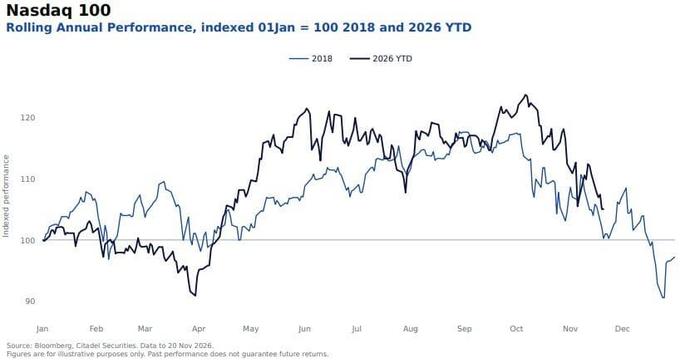
From an index-based perspective, the Nasdaq 100 index has fallen from its October high of around 124 to around 105 last Friday; during the same period in 2018, the index dropped from around 117 to around 90 on the eve of Christmas. The S&P 500 index has given back about 9 points of its year-to-date gains this year, while in 2018 it fell all the way below 90 during the same period. The tech sector has also seen a decline this year, falling from a high of around 140 to just over 110, whereas in 2018 it ended the year below its beginning levels.
Similar changes have also occurred in other sectors. Financial stocks have just fallen from high levels, while they had dropped to around 80 at the end of 2018; small-cap stocks have slid from 124 to around 107, compared to around 84 during the same period in 2018; global stock indices have now returned to around 105, whereas they had fallen to around 87 during the same period in 2018.
Flight also specifically mentioned the changes in defensive sectors. Before November 2018, the healthcare sector was one of the most resilient to declines, but it also began to weaken thereafter. Currently, the healthcare sector has also just started to soften from its high levels, and its trend is quite similar to that of 2018. This means that the market weakness is gradually spreading from cyclical and tech sectors to areas that were previously relatively resistant to declines.
Bonds and Credit Markets: No Key Signals Have Appeared Yet
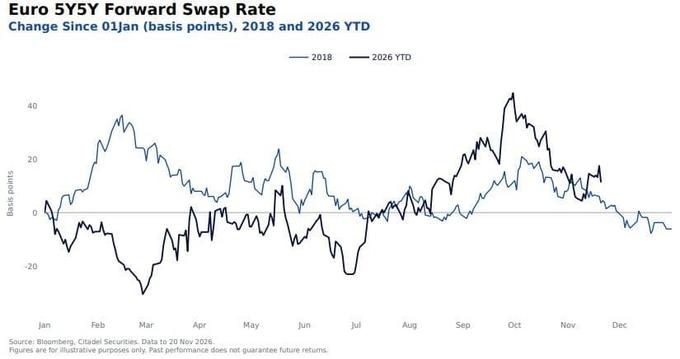
The most notable common point in both reports is that the bond and credit markets have not fully reflected the risks inherent in the stock market. Flight points out that in 2018, the market eventually turned around due to deteriorating economic growth prospects, and the fixed-income market subsequently rebounded significantly. However, the situation in 2026 is different; the yield on 10-year U.S. Treasury bonds has risen by about 85 basis points this year, exceeding the increase during the same period in 2018, and so far there has been almost no significant decline.
In 2018, the yield on 10-year U.S. Treasury bonds peaked in November, and by the end of the year, about two-thirds of the year's increase had been reversed. The yield on 2-year U.S. Treasury bonds also turned around in November, falling by about 45 basis points by the end of the year, reflecting that the market began to price in a shift in Federal Reserve policy. In contrast, there are no similar signs of a turnaround in the current U.S. Treasury bond market.
Privorotsky also noticed the divergence between the stock and bond markets. In his real-time comments on Monday, he said: 'What was most impressive yesterday was that despite the Nasdaq rising by 6.5%, the long-term yield remained almost unchanged.'
Another indicator he focuses on is the 2-year inflation swap rate, which has dropped to 2.09%, the lowest level in a year, and represents a significant decline from 3.13% in May. This is also an important basis for him to characterize the current market as an "inflation bear market."
The credit market also failed to exhibit risk pricing that matched the volatility of the stock market. The investment-grade credit spread widened by only about 13 basis points throughout the year, whereas in November 2018 it had already widened by 20 basis points and further expanded by about 25 basis points in December alone. Goldman Sachs previously noted that the CDX investment-grade index has so far only completed about 15% of the trend seen during the same period in 2018, which is one of the biggest differences between the current market and that of 2018.