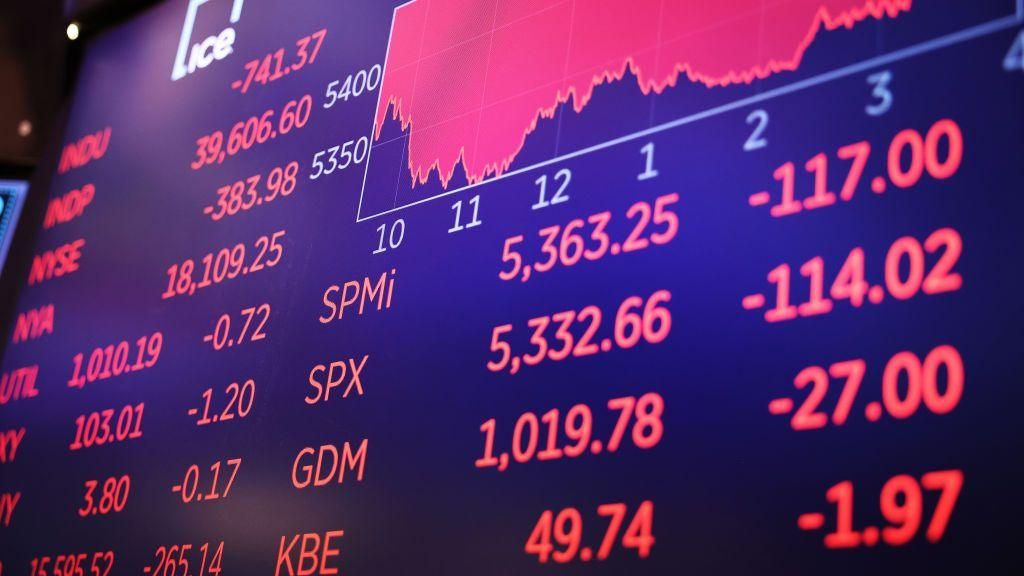
NVIDIA's board of directors reinstated Jensen Huang's position, reigniting market confidence in the artificial intelligence sector and driving U.S. stocks to record their largest single-day gain since April 2025 on Monday. Oil prices tumbled due to diplomatic tensions with Iran, 10-year U.S. Treasury yields fell, and the U.S. dollar index rose.
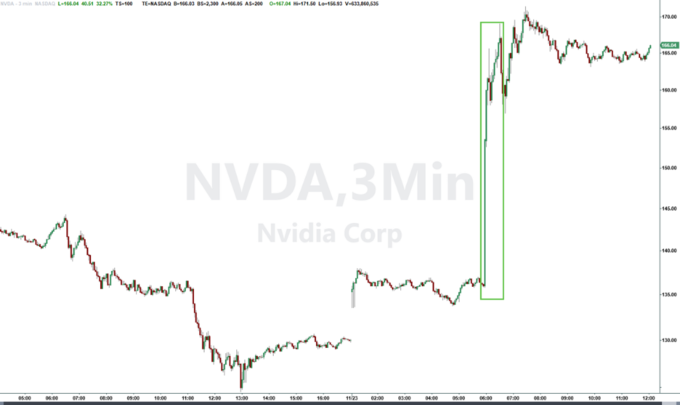
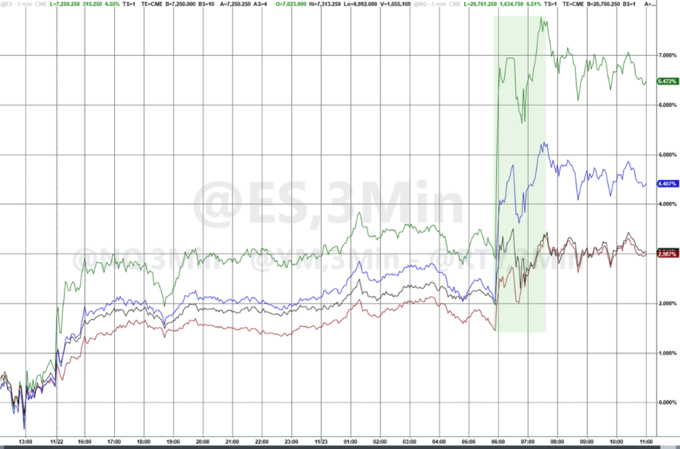
On Monday, the S&P 500 index rose by 4.7%, and the Dow Jones Industrial Average increased by 3%. NVIDIA's stock price soared by 31%, recording the largest one-day increase since 2003. The Nasdaq 100 index soared by 6.9% in a single day, with its market value increasing by over $2 trillion.
A week earlier, impacted by the news of Jensen Huang's resignation, the Nasdaq 100 index was on the verge of a bear market, while both the S&P 500 index and the Dow Jones Industrial Average entered a correction phase.
On that day, Trump posted on social media, expressing his hope that the board of directors would rehire Jensen Huang. After the news of his reinstatement was announced, he stated that he had done nothing wrong. In their announcement, NVIDIA's board of directors stated that they had taken into account the opinions of senior U.S. government officials and were confident that his reinstatement did not pose a national security risk. This news directly triggered a concentrated liquidation of short positions.
On the same day, the crude oil market moved in opposite directions. Trump indicated that he would give more time to diplomatic efforts towards Iran, and the risk hedging measures established in anticipation of a military escalation over the weekend were lifted; the reopening of the Sharara pipeline in Libya also alleviated concerns about supply. The WTI settlement price fell below $81, and Brent crude fell below $90, both returning to August levels.
The US Dollar Index rose by 0.5%. Spot gold increased by about 3%, pushing higher during the session before giving back some of its gains, but still maintained most of its upward momentum; spot silver also rose by 4.76%.
This Wednesday, the United States will release the third-quarter GDP revision values and the October Core Personal Consumption Expenditures Price Index. The market expects a 0.3% month-on-month increase in core prices. On December 1st, Jensen Huang will be subject to closed-door questioning by three House of Representatives committees regarding these matters, followed by NVIDIA's Chief Legal Officer Tim Teter on December 2nd.
Jensen Huang resumes his position, and the AI trading crisis is temporarily resolved.
On Monday, all three major U.S. stock indices saw substantial gains. The S&P 500 rose 4.74% to 7,237.71 points, ending a seven-day decline; the Nasdaq Composite Index rose 6.51% to 24,089.56 points, and the Dow Jones Industrial Average rose 3.01% to 49,595.31 points.
The Nasdaq 100 index rose by 6.86% to 26,746.10 points, while the Russell 2000 index increased by 3.40%. Assets related to technology and semiconductors led the gains, whereas sectors such as energy and consumer staples lagged behind.
The Panic Index VIX has been experiencing severe fluctuations. Analysis suggests that it first soared due to market stimuli, with a large number of algorithmic traders buying call options, followed by a sharp drop. Hedging trades were liquidated amidst these intense price movements.
On November 12th, Jensen Huang announced his resignation following the exposure of an extramarital affair scandal, and shortly thereafter, the AI trading market plunged into crisis. As a key asset in this round of AI enthusiasm, the sudden departure of its leader, NVIDIA, caused serious doubts about the future of the entire industry sector.
NVIDIA announced on November 23 that the board of directors has decided to reinstate Jensen Huang as the company's President, Chief Executive Officer, and Director effective immediately. The company's stock price closed at $165.05, with a market value returning to approximately $3.99 trillion.
Short positions were subject to forced liquidation. A product that shorted NVIDIA by three times lost most of its value during the trading session.
NVIDIA's rebound has not yet been complete. Compared to when the related allegations emerged on October 29th, the stock price is still about 20% lower, whereas at that time the market value exceeded $4 trillion.
Option data institution SpotGamma indicates that there are still a large number of negative gamma positions in the range of $165 to $200, and fluctuations during the rebound may be amplified.
As the news of Jensen Huang's reinstatement became official, market sentiment quickly reversed. According to Jose Torres from YingTou Securities:
NVIDIA AI The key figure in infrastructure construction has taken back the reins, boosting market confidence that the momentum of modern technological development will remain strong. At the same time, it has also temporarily dispelled external concerns about a slowdown in the industry.
GDS of the financial management company pointed out that Jensen Huang's return will help to eliminate a key uncertainty factor in AI transactions. Glen Smith believes:
The worst seems to be over, and the company can turn this ordeal into a positive opportunity to move forward.
He added:
Sometimes callbacks come quickly, and they go just as quickly; we believe that a temporary bottom in the stock market may have been formed.
Bloomberg macro strategist Michael Ball also stated:
This round of adjustments in the S&P 500 is more of a crisis of confidence than a substantial impact on economic growth. Jensen Huang's reinstatement precisely demonstrates how quickly such confidence can be restored.
The tech sector rebounded across the board, with semiconductors leading the gains.
NVIDIA's comeback-driven rebound has lifted the entire tech ecosystem as a whole.
The Philadelphia Semiconductor Index soared 14% in a single day, with large-cap tech stocks such as Amazon, Microsoft, Meta, and Alphabet all seeing significant gains. Emerging cloud computing and data center companies, which had been under pressure due to the resignation of Jensen Huang, also rebounded across the board.
Tesla rose 11.60% to $385.92, Meta rose 6.55% to $597.60, Google rose 6.34% to $282.10, Microsoft rose 1.65%, Apple rose 1.90%, and Amazon rose 3.47%.
Chip stocks led the gains. Micron Technology closed at $707.70, up 19.04%; Arm closed at $176.67, up 16.08%; AMD closed at $453.46, up 6.85%. Cloud computing service provider CoreWeave rose 22.32% to $48.33, and server manufacturer Supermicro Computer increased by 13.30%.
New stock Anthropic has performed the opposite. The company's options began trading on the 23rd, with the stock price closing at $87.64, a decrease of 1.43%. The price briefly approached $94 during the session before falling back, but still remained slightly above the issue price. After achieving a record listing last week, the stock has already lost most of its gains from the first day.
Gabelli Fund portfolio manager and research analyst Hendi Susanto stated that the Jensen Huang regression helps to restore market confidence in the AI ecosystem, including suppliers, infrastructure, and future demand prospects; financing, geopolitics, and growth sustainability remain unresolved issues.
Joe Tigay points out that although NVIDIA's recent business fundamentals are roughly the same with or without Jensen Huang, under Jensen Huang's leadership, the nature of this stock is fundamentally different. Torres also agrees:
Jensen Huang has always been a key promoter, transaction facilitator, power broker, financier, and executor in this industry. When there were doubts from the outside world about massive capital expenditures, uncertain investment returns, and integration capabilities, he consistently endorsed industry expansion and maintained an optimistic market sentiment.
Globalt Investments Senior Portfolio Manager Thomas Martin indicates:
Previously, the market generally believed that Jensen Huang was irreplaceably important for NVIDIA and the trading of AI. Today's market conditions have confirmed this judgment.
Morgan Stanley's Senior Portfolio Manager for Investment Management, Andrew Slimmon, stated:
We believe that this rebound has not yet come to an end, and at the current level, it is not too late to gradually increase our exposure to technology stocks.
US stocks rebounded but stopped within 20 minutes of the opening; the 200-day moving average remains a pressure point.
The increase throughout the day was concentrated between 8:55 and 9:15 AM Eastern Time, after which the major indices did not see further gains.
Data from Goldman Sachs' trading desk shows that despite increased trading volume, the overall activity for the day was only 5 out of 10. The buying bias was 10%, mainly driven by hedge funds, with purchases concentrated in ETF and the information technology sector.
Goldman Sachs trading desk Brian Garrett noted that historically, after similar spikes in the panic index, the S&P 500 has averaged a gain of 5.1% the following day, and the opening increase this time is exactly that same figure.
The tension in the options market has not completely subsided. The implied volatility of panic index options remains high, and the return gap between the 12-month momentum strategy and the 3-month and 6-month strategies has reached its largest level on record.
Nomura Securities strategist Charlie McElligott previously noted that such capital flow predictions depend on more factors than just current prices and changes in volatility.
All three major indices are currently below their 200-day moving averages. On that day, Anton Tran from Goldman Sachs' trading desk wrote in their report that the fate of the market is almost synonymous with the fate of an individual. Whether this is a good thing or a bad thing remains to be determined at this time.
Risk-averting buying orders withdraw, and the yield curve of U.S. Treasury bonds flattens out
The yield on 10-year U.S. Treasury bonds closed at around 4.92%, down about 2.5 basis points from the previous day, ending a five-day consecutive decline.
On the short end, the opposite occurred: the yield for 2-year bonds rose by about 2.4 basis points to 4.67%, while that for 30-year bonds fell by about 3.4 basis points to 5.295%. The spread between 2-year and 10-year bonds narrowed by about 4 basis points.
During the morning rally in U.S. stocks, the hedging funds that flocked to U.S. Treasuries last week began to withdraw. Subsequently, a decline in oil prices and the strong performance of a $69 billion 2-year Treasury bond auction pushed down yields in the medium to long term.
Floodlines Research founder and investment strategist Anna Wu stated that last week, the selling of AI assets pushed investors towards U.S. Treasury bonds, and now some of the hedging purchases are beginning to withdraw.
Jeffrey's chief economist and strategist, Mohit Kumar, believes that it is difficult for the Federal Reserve to raise interest rates by 50 basis points in December, and the December policy meeting should mark the peak of this round of hawkish stance. Interest rate futures indicate that the market now pricing a 25 basis point rate hike in December has returned to over 90% probability.
Geopolitical premium unwound, pushing down oil prices; gold rebounds
WTI January crude oil settlement reported at $80.17, down 3.88%, hitting a new low in about 13 weeks; Brent January crude oil settlement reported at $89.37, down 3.46%.
Trump indicates a willingness to give diplomacy more time; the risk hedging measures put in place regarding the potential military escalation over the weekend have been lifted; the reopening of the Sharara pipeline in Libya has also alleviated concerns about supply.
The funding situation is also weak. Fund managers have reduced their WTI and Brent net long positions to multi-month lows before settlement, and the number of open contracts for WTI has dropped to its lowest level since March 2025.
U.S. natural gas futures tumbled 9.1% at one point during trading, hitting the largest single-day decline in nearly 10 months, and ultimately closed down about 5.95% at $3.525.
The catalyst is a dramatic change in weather forecasts, with temperatures in most areas of the Midwestern and Eastern United States expected to be above average in the coming two weeks. This indicates that the demand for heating will significantly decrease in markets where supplies are already ample.
Spot gold closed at $3,641.43, up about 2.9%. Last week, gold prices fell by 9.47% cumulatively, recording the largest single-week decline in eight months. Analysts believe that the concentrated covering of short positions drove the rebound on Monday.
Gold prices soared during trading but then gave back some of their gains, still maintaining most of the upward trend; spot silver also rose by 4.76%.
The US Dollar Index closed at 104.318 in the late session of the foreign exchange market, up 0.49%. The euro against the US dollar fell from 1.0970 to 1.0904, while the US dollar against the Japanese yen rose from 158.46 to 158.95.
Bitcoin soared during trading but then gave back some of its gains, closing at around $61,000, roughly the same as at the end of Friday's session.