

Goldman Sachs indicates that an abnormal trend in the job market may be affecting workers' salaries.
Goldman Sachs' analysis points out that the labor market pattern of 'low hiring and low layoffs' may lead to one consequence: employers are not conducting large-scale layoffs, but at the same time, they are also reducing new hires.
The economist Pierfrancesco Mei wrote in a report on Monday that this pattern has led to an "abnormally low" level of employee turnover, which is the rate at which workers change jobs in the market. Mei stated that in the end, this trend is not conducive to wage growth, as workers who switch jobs are more likely to accept lower salaries, while those who stay in their current positions are more likely to accept smaller salary increases due to a lack of security.
As an indication of turnover, the rate of job reconfiguration is currently hovering near its lowest level in 40 years. Recently, the average over 12 months for the proportion of new jobs created in the private sector compared to jobs that disappear from the employment market has dropped below 4%.
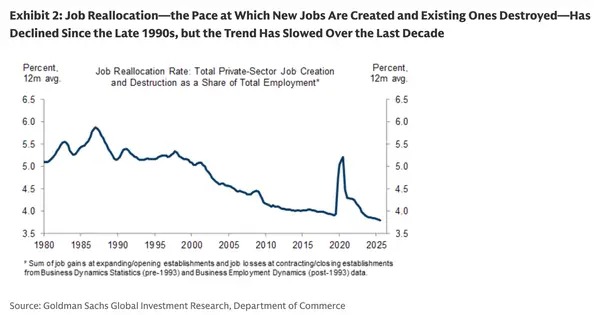
Goldman Sachs estimates that the low turnover rate has dragged down annual wage growth by about 0.3 percentage points. According to data from the U.S. Bureau of Labor Statistics, wage growth has been declining for most of the past five years, with the year-over-year growth rate dropping to 3.1% in October.

Mei indicates that, driven by the aging workforce and improvements in the matching of workers with employers, employee turnover has been declining for decades. This means that, compared to the past, there are fewer layoffs by employers and also fewer workers who resign voluntarily.
Goldman Sachs pointed out that there are two reasons for the recent acceleration in the decline in liquidity:
- The wave of job-hopping during the pandemic has subsided.
- The adoption of AI is also contributing to a reduction in turnover rates. Mei indicates that in industries with a higher adoption rate of AI and greater potential for automation, turnover rates have fallen below pre-pandemic levels.
It is generally believed by the outside world that AI may have a negative impact on workers, as theoretically companies can use this technology to reduce labor costs, thereby lowering the demand for workers in fields with a higher exposure to AI. An analysis by Apollo Global Management shows that the adoption of AI has eroded the salaries of the lowest-income groups: since 2023, the wages of workers in the lowest quartile of income have decreased by 10%.
Goldman Sachs also pointed out that if better labor-capital matching is hindered, productivity growth could also slow down. The bank stated that the ultimate impact could be a slowdown in "human capital accumulation," which means a decline in the long-term ability to create wealth.
In the current challenging job market, employees are now more inclined to keep their current jobs, a trend known as "holding on to jobs" ( job hugging ). According to data from the U.S. Bureau of Labor Statistics, the overall turnover rate has been around 2% in recent years, which is lower than the 3% in 2021.