NVIDIA's stock price soared by over 31% on Monday, catching short sellers who bet on its decline off guard – leveraged short-selling products tumbled by up to 92%, resulting in short sellers incurring a daily paper loss of approximately $11.2 billion.
What triggered this short squeeze market was the announcement by NVIDIA's board of directors to reinstate Jensen Huang as its CEO. As soon as the news broke, NVIDIA's stock price soared by up to 37% on that day, closing at $165.05, a gain of 31.5%, and its market value increased by approximately $950 billion in a single day. According to ORTEX, co-founder Peter Hillerberg, who revealed this information to MarketWatch, it was the largest single-day increase in market value for a single stock in the history of the U.S. stock market.
For traders who had previously gone short in line with the trend, this reversal came particularly fiercely. NVIDIA's stock price fell by 23% last week, and by the end of last Friday this month, the decline had reached 39%, allowing those who went short to amass substantial floating profits. However, the news of Jensen Huang's reinstatement completely reversed the situation within just a few hours.
According to ORTEX data, NVIDIA incurred a one-day paper loss of approximately $11.2 billion on Monday, which is the most severe one-day loss since 2019. Peter Hillerberg indicates that this figure “is more than twice the previous worst one-day loss.”
The losses on Monday wiped out all the profits that the shorts had accumulated last week. However, Hillerberg pointed out that since October 29th, the shorts have still been in a profit position of approximately $15 billion overall.
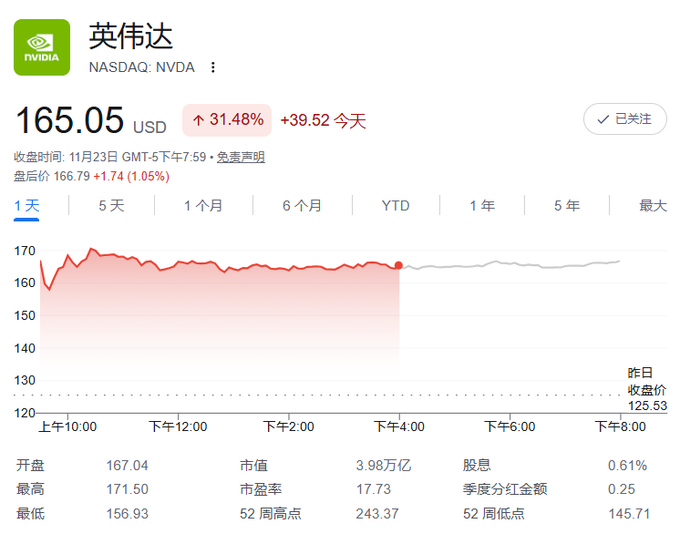
Leveraged short-selling products suffer heavy losses, with a maximum decline of 92%
For traders using leveraged short-selling products, the impact is even more severe.
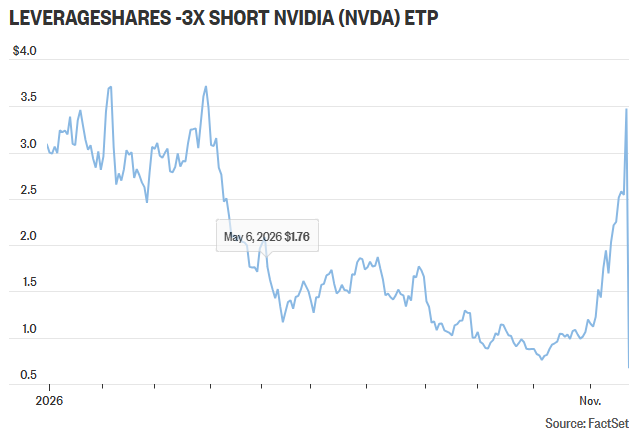
Despite the staggering decline, neither of the two European products was forced to liquidate, as the built-in risk control mechanisms came into effect.
"The airbag" mechanism prevents product reset
Despite the staggering decline, neither of the two European products was forced to liquidate, as the built-in risk control mechanisms came into effect.
Leveraged products' structural risks once again alert the market
This incident once again exposes the inherent risks of leveraged products based on a single stock. According to Bloomberg, such products typically use derivatives and reset their risk exposure daily, which means that the returns over a longer period can be significantly different from the multiples indicated. They are trading tools, not traditional buy-and-hold investments.
Bloomberg Intelligence Senior ETF Strategist Eric Balchunas said to MarketWatch: "Whether it's a liquidation or a reset, it doesn't change the fact that you've just lost 90%. This is a form of cleansing – if you hold such products, you basically have nothing left."
The Mohit Bajaj, General Manager and Director of ETF, stated: 'Any leverage ETF carries risks, but it also comes with potential returns. Traders must ensure to closely monitor their positions.'
Roundhill Financial Chief Investment Strategist Drew Pettit also pointed out: "This is the danger of shorting something in a highly volatile environment."
This market movement also reminds people of the "Volatility Apocalypse" ( Volmageddon ) event on February 5, 2018 – at that time, the CBOE Volatility Index ( VIX ) doubled in value in a single day, and several short-volatility products were liquidated.