Jensen Huang's reinstatement triggered an epic short squeeze in the U.S. stock market, but Nomura warns: Mechanical rebounds cannot solve structural problems.
On Monday local time, NVIDIA's board of directors announced that Jensen Huang would return to the positions of President and CEO. This unexpected press release completely ignited the mechanical buying that had been building up beforehand.
Nomura Securities' cross-asset strategist Charlie McElligott characterized this rebound in the latest report of the day as a combination of multiple mechanisms: put option hedging positions becoming ineffective, short sellers being forced to stop losses, and trend-following funds shifting to a bullish stance. He summarized the day's market movements in one sentence:
Hedging positions evaporated, shorts faced stop losses, and the S&P soared, chasing upward momentum.
At the same time, Nomura estimated that the passive rebalancing buying volume of leverage ETF before the close of trading on that day reached as high as $41 billion, making it the second-largest single-day purchase in history.
However, McElligott also warns that mechanical rebounds cannot eliminate structural pressures at the macro level: financial conditions are still tightening, there has been no dovish shift from the Federal Reserve, and the risk of deeper-level asset allocators "withdrawing" remains unresolved.
The premise for this rebound is the accumulated momentum for recovery that has built up after the market deteriorated severely over the past few weeks.
Last week, the S&P 500 index fell by 8.6% on a weekly basis, marking its worst performance since the tariff disputes last year; the Nasdaq 100 index tumbled 10%, experiencing its largest weekly decline since March 2020; NVIDIA's stock price plummeted by 23% that week, the biggest weekly drop since October 2008; the VIX Panic Index briefly broke through 40, for the first time since April 2025.
Goldman Sachs economists estimate that financial conditions have tightened by about 100 basis points since the beginning of this year, with just last week alone contributing more than 40 basis points to that tightening. According to Goldman Sachs' statistics, the market value of NVIDIA alone evaporated by $2.7 trillion within six weeks.
McElligott explains that when the stock market becomes the core mechanism for transmitting the tightness or looseness of the U.S. economic and financial conditions, authorities will only intervene after the situation has truly deteriorated, and their actions will inevitably be aimed at 'boosting the wealth effect.'
American households hold stock assets that are nearly 200% of GDP. This means that for every 10% decline in the stock market, household wealth loses approximately 20% of its value, which is equivalent to GDP. Based on this, McElligott believes that this explains why there has been direct intervention from the political level in response to this market crash.
It is worth noting that this "market rescue" did not involve interest rate cuts, quantitative easing, or liquidity swaps. Instead, it was a direct communication between the then-president and the board of directors of a listed company, as well as a national security designation backed by Washington for a certain entity identified as CEO. Goldman Sachs' Anton Tran commented on this as follows:
It's still uncertain whether having one's market fate tied so closely to one's personal fate is a good thing or a bad thing.
The first driving force behind this significant increase comes from the structural squeeze in the derivatives market.
As outlined in McElligott's report last Thursday, at that time the options market makers were in their largest net short position Gamma since 2019. A large number of customers holding put options created a huge short position Delta. Once the implied volatility stopped rising, market makers would be forced to buy back the futures positions they had previously sold to hedge their positions. On Monday, this mechanism was forcibly triggered.
According to Nomura's intraday data on that day, VIX fell by 7 points to 28.9, while the NASDAQ 100 index rose by 6.7%; VIX near-month futures fell by 4.4 points to 24.1; the implied volatility of NASDAQ, VXN, plummeted by 9.7 points to 35.5; and the volatility indicator of volatility, VVIX, tumbled by 20 points to 118.
The S&P 500 index directly broke through the upper limit of the daily straddle options, forcing market makers to repurchase futures on a large scale, creating a purely mechanical buying pressure.
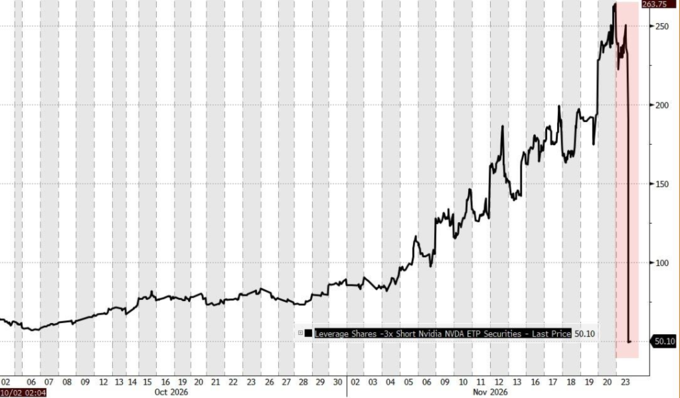
Meanwhile, short sellers suffered heavy losses. According to a fund flow report by Goldman Sachs John Flood, hedge funds re-established their total exposure on the largest scale in over four years last week, focusing mainly on short selling macro products, with the long-to-short ratio dropping to its lowest level on record. At the same time, NVIDIA's 3x short position on ETP plummeted by more than 91% within seconds after the market opened before trading began.
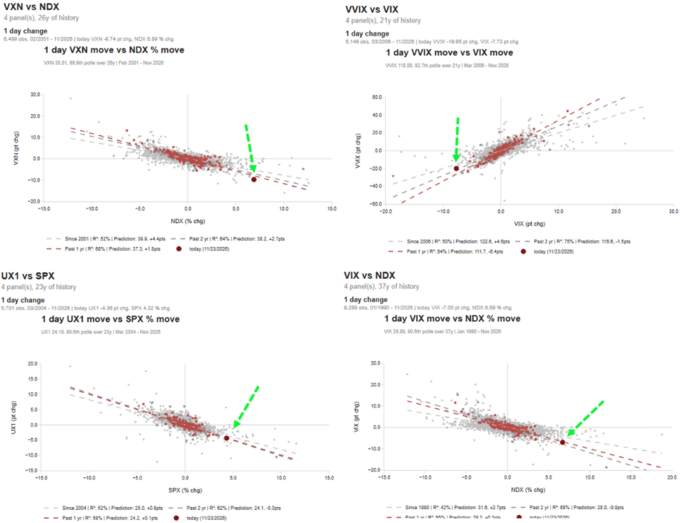
It is worth noting that although panic levels have clearly eased, VVIX is still more than 6 percentage points higher than its one-year historical relationship with VIX, and is at the 93rd percentile over the past 21 years; VIX itself reported a value of 28.9 against the backdrop of a 5% one-day increase in the S&P 500, placing it at the 91st percentile over the past 37 years. McElligott suggests that market fears have not completely dissipated.
The second round of mechanical buying came from the passive hedging of a systematic trend tracking strategy ( CTA ).
According to the Nomura model, if the S&P 500 index closes above 7,043 points, it will trigger a 12-month window where the net short position shifts towards near-neutral. This window accounts for 46% of the total model weight, and the resulting covering position would amount to $16.1 billion. The NASDAQ 100 index would also trigger a covering position of approximately $2.4 billion. At the global equity futures level, under a +4% impact, the model would need to buy approximately $34 billion in assets.
On Monday, the S&P 500 opened at 7,227 points, and this trigger level was effectively crossed at the beginning of trading, provided that the index remains above that level before closing.
According to Zerohedge, compared to Nomura's estimates last Thursday, the scale of the trigger has significantly expanded. At that time, the global buying volume corresponding to a +4% scenario was 21.1 billion US dollars, which has now increased to 33.6 billion US dollars. The reason is that the sharp declines on Thursday and Friday pushed the S&P signal from a slight bearish to a maximum bearish position; the deeper the selling, the larger the volume of covering purchases.
Goldman Sachs' model also confirms this logic: As of last Friday, CTA had sold $57 billion in the past month and was net short of approximately $19 billion in U.S. stocks, with all scenarios showing net selling; Goldman Sachs' long-term reversal threshold of 7,119 points was also surpassed at the opening of trading.
However, crossing 7043 points only means that the S&P signal has rebounded from -100% to -8%; trend-following funds are merely closing out their short positions, rather than taking a long position. To re-establish a net long position, the model requires 7625 points, and a full position building would occur around 7710 points. There is still a more than 5% increase potential between the opening price of the day and 7625 points, which still relies on other buyers to take over.
On Monday, the most overwhelming passive buying came from the closing rebalancing mechanism of the leveraged ETF.
Such products naturally form a negative "the more it rises, the more I buy" Gamma structure, and rebalancing purchases need to be completed before the daily close.
Nomura's real-time forecasts show that on Monday's close, the total rebalancing purchases amounted to approximately $41 billion, of which about $16.7 billion was in technology stocks, $12.8 billion in semiconductors, $4.2 billion in the "Big Seven Tech Companies," and $4.1 billion in products related to the S&P 500. All these amounts are at the 100th percentile of Nomura Securities' historical database, representing the largest volume ever recorded.
In a backtesting history of over 5,100 trading days, there was only one instance of a larger rebalancing purchase volume, which was $46.5 billion on April 9, 2025, on the day when tariffs were temporarily suspended.
According to data from the person in charge of Goldman Sachs’ ETF business, Chris Lucas, despite the Nasdaq 100 index falling by nearly 20% over 33 trading days, leveraged ETF still recorded a net inflow of $20 billion during the same period. Retail investors continued to increase leverage to buy at low prices, creating today’s group of passive buyers worth billions of dollars. Two weeks ago, when the composite was last estimated, its total size had reached $151.5 billion.
Zerohedge summarizes the three-stage framework of McElligott as follows: a leverage of $41 billion for ETF buying orders, combined with up to approximately $34 billion in CTA covering positions. After deducting $10 to $16 billion that was forced to be sold by volatility control funds due to excessive daily fluctuations, there is already about $60 billion in net passive buying orders in the market before any active investors make decisions.
Despite the rarity of such a mechanical rebound in intensity, most strategists are cautious about its sustainability.
Goldman Sachs strategist Ben Snider believes that for the S&P 500 to reach its true bottom, three conditions must be met simultaneously: first, a catalyst that can rebuild investors' confidence in AI profits; second, a more accommodative macroeconomic environment (such as dovish signals from the Federal Reserve); and third, a significant reduction in positions.
According to this framework, more than half of the three conditions have been met in the past week: The AI catalyst is directly provided by the White House; in terms of positions, hedge funds have significantly reduced their holdings, but according to Goldman Sachs' Lee Coppersmith data, other institutional investors still hold relatively high positions. Deutsche Bank strategist Parag Thatte ranks active investors in the 4th percentile, with overall positions in the 11th percentile, and there has not yet been a widespread sell-off; meanwhile, there is no sign of a dovish Federal Reserve. The market still considers a December interest rate hike as a near-certain event, and Goldman Sachs expects another rate hike in March. A 5% one-day increase in the S&P 500 has objectively relaxed the financial conditions that previously served as a substitute for the Fed's tightening measures.
Historical benchmarks also suggest caution. According to research by Deutsche Bank Thatte, once such volatility shocks occur, it typically takes six to eight weeks for volatility to subside and for the stock market to bottom out. In non-recessionary scenarios, the S&P 500 is also expected to fall an additional 14% to 16% on average.
JPMorgan Chase's market intelligence team adjusted its stance to tactical caution on Monday, referring to the end of 2018 as a benchmark – during that year, the rally on Thanksgiving was followed by continuous selling all the way to Christmas Eve.
McElligott I have also clearly defined the boundaries of the significance of this mechanical rebound: 'This 'mechanical rebound' does not provide any guarantee for the longer-term 'structural forces' that I discussed earlier,' including the tightening of financial conditions, AI the negative impact of reduced capital expenditure expectations on economic growth, and the fact that inflation remains high, forcing policies to remain tight.
His framework points to a more fundamental question: between the reflex of “buying on dips” over the past fifteen years and the recent shift in paradigm towards “protecting principal,” which side will large asset allocators ultimately lean towards? The answer is not to be found in Monday’s closing quotes.