After establishing a dominant position in the obesity market, Eli Lilly is shifting its strategic focus to the oncology field and accelerating this transition with an unprecedented level of mergers and acquisitions.
According to Bloomberg, Jake Van Naarden, the head of Eli Lilly's Business Expansion and Oncology Department, the company currently has eight oncology drugs that are in or about to enter the late-stage clinical development phase, with the potential to be launched over the next five years.
Three of these drugs are expected to yield results from late-stage clinical trials next year, including the oral breast cancer medication Inluriyo — which has previously been approved for use in certain patients with advanced or metastatic breast cancer. The company is currently testing its effectiveness in reducing the risk of recurrence in early-stage disease.
This will directly compete with Roche's ( Roche Holding AG ) similar drug Wilserdly, which was recently approved by the US Food and Drug Administration ( FDA ) on Monday for use in patients with early-stage breast cancer.
At the mergers and acquisitions level, Eli Lilly has spent over $20 billion this year to complete a series of transactions, significantly exceeding the company's internal targets and far surpassing the merger and acquisition scale of about $4 billion set for 2025.
Van Naarden indicates that the substantial cash flow generated by the obesity business provides the company with the confidence to more boldly pursue high-value assets. The broader strategic goal is to reserve momentum in advance for any potential slowdown in the growth of the obesity business by the 2030s.
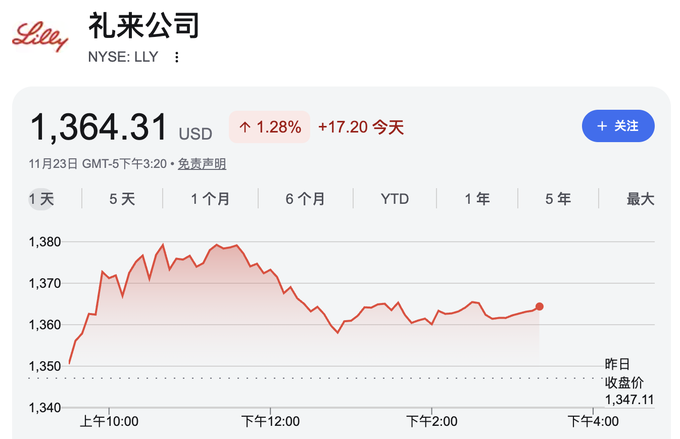
As of press time, Eli Lilly rose by 1.28% on Monday.
Tumors become “the next pillar”
In an interview at Bloomberg's New York headquarters on Monday, Van Naarden stated: "Tumors could be Eli Lilly's next pillar of growth."
Of the eight candidate tumor drugs, half were developed internally, and the other half came from external acquisitions. Apart from Inluriyo, two other drugs that are expected to have phase late data next year are the experimental lung cancer drug olomorasib and sofetabart and mipitecan for ovarian cancer and endometrial cancer, respectively.
Van Naarden indicates that he hopes the latter will ultimately be able to replace the chemotherapy regimen for some patients.
In the field of breast cancer, Inluriyo and Roche's Wilserdly both belong to the new generation of oral selective estrogen receptor degradators (SERDs), and they work by blocking the signals that promote the growth of certain types of breast cancer. Both target the early-stage breast cancer market, and the competitive landscape is becoming increasingly clear.
Mergers and acquisitions this year exceeded $20 billion, with a significant acceleration.
Eli Lilly has significantly increased its investment in mergers and acquisitions this year.
In April of this year, the company announced the acquisition of Kelonia Therapeutics for up to $7 billion, obtaining an experimental CAR-T therapy. This therapy does not require modifying patients' immune cells in vitro as traditional CAR-T therapies do; instead, it modifies the cells directly within the body.
Eli Lilly plans to advance this technology to the clinical research stage for lymphoma in the near future, further expanding the indications based on its existing multiple myeloma projects.
In July, Eli Lilly acquired the psychedelic drug developer AtaiBeckley Inc for up to $3.8 billion, positioning itself in the field of neuroscience and gaining access to an experimental nasal spray for treatment of refractory depression.
Van Naarden indicates that, compared to other psychedelic drugs currently under development, this drug requires fewer treatment sessions and a shorter course of therapy, offering greater convenience in use.
In terms of mergers and acquisitions strategy, Eli Lilly intends to shift the focus of its investments from the early research phase to experimental drugs that have shown potential in human trials, in order to increase the chances of success.
Obesity business provides financial support, with a strategy that goes beyond a single niche market.
Lilly's robust obesity business is the financial foundation for its major acquisitions, but the company does not intend to concentrate its resources in this area.
Van Naarden indicates that, as Eli Lilly has already mastered many of the most promising research and development directions in obesity, its external acquisitions in this area are relatively limited. Instead, more funds have been directed towards fields such as oncology, neuroscience, and immunology.
Behind this layout lies a clearer strategic logic: intensified competition, expiring patents, and pricing pressures may hinder the growth of Eli Lilly's obesity business in the coming years. "We are looking for products that we can launch in the 2030s," said Van Naarden, "and it would be ideal if we could see signs of that as early as possible and take action accordingly."
He also emphasized that Eli Lilly does not avoid risks. "Risk is our friend," he said, adding that the company prefers assets whose potential has not yet been fully recognized by others.