

Jensen Huang suddenly returned to the position of CEO at NVIDIA ( NVDA ), which caused a severe shock to investors who had been betting on the stock's decline. With NVIDIA's stock price rebounding significantly on Monday, some products with two- and three-times reverse leverage suffered nearly devastating one-day losses.
After NVIDIA's board of directors announced the reinstatement of Jensen Huang CEO, NVIDIA's stock price surged by 37% at one point during trading, rapidly reversing the short-selling strategies that had previously profited from selling in the artificial intelligence (AI) sector. Some inverse leveraged funds experienced a decline of 73% to 92% on that day.
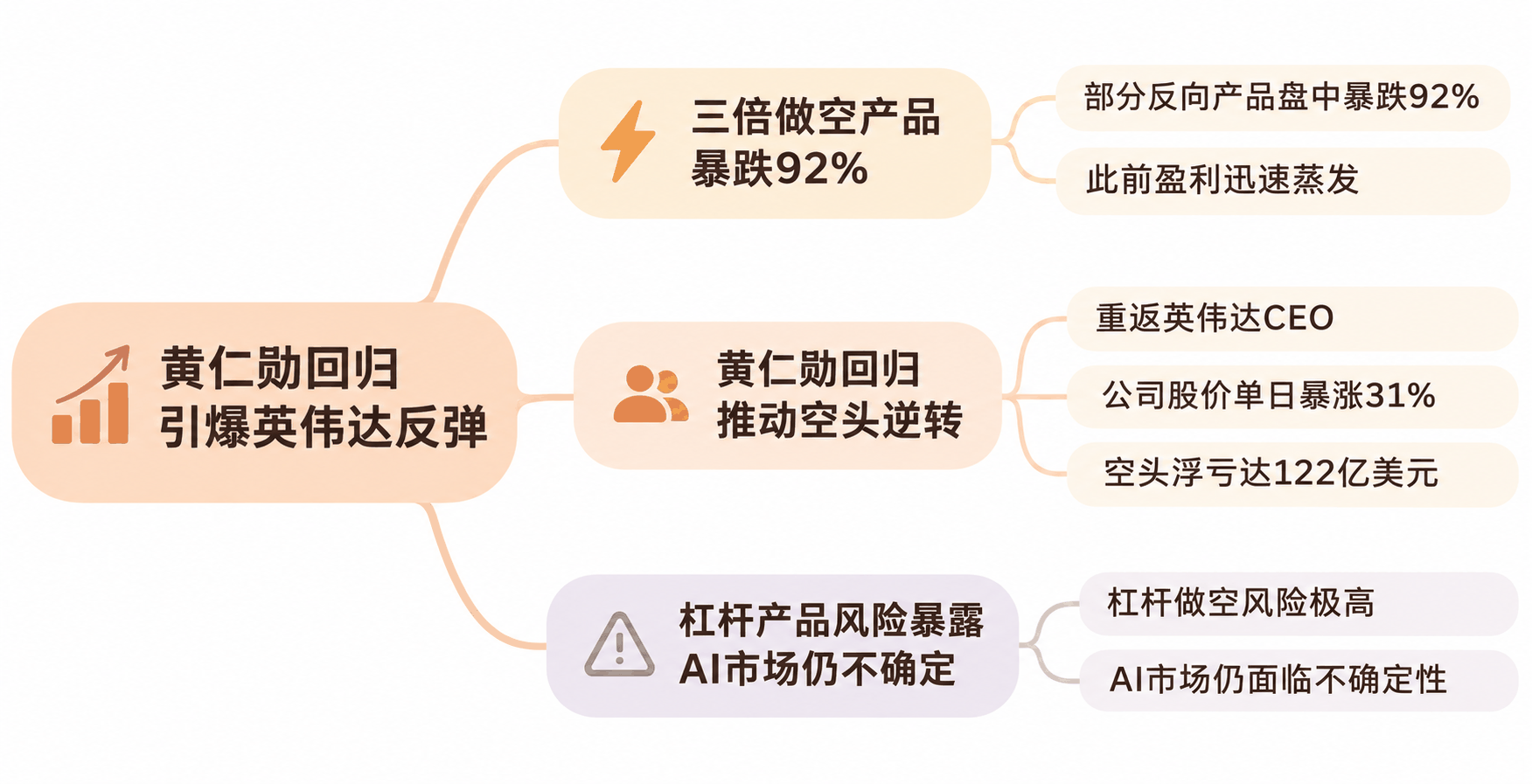
The triple short-selling product plummeted by 92%, with previous profits evaporating rapidly.
During the previous continuous sell-off of tech stocks, this strategy performed exceptionally well. As of last Friday, NVD had accumulated a gain of 46% for the year. However, in just one trading day, the market trend reversed.
Calculated based on a simple leverage ratio, if a stock rises by more than 33.3% in a single day, without any protective mechanisms and with a fixed three-fold short position maintained, the related products could theoretically suffer a loss of their entire net value. However, the actual trading results are also affected by factors such as daily leverage resets, intraday risk control mechanisms, and derivative pricing.
Jensen Huang's return has triggered a reversal for the bears, with estimated floating losses reaching $12.2 billion.
The direct cause of this market reversal was a sudden change in stance by NVIDIA's board of directors. On November 12th, Jensen Huang resigned from his position due to a personal relationship controversy, which quickly intensified market concerns regarding the stability of NVIDIA's leadership and the future prospects of the AI industry. NVIDIA's stock price fell by 23% last week, with a cumulative decline of 39% for that month.
On Monday local time, NVIDIA's board of directors suddenly announced that Jensen Huang would immediately resume his CEO position. The company stated that, after obtaining relevant opinions from senior U.S. government officials, the board believed that his return would not pose any security risks. This decision also received support from U.S. President Donald Trump, as well as some investors, employees, and individuals in the tech industry.
After the announcement of the news, NVIDIA's stock price quickly rebounded, driving up the entire AI sector. NVIDIA closed Monday with a gain of about 31%, helping the company to restore a market value of over $900 billion.
Short sellers suffered significant losses. According to financial data institution ORTEX, based on NVIDIA's stock price of $168.50, the related short positions faced a paper loss of approximately $12.2 billion on Monday, which represents the largest single-day loss since at least 2019, exceeding the $10.5 billion in paper profits that short sellers made last week.
However, ORTEX pointed out that since October 29th, NVIDIA's shorts have still accumulated approximately $14 billion in book profits overall.
ORTEX Co-founder Peter Hilberg ( Peter Hillerberg ) stated that the proportion of NVIDIA's tradable shares that were short-sold is only slightly over 1%. Therefore, this rise is more of a concentrated market reaction to the news of Jensen Huang's return, rather than a forced buying situation driven entirely by short sellers covering their positions.
Leveraged product risks are exposed, and the AI sector still faces uncertainties.
The sharp reversal in NVIDIA's stock price once again highlights the risks faced by leveraged funds that focus on a single stock. Unlike ordinary ETF, leveraged and inverse leveraged products typically achieve their daily target returns through derivatives and readjust their risk exposure every day. As a result, their long-term cumulative performance may differ significantly from the double or triple returns that investors simply calculate.
When volatility is high and the market reverses frequently, continuous daily resets may also exacerbate net value losses.
Mohit Bajaje, Business Managing Director of WallachBeth Capital ETF, stated that the potential returns of leverage ETF are always accompanied by corresponding risks, and traders must continuously monitor their positions.
However, Jensen Huang's return does not mean that all the risks associated with NVIDIA and the AI industry have been eliminated. Investigations surrounding NVIDIA are still ongoing. At the same time, market concerns regarding the huge capital expenditures on AI data centers, debt financing, and future investment returns will not disappear automatically just because of a change in management.