

XRP Speed up your pace
Monero becomes a short-term focus
Will Dogecoin make a comeback?
With a deeper correction in the cryptocurrency market, we have finally seen a certain rebound in several of the top 15 digital assets, including XRP, Monero, and Doge Coin.
The network usage of XRP has increased compared to October. Monero has gradually outperformed the market in the past 24 hours, while Dogecoin is attempting a partial price recovery, although the increase is not significant.
An important development that was not anticipated earlier is that Jensen Huang returned on November 23 to take on the role of CEO at NVIDIA ( NVDA ), just 11 days after he resigned. This news triggered a significant rebound in the market; the stock price of NVDA rose by over 30%, and NASDAQ increased by about 6.8%, recovering a considerable portion of the losses from last week.
XRP Speed up your pace
Fortunately, XRP has demonstrated resilience beyond conventional market indicators: the average number of payments this month has exceeded 1.1 million per day, representing a 107% increase from the October baseline. There is a solid foundation behind this turnaround: increased market volatility triggered a significant decline in this asset earlier on.
Under the rapid fluctuations in the market, it is not surprising that this asset recorded over 1.33 million transactions in the first 7 days of this month. According to the XRPScan query from November 23rd, 4,065 new wallets were added within a 24-hour period.
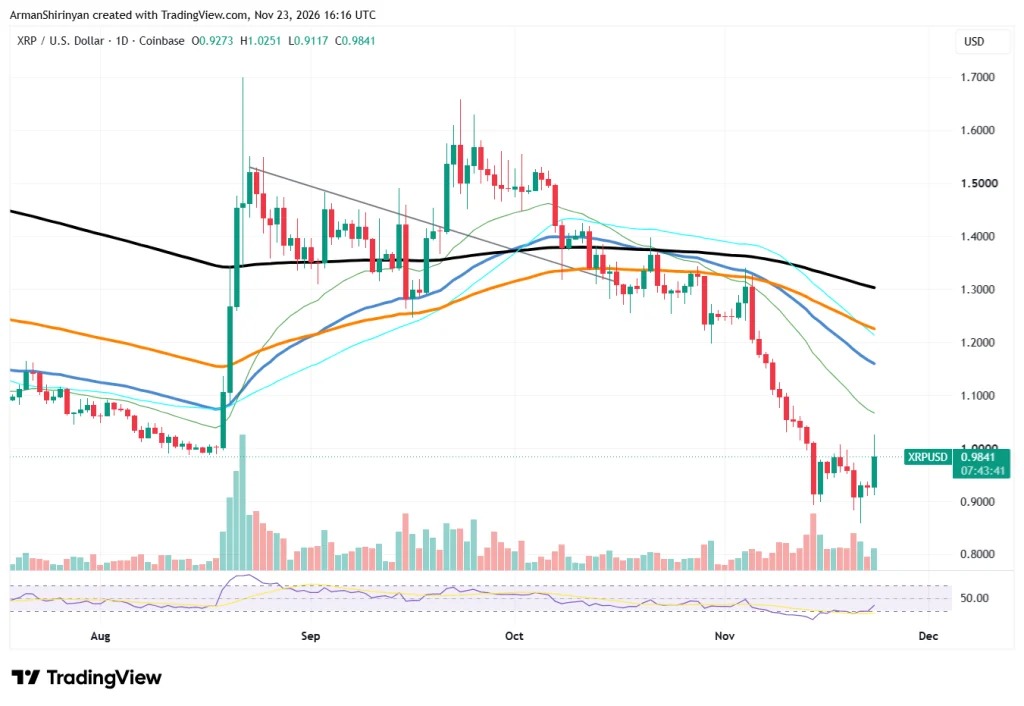
From a technical perspective, XRP is currently trading around $0.99, which is about 23% lower than the 30-day average, in line with the previously mentioned bearish narrative. The decline in spot trading volume is also an important signal: throughout the month, the trading activity of spot investors has decreased by approximately 22.5%.
The decline in futures trading volume also makes the situation more complex than it appears on the surface. After the price fell, volatility increased along with a rise in open contracts. Therefore, the current decline is more like a return to the baseline rather than the problem itself.
The current resistance and support levels are relatively scattered and have not been fully tested, except for the local support level of $0.9. The next immediate breakout test is likely to occur around $0.99, with the possibility of further consolidation. $1.00 is more of a psychological barrier, while $1.04 should be regarded as the threshold for the end of the downward trend.
Monero becomes a short-term focus
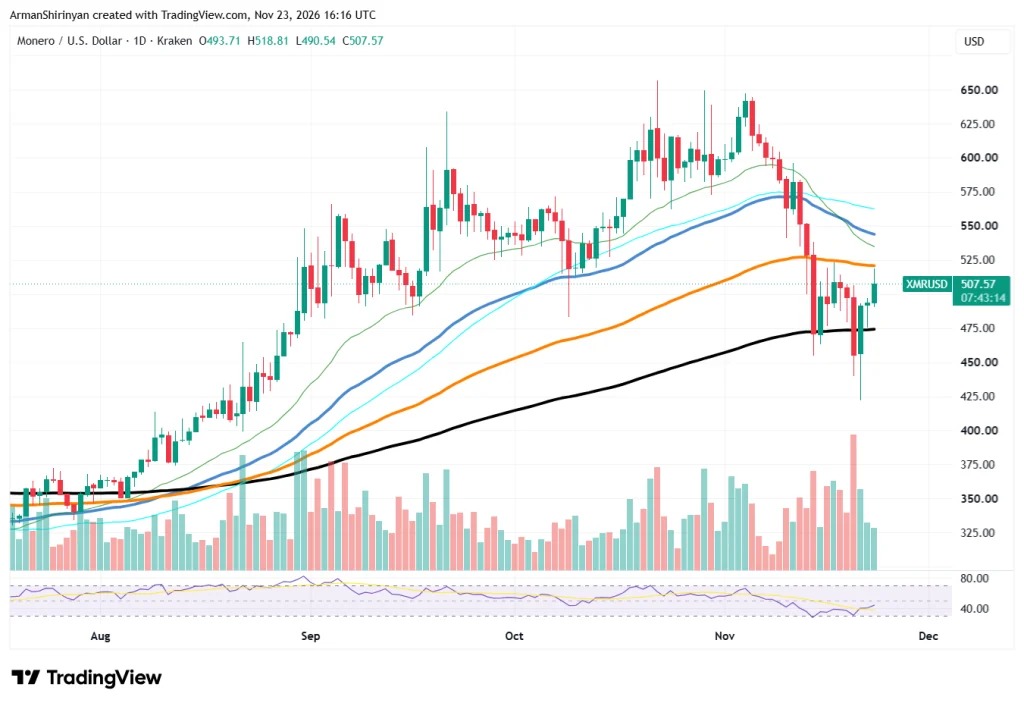
According to the data from CoinMarketCap, in the past 24 hours, Monero has consistently lagged behind XRP and Dogecoin. However, it is necessary to distinguish between increasing demand and active speculative buying. Within the past 24 hours, the price of Monero has risen by more than 4.7%. The number of open futures contracts has exceeded 230 million US dollars.
As mentioned earlier, Monero is the weakest among the three, with a gain of 4.7% in the past 24 hours. However, upon closer inspection, a series of issues become apparent: both spot and futures trading volumes, open interest, and the amount of margin calls indicate that the current market is quite sluggish and lacks momentum, rather than showing a explosive recovery that could lead to a genuine upward trend. The good news is that most of the positions that were liquidated came from the short side.
From a network usage perspective, Monero has been struggling, with the number of transactions falling below the 30-day average, which indicates that the current price resilience lacks a solid foundation. However, due to the existence of transaction protection mechanisms in Monero's network design, it indeed limits the possibility of a comprehensive analysis by outsiders.
The most significant development surrounding Monero is, of course, the recent Wrapped Monero incident. Although this wrapped token itself has little to do with the mainnet of this asset, Monero itself still had to endure the selling pressure that spread from it. The value of this token dropped by over 99%, resulting in a loss of 13 million US dollars.
Monero's mainnet itself completed a security audit on November 18th, and no high-risk or medium-risk vulnerabilities were found. Only some minor security issues were identified, and the developers have been notified accordingly.
If technical analysis is still important, then the most critical short-term price range is between $508 and $510, which corresponds to the current breakout area; the nearest support level is at $500.
Among these three cryptocurrencies, Monero is the only one that has shown some positive performance over the past 7 days, despite the token encapsulation incident. Privacy-oriented assets such as XMR or Zcash tend to be more resilient during market downturns. The author believes that this is likely due to the persistent demand for privacy in the industry.
Will Dogecoin make a comeback?
Dogecoin's technical repair attempts are encountering some resistance. The daily, weekly, and four-hour trends all show clear bearish dynamics, and the price has fallen below all 8 moving averages tracked on the chart.
CoinGlass Data shows that the current trading activities are quite divergent: both spot and futures trading volumes are declining, while the number of open contracts has increased slightly. Futures trading volume amounted to 584 million US dollars, and spot trading volume was 86 million US dollars. The scale of margin calls for long and short positions is roughly balanced.
Unfortunately, insufficient online activity indicates that there is a lack of foundation for price corrections in the current market: only 37,000 addresses have been active in the past 24 hours, which is a 24% decrease from the beginning of the year to date. In addition, browser data shows that the top ten addresses of DOGE hold more than 44% of the circulating supply.
This does not mean that only 10 users hold the majority of the token supply, but rather that DOGE has a high concentration in the exchanges, which often leads to additional selling pressure.
In a situation where both trading volume and open interest are low, any technical price level, whether it's a resistance level or a support level, can quickly become ineffective; however, it is still meaningful to identify these levels as references. The first resistance level is at $0.0599, and the threshold for trend reversal is around $0.06.
The support level has continuously declined to the important psychological barrier of $0.05, with the most recent support level at $0.054. The obvious trend reversal threshold is of course $0.06. Before the price stabilizes at this level, discussing a recovery is not the best option.