

Wall Street hedge funds are further withdrawing from stocks that previously performed strongly. As assets related to artificial intelligence continue to decline, momentum trading, which was once sought after by institutions, has seen a clear reversal, and some funds have begun to shift from betting on rises to taking a net bearish stance.
Morgan Stanley's latest principal broker business data shows that hedge funds have now turned net bearish on momentum factors for the first time since April 2025. This change comes amid ongoing adjustments in global tech stocks and a rapid decline in fund leverage levels.
So-called momentum trading refers to buying stocks that have performed strongly over a certain period of time and selling stocks that have performed weakly, in order to continue the market's existing price trend.
In the past few years, artificial intelligence, semiconductors, and large tech stocks have been significant beneficiaries of related strategies. However, as the investment returns of AI have come under question and expectations for interest rate hikes by the Federal Reserve have risen, the previously crowded trading landscape is rapidly reversing.
Hedge fund net leverage drops to 41%
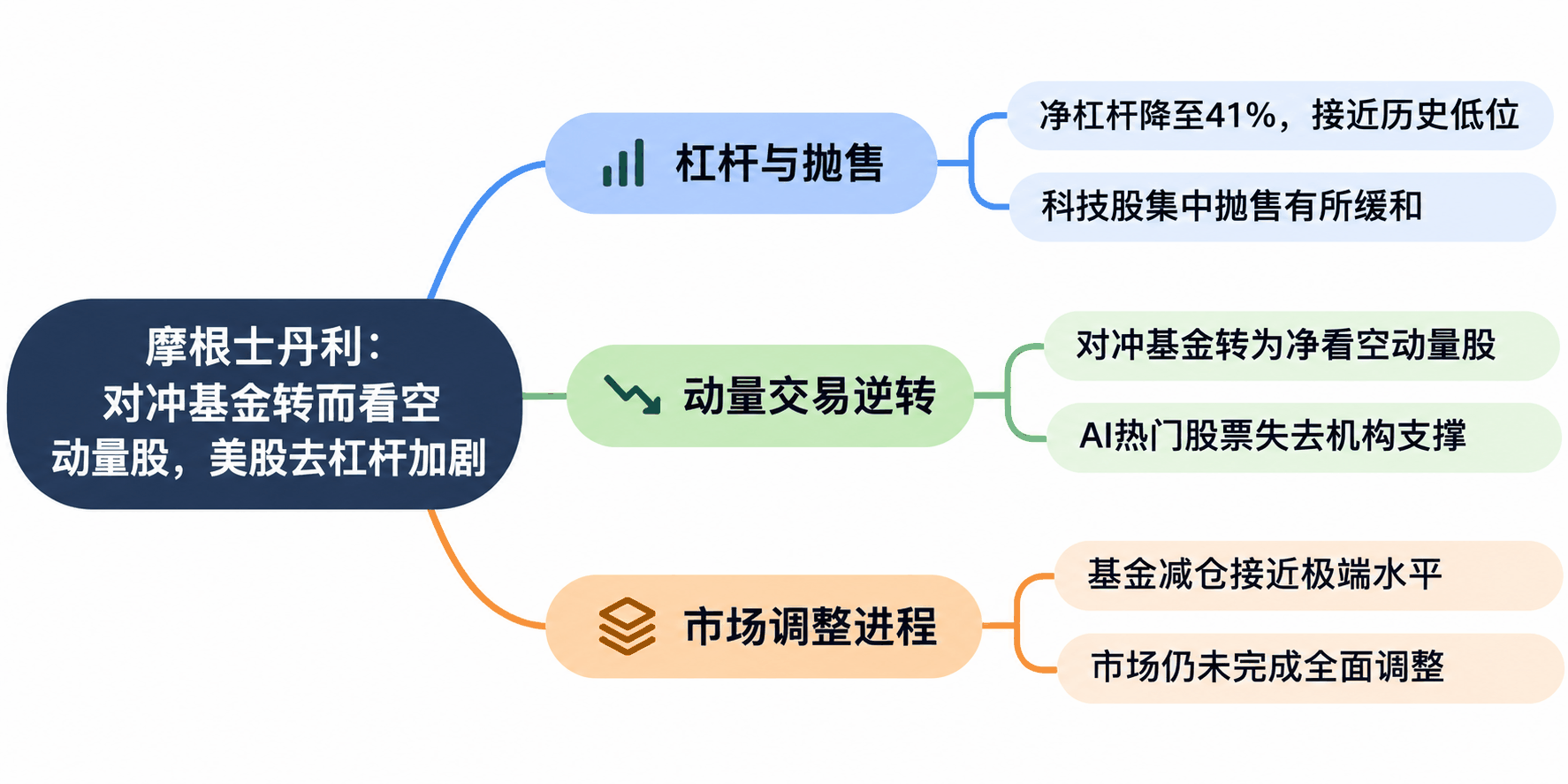
Morgan Stanley data shows that as of November 19, the net leverage ratio of U.S. equity long-short hedge funds had dropped to around 41%, a decrease of 5 percentage points from the previous week, and is near the 6th percentile of the historical distribution since 2010.
During the same period, the total leverage ratio of the fund decreased by 4 percentage points to 195%. Both indicators fell to their lowest levels in the past 12 months.
This reflects that institutional investors are not only reducing their long stock positions but also shrinking the overall size of their portfolios in order to cope with market volatility.
In terms of regional distribution, hedge funds in the United States, Asia, and Europe all exhibited net selling.
Among them, the total leverage ratio of Asian funds dropped to around 121%, hitting a five-year low. Semiconductor, hardware, and internet stocks accounted for approximately 75% of the recent selling volume in this region.
However, Morgan Stanley also observed that the pace of the latest round of deleveraging has slowed down compared to before.
In the U.S. market, hedge funds have recently mainly sold index products, energy, and financial stocks, while the large-scale selling in the technology, media, and telecommunications sectors that persisted for several weeks prior has eased.
This means that institutional investors have entered a deeper phase of reducing their holdings in tech stocks, but the behavior of risk aversion is spreading to other industries.
Momentum trading reversal
The continuous adjustment of tech stocks is an important reason for hedge funds to change their trading directions.
Recent data from Morgan Stanley shows that hedge funds' net exposure to the tech industry is about 22.5%, which is in the lowest 1% range of the past year.
In contrast, the relevant holding indicators in the healthcare sector are at their highest levels in the past year.
At the same time, funds maintain a small net short position in the consumer staples sector, indicating that not all institutions are uniformly increasing their holdings of traditional defensive stocks.
Goldman Sachs' principal broker data also shows that positions in momentum factors have undergone significant adjustments.
In June this year, the momentum exposure of some fundamental stock long-short funds reached a high of around 70%, and since then it has continued to decline. It is now back below zero, at its lowest level since the end of 2022.
This change indicates that funds no longer generally bet that stocks that had seen the largest increases before will continue to lead the market.
However, simply looking at the bearish momentum factor does not mean that the fund is short-selling all tech stocks. The related exposures reflect an overall bet on the investment factor of stock price trends, rather than a unified judgment on a single industry or company.
Over the past week, market adjustments have further intensified.
The Nasdaq 100 index has fallen by approximately 10% cumulatively, recording one of the worst single-week declines since 2020, with a total retracement of nearly 20% from its historical high in October.
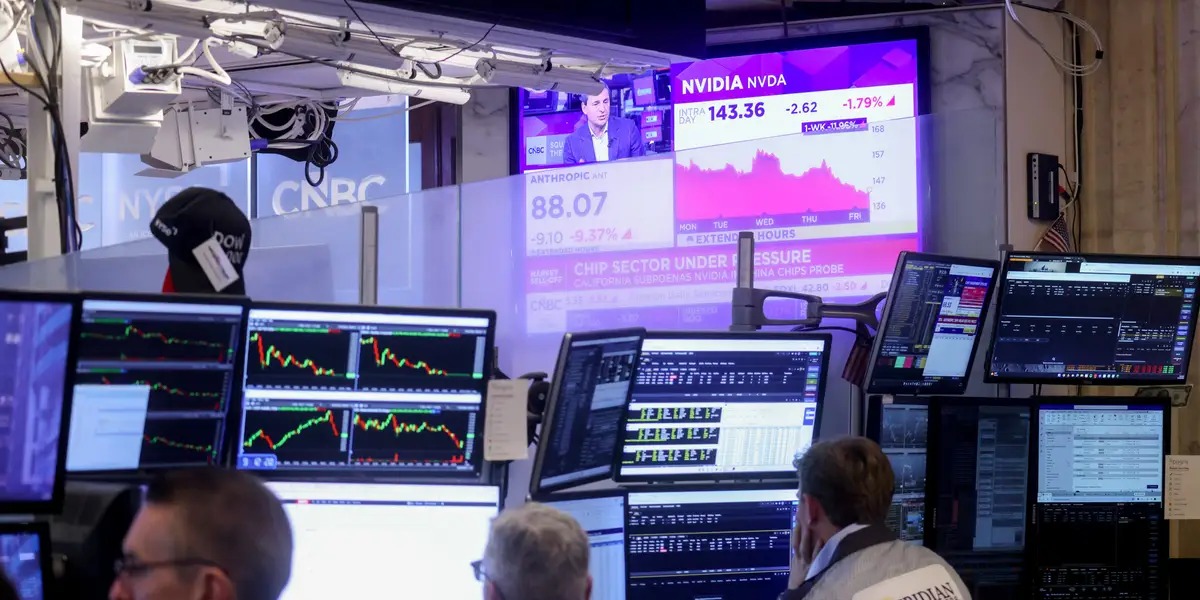
NVIDIA's stock price fell by about 23% in a single week. Despite its latest financial report showing strong growth, investors' concerns regarding AI infrastructure financing, regulatory risks, and the sustainability of future profits have not eased.
Fund reductions approach extreme levels
Hedge funds continue to reduce leverage, which has also sparked discussions in the market about whether the selling spree is coming to an end.
Goldman Sachs' latest data shows that its Volatility Panic Index rose to 9.8 last Friday, approaching a full score of 10 points.
According to this statistic, hedge funds have been net sellers of global stocks for the third consecutive week, with the weekly short-selling volume of individual U.S. stocks reaching its highest level since June 2022.
However, Goldman Sachs also pointed out that there has not yet been a situation where all investors withdraw simultaneously from the stock market.
Despite hedge funds significantly reducing their risk exposure, other institutions and individual investors still maintain a relatively high allocation to stocks.
Data shows that since the fourth quarter of this year, U.S. equity mutual funds and ETF have attracted a total of nearly $170 billion in capital inflows.
This phenomenon has led to a clear divergence in the market: some short-term trading funds have significantly reduced their leverage, but long-term investors have not yet withdrawn in the same proportion.
Goldman Sachs' trading team believes that the recent sharp decline may present opportunities for a temporary rebound, but the Federal Reserve is still in an interest-rate hike cycle, which is different from historical situations where markets rebounded rapidly thanks to loose monetary policies.
This study shows that during periods of interest rate hikes by the Federal Reserve, following five historical episodes of extreme panic, the S&P 500 index only rose by an average of 0.4% in the following three months, which is significantly weaker than its performance during times when monetary policy was paused or shifted towards easing.
Morgan Stanley also believes that the subsequent market trend will be influenced by economic growth, corporate profit expectations, and Federal Reserve policies.
Currently, some funds have reduced their positions to levels close to historical extremes, which means that if market sentiment improves in the future, covering short positions and re-increasing exposure could drive a short-term rebound.
On the other hand, if the slowdown in AI investment gradually affects corporate profits and the overall economy, industries that have recently received some of this funding, such as finance, industry, and consumption, may also face a new round of adjustments.
Therefore, the shift of hedge funds to a net bearish stance on momentum stocks marks an important change in the trading patterns on Wall Street, which previously relied heavily on the upward trend of tech stocks.
As for whether this change will ultimately be a drastic adjustment of positions or a prelude to a broader market downturn, it still depends on whether the financial markets can regain stability in an environment of ongoing tightening of monetary policy.