On November 23rd, Zhipu (02513. HK) launched its new model GLM-5.4, which includes a subscription system. This model is also integrated with coding platforms such as ZCode and Trae. The quota for users subscribing to V2, V3 and the team version has been increased to 1.5 times the original amount.
According to Zhipu's introduction, GLM-5.4 is the company's first-generation flagship model that adopts the Loop Transformer architecture. The approach involves changing the 28 layers in the GLM-5 base to shared weights and executing two rounds in a loop, thereby increasing the model's computational depth without increasing the number of parameters. The base has approximately 750B parameters.
Zhipu stated that API will be opened after completing the security assessment, and the model weights are planned to be open-sourced.
Compared to the previous generation, the changes in GLM-5.4 are focused on the architectural layer. GLM-5.3 and GLM-5.2 share the same foundation, with improvements in capabilities coming from post-training. GLM-5.4 returns to the foundation for modification, and the second round of iterations builds upon the output of the first round, effectively resulting in a deeper network.
Zhipu explained in its technical blog that the loop structure is not an original invention of the company. The paper Universal Transformer proposed a deep structure with weight sharing in 2018, and it was officially published in ICLR in 2019. "We did not perform pre-training from scratch; instead, we transformed a pre-trained base model into Loop Transformer through further training, achieving an increase in intelligence at a lower computational cost."
The main costs of loop structures are video memory and inference overhead. Zhipu made three modifications for models of the 750B level.
First, it involves writing back progressively gate-controlled by each token, writing the candidate changes from each round back into the residual stream proportionally. The first round establishes a global context state, while the second round is responsible for refining and fully writing the results back.
Secondly, in the KV Cache cross-round sharing mechanism, the sparse KV from the first round is reused in the second round, with only a new sliding window of KV added, without retaining the entire cache. Zhipu claims that this design helps to keep the increase in deployment costs for GLM-5.4 relative to GLM-5.3 under control.
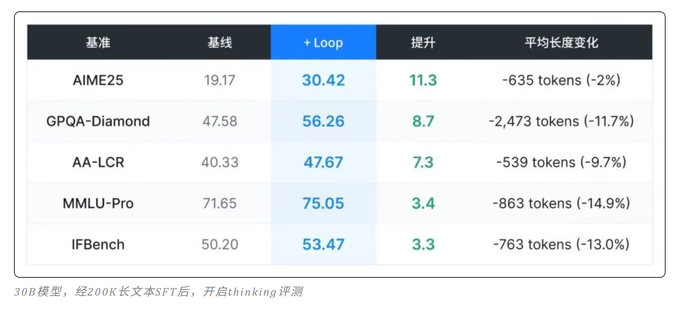
The performance data comes from a comparative experiment with 30B parameters published by Zhipu on their technical blog. The control model has the exact same architecture as the 750B base model. After enabling thinking following training on 200K long texts, the training computation volume increased by about 10%. Once the loop was activated, AIME25 increased from 19.17 to 30.42, GPQA-Diamond increased from 47.58 to 56.26, and MMLU-Pro increased from 71.65 to 75.05.
The output length has also decreased; Zhipu claims that on benchmarks such as GPQA and MMLU-Pro, the average output length has dropped by 10% to 14%. This reduction mainly comes from the thought chain, which means that some of the reasoning has shifted from token to the additional computational depth brought about by loops. As a result, the model can complete its thinking with fewer token.
In terms of speed, GLM-5.4 can reach up to 200 token /s during off-peak hours, and 70 to 80 token /s during peak hours.
Zhipu positions GLM-5.4 as the initiation of "pan-Coding", meaning that this code becomes a fundamental capability for accomplishing a wider range of tasks. Examples listed on the technology blog include using front-end code to draw images in real-time and invoking third-party music models to create MV, generating 3D interactive scenes with mathematical geometry and shaders, and completing robotic arm modeling and motion simulation through FreeCAD and Blender.
GLM-5.4 supports image input. The previous generation flagship, GLM-5.3, only supported text input, while the model in the same series, GLM-5.3-Flash, is a native multimodal model.
In terms of boundaries, when GLM-5.4 was launched, no comprehensive benchmark scores were announced, and the 200 real-scenario programming evaluations mentioned by Zhipu did not provide specific scores. The comparative data that can be found currently comes from private tests conducted by individual evaluators and has not been independently replicated.
Previously, cyclic language models in published papers ranged from 1B to 3.5B in scale. GLM-5.4 has pushed this scale to 750B levels. Zhipu mentioned in their blog that whether long-term benefits can continue to increase with the number of cycles and model size remains an unanswered question.
JPMorgan Chase research notes indicate that Zhipu's management expects to launch a next-generation model with significantly larger parameter scale in the fourth quarter. However, Zhipu has not yet confirmed this plan. Subsequently, you can pay attention to the pricing after API is made open and the licensing terms regarding open-source weights and third-party evaluation results.