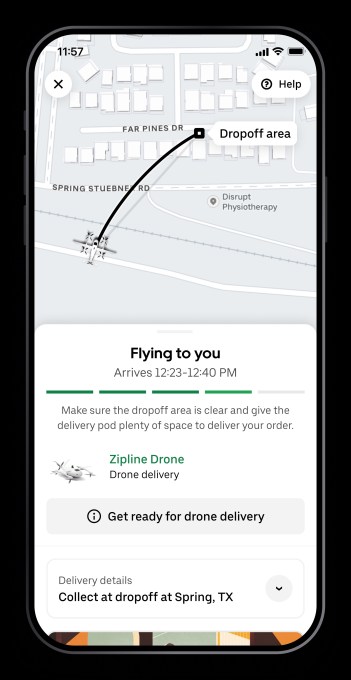
Uber Eats Users can now receive meal deliveries via Zipline drones in the suburbs of Houston, marking the first commercial implementation of this collaboration since it was announced earlier this year.
This business collaboration was launched on Tuesday in Spring Town, Texas ( Spring ), and will subsequently be extended to Dallas. However, the two companies have bigger plans: Uber and Zipline intend to introduce drone delivery services in dozens of other cities across the United States, with the goal of achieving one million deliveries per day by the end of 2029 with the help of this startup's drones.
The long-range autonomous delivery drones of Zipline will be used to deliver Uber Eats food orders weighing no more than 8 pounds, flying at an altitude of about 300 feet and reaching a maximum speed of 70 miles per hour. Zipline The drones do not land; instead, they use a tether to drop the orders, which are contained in small protective pods, at the customer's location.
Users within the service area with the identifier Uber Eats can click on the new “drone” icon on the app homepage to view all restaurants participating in the delivery service. Uber indicates that when the service is launched in the Houston area, multiple national chain restaurants, including those with identifiers Jersey Mike and Zaxby, as well as dozens of local restaurants such as Urban Bird and Abu Omar Halal, will offer drone delivery services.
Zipline CEO and Co-founder Keller Cliffton stated in a statement: "By collaborating with Uber Eats, we will create new expectations for delivery in the United States." This statement also highlights the ambitions of both parties.
These national goals resonate with the ambitions of other drone delivery companies, including Wing under Alphabet and Amazon's Prime Air service. However, these plans have also begun to clash with the concerns of residents in some areas, who complain about the noise, worry that drones may disturb wildlife, and are concerned about potential safety and privacy risks.
Companies that have attempted to scale up in this emerging industry have always believed that drone delivery is a net benefit to society, pointing out its advantages including reducing traffic congestion. Industry supporters argue that customers no longer need to drive to stores to pick up items they forgot to buy or take out food; instead, they can rely on drone delivery.
Although Zipline and other companies have been developing drones for many years, the industry is still in its early stages, and the popularity of related services within the community remains limited.
Zipline was established in 2014 and has developed a drone delivery ecosystem that includes aircraft, landing systems, and logistics software. Initially headquartered in California, the company focused on transporting blood in Rwanda before gradually expanding its business to the United States. In 2022, after obtaining the 135 Air Carrier Certification from the Federal Aviation Administration (FAA) of the United States, Zipline saw rapid expansion of its business in the U.S.; this critical regulatory milestone authorized the company to carry out long-distance commercial drone deliveries.
The collaboration between Uber and Zipline goes beyond a mere business relationship. Uber, a giant in the ride-hailing industry, has also made investments in this startup company. Neither party has disclosed the amount of the investment, but Zipline announced last week that the company has completed a round of financing led by Paradigm, WCM Investment Management, and Layer Global, with a total financing amount of $1.5 billion. Institutions such as Uber also participated in the investment.