Brief
- A wallet related to the Binance hacking incident on October 29th has remained inactive since October 30th. On Tuesday, it sent 34,279.66 ETH to three new addresses, worth approximately 63 million US dollars.
- On-chain data shows that a total of 74,880 ETH, approximately $136.8 million, was transferred from wallets related to the hacking incident. Some of this funds are being exchanged for Bitcoin through Thorchain.
- The U.S. Department of Justice has court authorization to seize or restrict assets worth over $1.2 billion related to this theft case, but transfers between wallets do not imply that the stolen cryptocurrencies have been cashed out.
Wallets related to the $6.3 billion Binance hacking incident began transferring a large amount of stolen Ethereum on Tuesday, breaking a silence that lasted for over two weeks; meanwhile, U.S. authorities are still attempting to recover these funds.
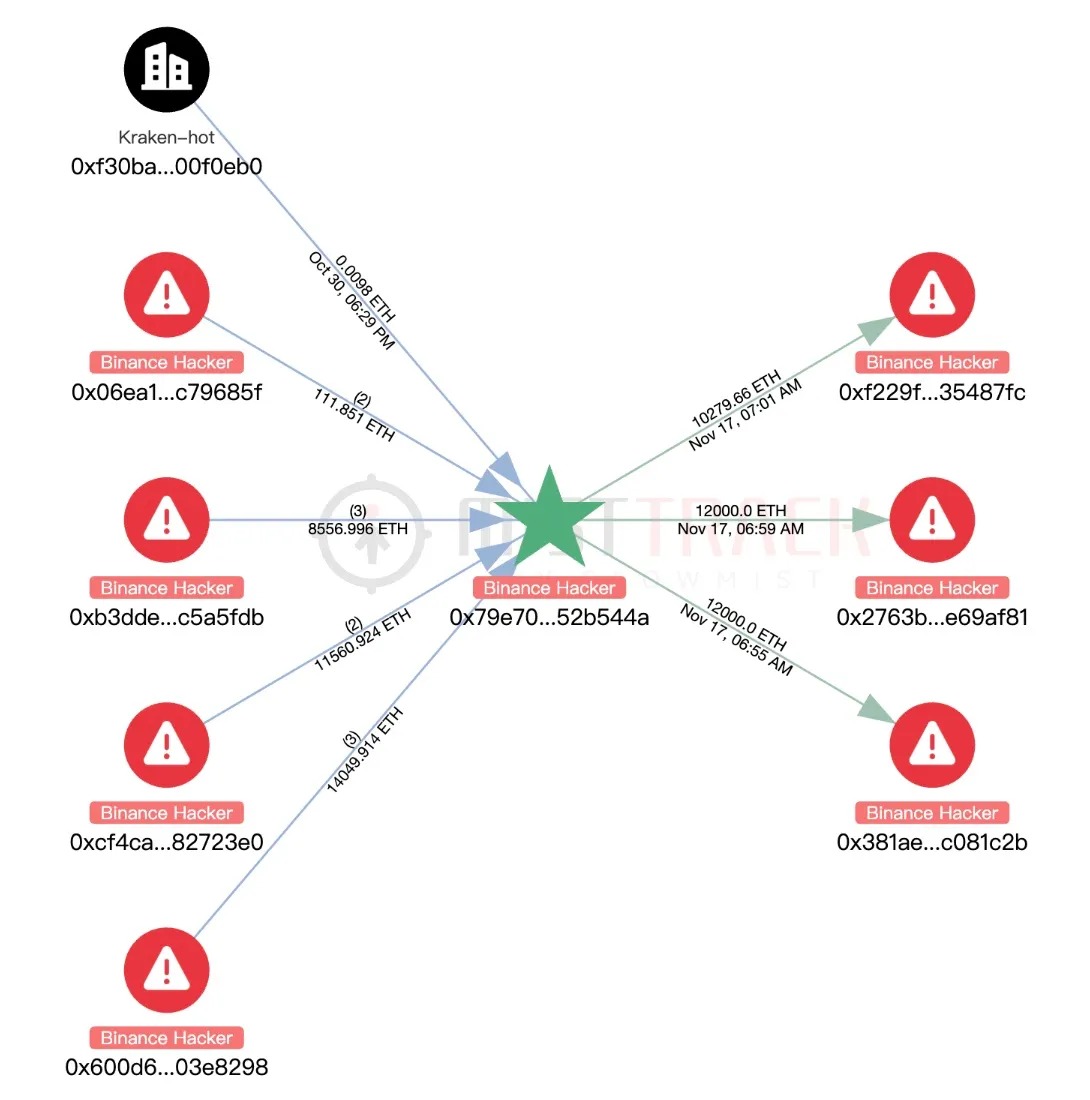
Blockchain security service MistTrack reports that an address related to the theft on October 29th sent 34,279.66 ETH to three newly created wallets, which is approximately equivalent to 63 million US dollars at that time's price. Since October 30th, that address has not transferred any funds again.
On-chain records show that around 7 a.m., UTC had three outgoing transactions: two transactions of 12,000 ETH each, totaling approximately 21.2 million US dollars; the third transaction was for about 10,279.66 ETH, which is roughly 18.2 million US dollars. MistTrack indicates that at the time of the initial alert, the receiving wallet had not yet proceeded to transfer out those Ethereum coins.
This transfer of $63 million was just part of the activities on Tuesday. Another wallet related to the same hacking incident transferred another $40,600.66 ETH, worth approximately $74 million, through five transactions.
Analysis of company Arkham shows that wallets related to this attack transferred a total of 74,880 ETH within about three hours, worth approximately 136.8 million US dollars, and some of the funds began to be exchanged for Bitcoin through Thorchain. Thorchain is a service for transferring and exchanging cryptocurrencies between different blockchains.
Stolen Cryptocurrencies and Frozen Assets
These transfers occurred five days after the Ministry of Justice stated that the courts had authorized it to seize or restrict over $1.2 billion in assets related to the Binance theft case. This amount is part of the more than $2.7 billion in assets that were frozen through a joint effort between the government and the private sector, and it is not an additional recovery based on that.
FBI attributed this attack to TraderTraitor, which it considers to be a hacking operation related to the North Korean military. According to blockchain analysis firm Elliptic, the intrusion on October 29th resulted in the theft of approximately $6.43 billion from Binance across 11 blockchains, making it the largest known cryptocurrency theft case. North Korea denies any involvement.
ETH Price, November 22nd UTC Time: 4:59 PM
Attackers are eager to convert stablecoins into assets that the issuers cannot freeze. While Tether and Circle can block stolen tokens on their networks, ordinary ETH and Bitcoin do not have a central authority that can prevent a specific wallet from sending these assets.
Analysis on November 16th, as indicated by Elliptic, showed that the amount frozen or seized was 2.85 billion US dollars, and it was stated that the majority of Bitcoin and ETH holdings remained in addresses related to the attack. This was before the transfers on Tuesday; these transfers indicate that at least a portion of the previously inactive ETH has begun to move.
Transferring funds does not equate to cashing out.
Investigators have traced the stolen Binance assets through decentralized exchanges, cross-chain transfers, and privacy services. It was found that as of November 16th, approximately $267 million had been converted into Bitcoin, while at that day's price, about $2.55 billion remained in the addresses related to this theft case.
The attackers also dispersed the activities across nearly 27,000 wallets and over 83,000 transactions. This complex trail of funds does not necessarily mean that they have converted most of the stolen assets into cash.