Key points:
- Bitcoin mining farm facilities can be converted into AI data centers
- The infrastructure project budget for Core Scientific reaches $5.5 billion.
- Current power access methods can save time, but not billions of dollars.
Bitcoin mining farms already possess a condition that AI companies desperately need: access to large amounts of electricity. However, transforming these infrastructures into modern AI data centers is far more complex than simply replacing Bitcoin mining machines with NVIDIA GPU.
Core Scientific provided a very representative example. According to its financing disclosure in April 2026, for the six data center projects leased to CoreWeave, with a contract capacity of 590 megawatts and IT, the estimated construction expenditure is about 5.5 billion US dollars.
This is equivalent to about $9.3 million per megawatt, although this figure covers a broader range of development combinations rather than a standardized renovation cost.
Why can't Bitcoin mining farms directly run AI
Traditional Bitcoin mines use specialized ASIC machines that perform repetitive calculations. They require electricity, ventilation, and network connectivity, but compared to high-performance AI computations, their infrastructure is relatively simple.
Modern GPU clusters require a cooling system with even higher standards, high-bandwidth fiber optic connections, advanced power distribution, and a reliable operating environment. Mining farm warehouses may already be connected to power supplies, but they may still need to be extensively rebuilt.
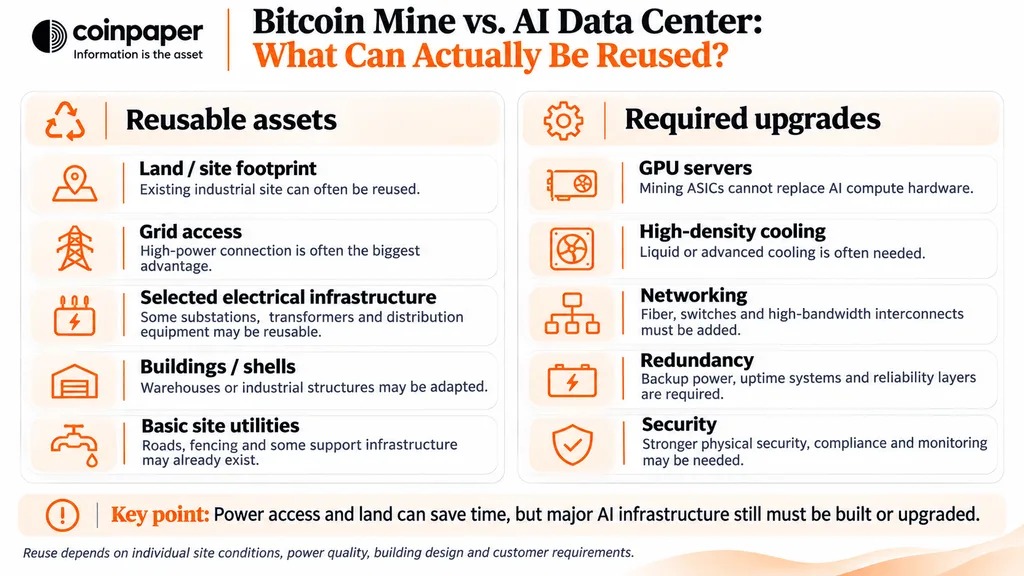
This is also why for Bitcoin miners shifting to AI, what is increasingly valued are land and power infrastructure, rather than the existing mining equipment.
Core Scientific has committed to converting its facilities into high-density hosting infrastructure, while other operators, including TeraWulf and Hut8, are also advancing long-term AI infrastructure contracts.
How much will it actually cost to carry out the transformation?
The development plan for Core Scientific outlines this financial scale. The disclosed construction budget of $5.5 billion covers 590 megawatts, which means that each megawatt contract for IT has a cost of approximately $9.3 million.
The company disclosed separately that the indicative development cost for the expansion of its larger data center portfolio is approximately $11 million per megawatt.
These estimates are not universally applicable transformation prices, and neither of these two figures should be interpreted as including the customer's entire GPU investment.
In their agreement with CoreWeave, for certain facility expenditures, up to $1.5 million per megawatt can be funded by the client, which can later be recouped through hosting fees. Other renovations are directly purchased by CoreWeave.
Another 70-megawatt expansion project also requires Core Scientific to contribute approximately $104 million for the core and infrastructure necessary for power access.
These expenditures explain why the infrastructure financing for AI increasingly involves project debt, long-term leases, and specialized infrastructure investors.
Is it worth transforming Bitcoin mining farms?
For miners, the attraction lies in the predictable customer revenue. The profitability of Bitcoin mining fluctuates with the price of cryptocurrencies, the difficulty of the network, and electricity costs, whereas AI hosting contracts can lock in payments for many years.
Core Scientific stated in a demonstration in November that the agreement with CoreWeave could generate approximately $10 billion in revenue, with an average annualized managed income of around $850 million.
However, expected contract revenue does not equate to guaranteed profits, and construction financing remains a significant commitment.
This difference is important because mining infrastructure stocks are facing concerns from investors regarding debt and development costs, despite the fact that the AI custody revenue is still growing.
This also highlights a key difference between developers and customers. As is evident from the broader AI data center financing model, the companies that provide land and electricity do not necessarily own the GPU facilities, nor do they necessarily bear all of the construction costs.
Adrian Cole
Adrian Cole has been engaged in financial market reporting for over 6 years, with a focus on cryptocurrencies, stocks, and macroeconomic trends. He tracks Bitcoin, major altcoins, the U.S. stock market, interest rates, commodities, as well as data that drives market changes. Over the years, he has written hundreds of market updates and analysis articles, with an emphasis on price trends, investor sentiment, and the connections between traditional finance and digital assets.