


After the price of Ethereum fell below the psychological support level of $2,000, it has since struggled to hold within the $1,900 range.
Ethereum's decline was driven by multiple factors, including the ETF redemption, large-scale selling by institutional investors, and massive liquidations in the derivatives market.
Currently, the support level of $1,829 is of vital importance for ETH. If buyers fail to hold this level, prices could further decline to $1,725; however, if they manage to rebound above $2,000, that could bring some relief.
As selling pressure continues to drag down the broader market, it remains difficult for Ethereum prices to recover above the $2,000 level. The continuous outflow of spot Ethereum ETF, sales from wallets associated with the Ethereum Foundation, and large-scale trades by whales have all exacerbated concerns regarding investor confidence. At the same time, liquidations in the derivatives market are also increasing, putting pressure on traders who use leverage.
However, selling off is not the only situation ETH is facing. Online activity remains quite active, which has also raised questions about the disconnect between Ethereum's underlying usage and its recent market performance. With derivative positions weakening and institutional capital flows being closely watched, will ETH be able to stabilize and regain the $2000 level, or will it face another round of decline?
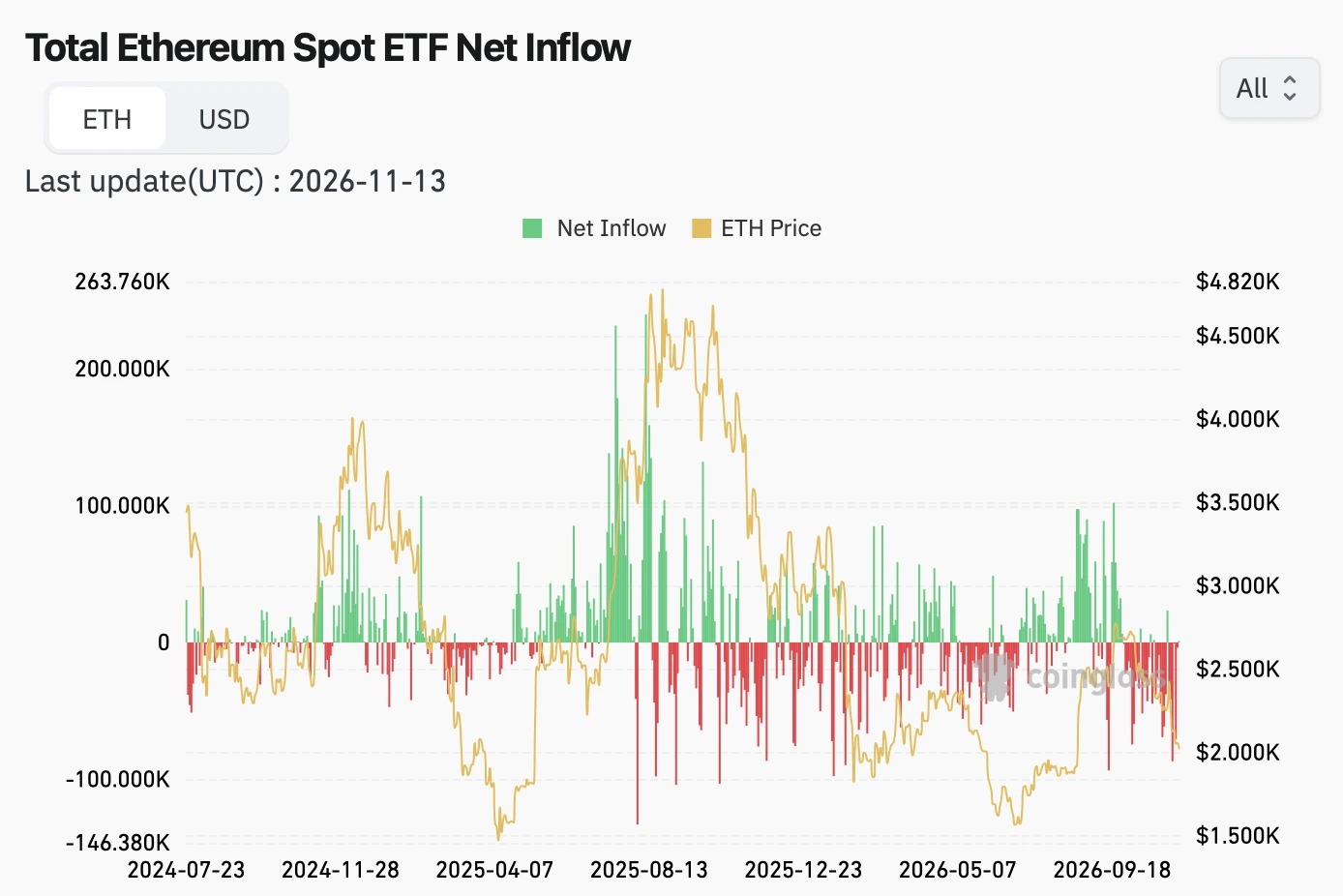
With the outflow of funds related to ETF and an increase in whale activities, Ethereum is facing selling pressure.
The withdrawal of institutional funds has become one of the main sources of selling pressure on Ethereum. The US spot Ethereum ETF recorded a net outflow of approximately $695.9 million in November, with fund withdrawals occurring on 7 out of the first 8 trading days of that month. On November 13th, this trend continued, with the related fund once again experiencing a net outflow of about $64.95 million that day.
In addition, on-chain activities have also exacerbated market concerns. A blockchain tracker identified a wallet associated with the Ethereum Foundation as a relevant address, which sold another 2,000 units of ETH on November 13, worth approximately $3.87 million. According to reports, as of that day, the cumulative number of units sold by this wallet since October 26 had reached 6,785. On November 14, Lookonchain reported that the same wallet sold an additional 1,000 units of ETH, bringing the total number of units sold over the past five days to 5,000.
Wider whale activities are not entirely one-way. Reports indicate that a large holder exchanged 16,700 ETH for approximately $30.94 million worth of USDT; another whale, despite incurring significant unrealized losses, still increased their holdings by 10,380 ETH, worth nearly $19.91 million. These transactions show that the strategies among large holders are not consistent, and not all are shifting towards selling. However, the continuous outflow of ETF funds, combined with large-scale sales of ETH, continues to keep market sentiment cautious, especially as the token price remains below $2,000.
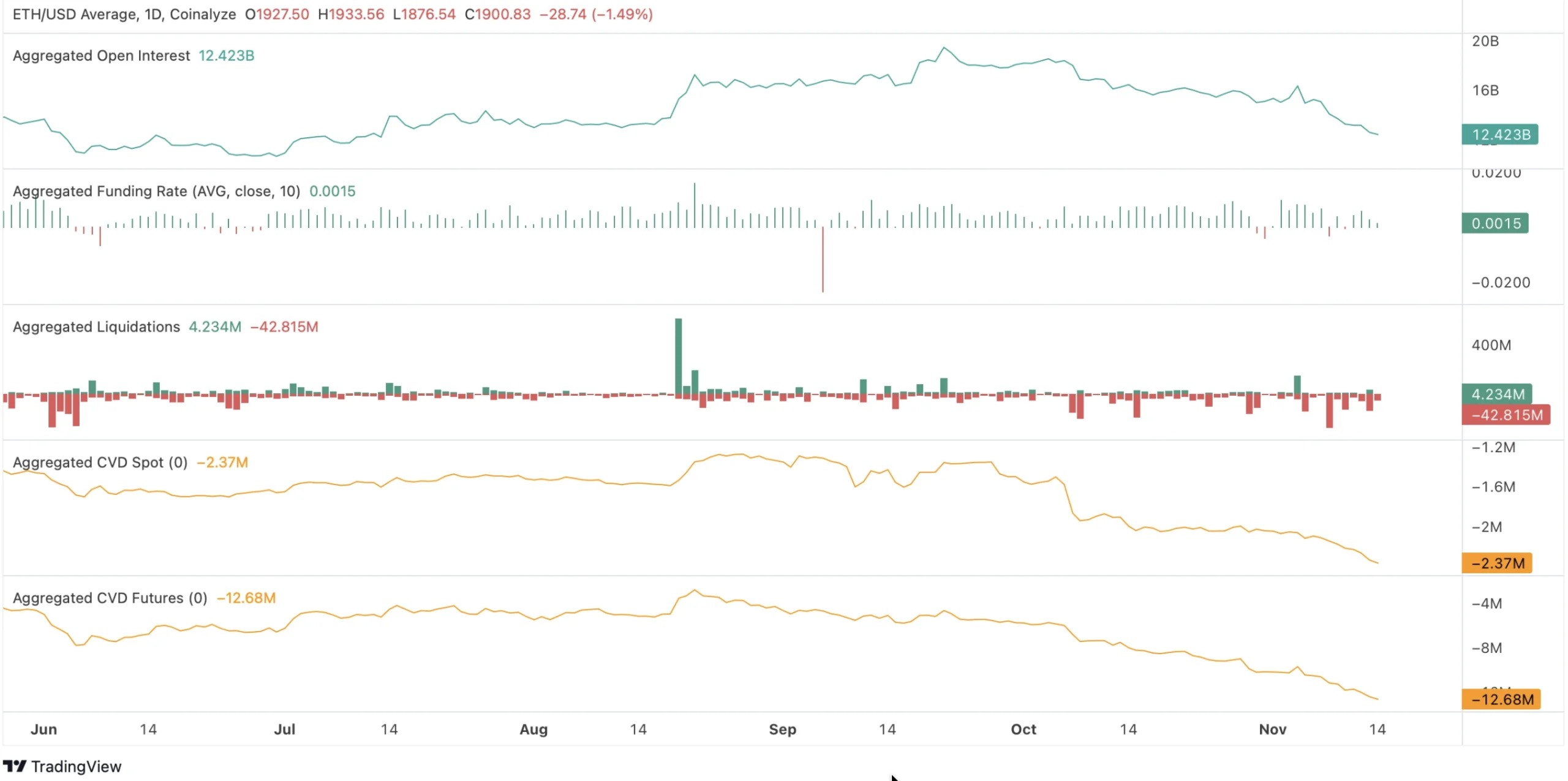
ETH Derivative signals have further weakened, with an increase in long positions being liquidated.
As prices struggle to recover, the Ethereum derivatives market indicates that traders are becoming more cautious. The number of open contracts on various exchanges has dropped to approximately $23.08 billion, a decrease of 3.85% within 24 hours. In addition, within the past 24 hours, a total of $241.41 million worth of ETH positions were liquidated, with long positions accounting for about 76% of the total.
At the same time, the funding rate has approached neutrality, at around 0.0001%. This indicates that the previous bias towards long positions has significantly weakened, and the positions of long and short traders are more balanced. Futures trading activity is still significantly higher than spot trading; the 24-hour futures trading volume is about $47.33 billion, while the spot trading volume is about $3.1 billion. This highlights that ETH trading still relies heavily on the derivatives market.
The $1,829 support level has become a focal point; ETH faces the risk of further decline.
The order block also shows that the sellers are gaining the upper hand. Ethereum has not encountered resistance at a fixed price level; instead, it has continuously faced selling zones within a gradually declining price range. Each attempt at a rebound has struggled to break through these zones, indicating that sellers are getting involved earlier, making it more difficult for buyers to regain control of the situation. The latest drop below $1900 has further increased this pressure and makes the market appear even more vulnerable.
Conclusion: As selling pressure intensifies, can Ethereum hold above $1,829?
Ethereum is facing multiple pressures: ongoing ETF capital outflows, alleged selling by large traders, and a wave of long positions being liquidated, all of which are weighing on market sentiment. The derivatives market also indicates that traders are reducing their positions, while the daily charts point to a weaker price structure. A series of declining order blocks suggest that sellers are defending at lower levels, making it more difficult for any sustained rebound to occur.
Currently, $1,829 remains a key support level that requires close attention. If this level is broken through, ETH could further decline to $1,725; however, if it manages to rebound above $2,000, that would be an early signal of a return of buying interest. Nevertheless, a more bullish outlook is still difficult to establish until ETH breaks through the upper selling zone and improves the broader moving average structure. Meanwhile, the risk of further declines still exists.