Key Points
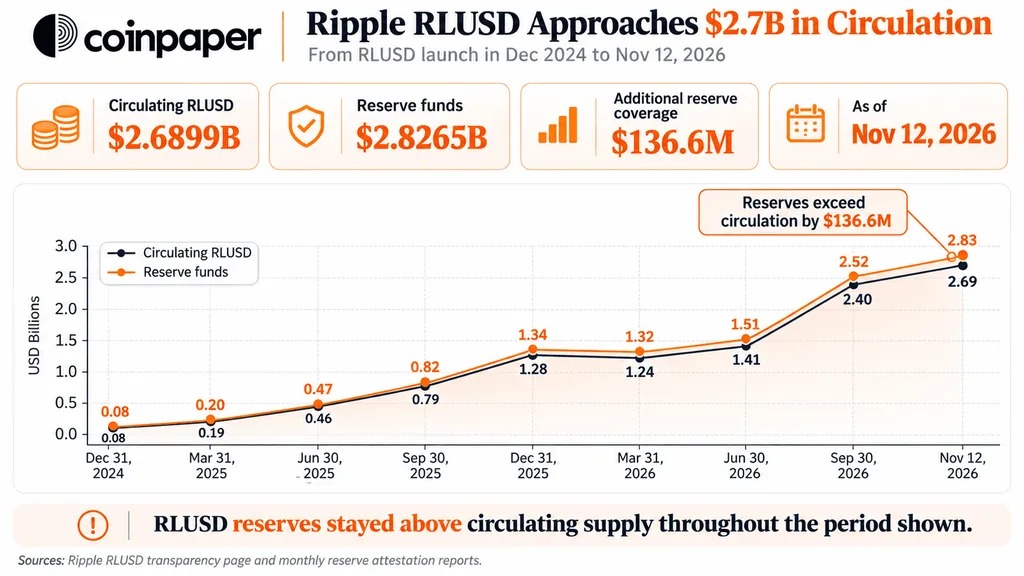
- According to Ripple, the circulation scale of RLUSD is close to 2.69 billion US dollars.
- RLUSD Reserve assets are $136 million higher than the outstanding supply.
- The collaboration with Coinbase and Robinhood has expanded the distribution channels for institutional stablecoins.
As both fintech companies are expanding their presence in the digital payment sector, the circulation of RLUSD, a stablecoin pegged to the US dollar under Ripple, has approached $2.7 billion, which has intensified the competition between it and PYUSD from PayPal.
According to the official transparency dashboard of Ripple, as of November 12, 2026, the circulation scale of RLUSD was 2.6899 billion US dollars, supported by reserve assets amounting to approximately 2.8265 billion US dollars.
The RLUSD of Ripple reached $2.69 billion, with reserves at $2.83 billion.
The company stated that these reserves are held in segregated accounts and consist of cash, U.S. government securities, and other highly liquid assets.
RLUSD is issued by Ripple Custody & Trust Co. It is a trust company regulated by the New York State Department of Financial Services.
The stablecoin was launched in December 2024. As Ripple introduces more institutional payment and settlement services, its scale has rapidly expanded.
Earlier this month, Brad Garlinghaus (the CEO of Ripple), responded to concerns that RLUSD would replace XRP, explaining that these two assets serve different purposes.
Unlike XRP, which fluctuates with market demand, the goal of RLUSD is to stabilize its value at $1.
PayPal's PYUSD faces increasingly powerful institutional competitors
PYUSD is another type of regulated US dollar stablecoin, issued by Paxos Trust Company, and is primarily aimed at consumer payments, transfers, and digital wallet scenarios.
Both of these stablecoins aim for a target value of $1, which means that their market value mainly depends on the circulating supply, rather than speculative price increases.
However, a direct comparison requires data from the same reporting period. Ripple discloses the circulation data for November 12th, but the reserve report publicly available in Paxos cannot independently confirm the circulation scale of PYUSD on that date.
Therefore, this competition is not only reflected in market capitalization rankings but also extends to distribution capabilities, redemption services, and the adoption by institutions.
Ripple has recently received custody support from Standard Chartered Bank, while the plan to integrate RLUSD into LMAX Group's collateral infrastructure still needs to meet the implementation requirements before it can proceed.
The company has also received an investment-grade rating from Moody's ( Moody 's), which adds another factor for institutional investors to consider when evaluating the quality of reserves and redemption risks.
Author Marcus Hale introduces himself as a journalist specializing in the crypto and financial markets, covering topics such as Bitcoin, Ethereum, digital assets, regulation, ETF, and institutional adoption. He focuses on developments that can drive market changes, investor trends, as well as the broader forces that shape the crypto economy.