

How children use generative AI, the industry has accumulated a large amount of product data, yet there is a lack of sufficiently unified measurement methods. Different companies use different age groups, risk definitions, and reporting criteria, making it difficult to determine which scenarios are truly helpful and which interactions may affect safety and development. On November 12th, OpenAI announced an investment of 2 million US dollars to support the scientific research network under the "AI Children's Rights and Protection Alliance," with a focus on establishing shared measurement tools.
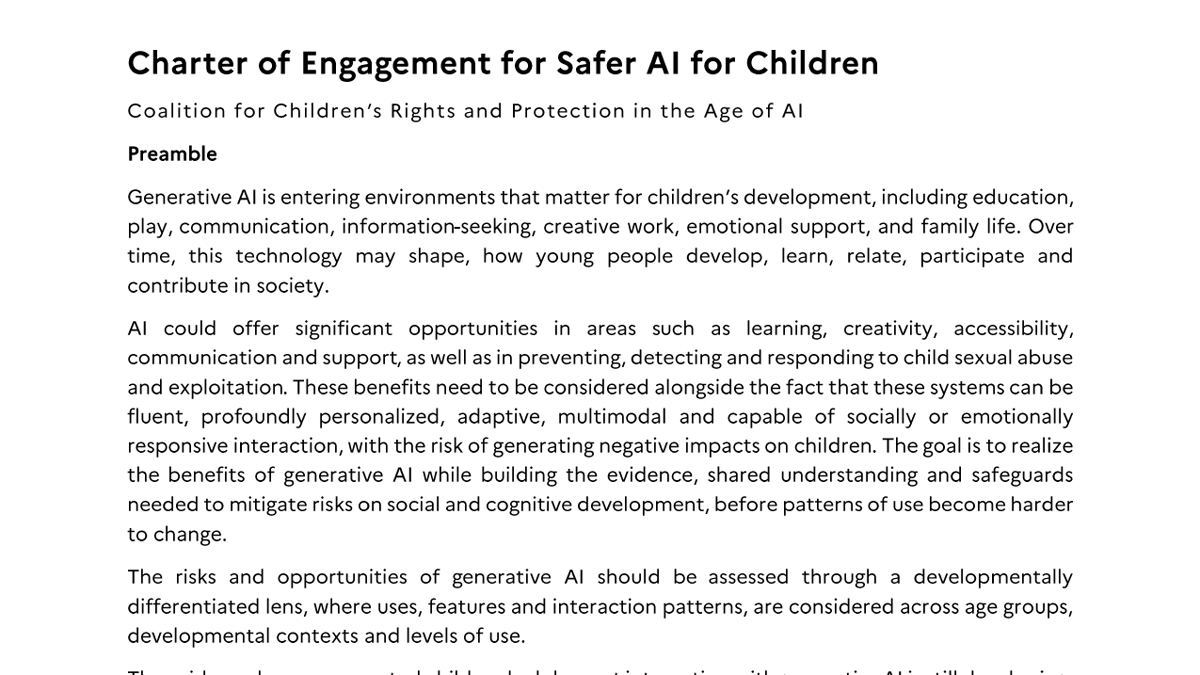
This funding is not for a new parental control feature, nor is it a certification of the existing product's security. OpenAI has also signed the "Children Safer AI Participation Charter" promoted by the Paris Peace Forum. The official statement focuses on research infrastructure: to enable researchers to better measure the risks and opportunities that AI pose to children, and to use this evidence in products and policies.
It is more difficult to establish a unified measurement standard than to list a set of principles separately.
"Appropriate age," "safe," and "beneficial" are terms that seem easy to agree on, but in practical research, they require reproducible indicators. Researchers need to distinguish between short-term discomfort, persistent dependence, misleading advice, privacy exposure, and learning assistance. They also must take into account factors such as age, language, family environment, and purpose of use. Simply counting the number of harmful responses does not indicate whether children understand the content, nor can it assess long-term behavioral changes.
The value of sharing measurement tools is that it allows different models, regions, and research teams to compare their results. For example, the same set of tests can be used to observe whether a system identifies minors, whether it sets appropriate boundaries on high-risk topics, and whether parental control tools and help resources are placed in easily accessible locations. If each company only publishes its own pass rate, it is difficult for outsiders to determine whether these numbers are comparable.
However, measurement tools also shape industry priorities. Errors that are easy to quantify may be repeatedly optimized, while the psychological, educational, and social impacts that occur more slowly are overlooked. Therefore, indicators should not be set solely by model companies. Experts in child development, educators, parents, non-governmental organizations, and young people from different regions need to be involved; otherwise, "safety" may only represent the part of the product that is easiest to statistically analyze.
The funds come from enterprises, so the conclusion must be uncomfortable for them.
According to OpenAI, the research team retains control over the conclusions, and the research findings will be made public, including negative or inconclusive results. This is a core commitment to independence. The real test lies not on the day of the announcement, but when there is a conflict between the research findings and the commercial interests of the funders: whether the team can choose the topic of study, publish the complete methodology, report failed results, and publicly criticize without the permission of the company.
Independent research also requires access to data. If external teams can only test the public interface, they may not be able to observe age recognition, recommendation algorithms, or internal security incidents; if they gain access to more in-depth data, then child privacy must be protected. A reasonable mechanism should include data minimization, independent ethical review, a secure access environment, and clear rights to publication. Key findings should not be locked away by confidentiality clauses.
2 million US dollars can be used to initiate the construction of networks and tools, but it is not sufficient to cover all the needs of the AI research for children around the world. There are significant differences in usage patterns among different languages and income regions, and factors such as device sharing, school management, and parents' digital capabilities also affect the risks involved. If funds are concentrated in the English-speaking market, the resulting "global standards" may still only be suitable for a portion of users.
Product protection cannot wait until all research is completed.
Establishing evidence takes time, and companies still need to assume responsibility for their existing products in the meantime. Default age-appropriate protection, parental controls, regular risk assessments, and accountability mechanisms are all policy directions supported by OpenAI in their announcements. Research can improve these measures, but it cannot be a reason to delay action. For known high-risk scenarios, products still need to be restricted, monitored, and provide avenues for human support first.
Parents should not be placed in a position of sole responsibility either. Many families are unable to continuously monitor every conversation, while schools and platforms have greater control over the functionality, data storage, and recommendation methods. Good parental control tools should be clear and reversible, and should inform children about which data will be shared, rather than shifting complex settings and ultimate risks onto the family.
What deserves attention about this funding is not the amount itself, but whether it can establish a measurement foundation that is commonly accepted by the industry and can be replicated externally. If researchers are able to publish unfavorable results with sufficiently transparent methods and data, policymakers will have the opportunity to turn "protecting children" from being just a corporate slogan into verifiable requirements. Conversely, if research only produces principle statements and incomparable reports, no amount of investment will be able to change the actual choices made in products.
The challenge in ensuring the safety of children AI has never been a lack of goodwill statements, but rather a lack of evidence that can be verified across companies, languages, and over time. OpenAI This time, by investing funds in shared research networks, a more valuable path has been opened up; whether it will ultimately be credible will depend on the independence of the research, the degree of openness, and whether the products can withstand external scrutiny and corrections.