
















Placing the same sequence of DNA into cardiac muscle cells, immune cells, or nerve cells may produce completely different effects. Past genetic models often processed large amounts of tissue data together, which allowed for a general overview but tended to overlook changes that occurred only in certain types of cells, at specific stages of development, or under certain disease conditions. Google DeepMind was released on November 11th. AlphaGenome aims to advance predictions from tissue averages to specific cell types and states.
According to the official introduction, the training data for the new model covers over 100 million single-cell profiles from 68 different tissues, and is capable of predicting gene expression, chromatin accessibility, histone modifications, and DNA methylation levels, among other readings. It does not directly tell doctors that a certain mutation will definitely lead to a disease; instead, it estimates how a particular DNA sequence will be interpreted in a specific cellular environment, helping researchers determine which mutations and experiments are worth prioritizing for further investigation.
From organizational average to individual cell state
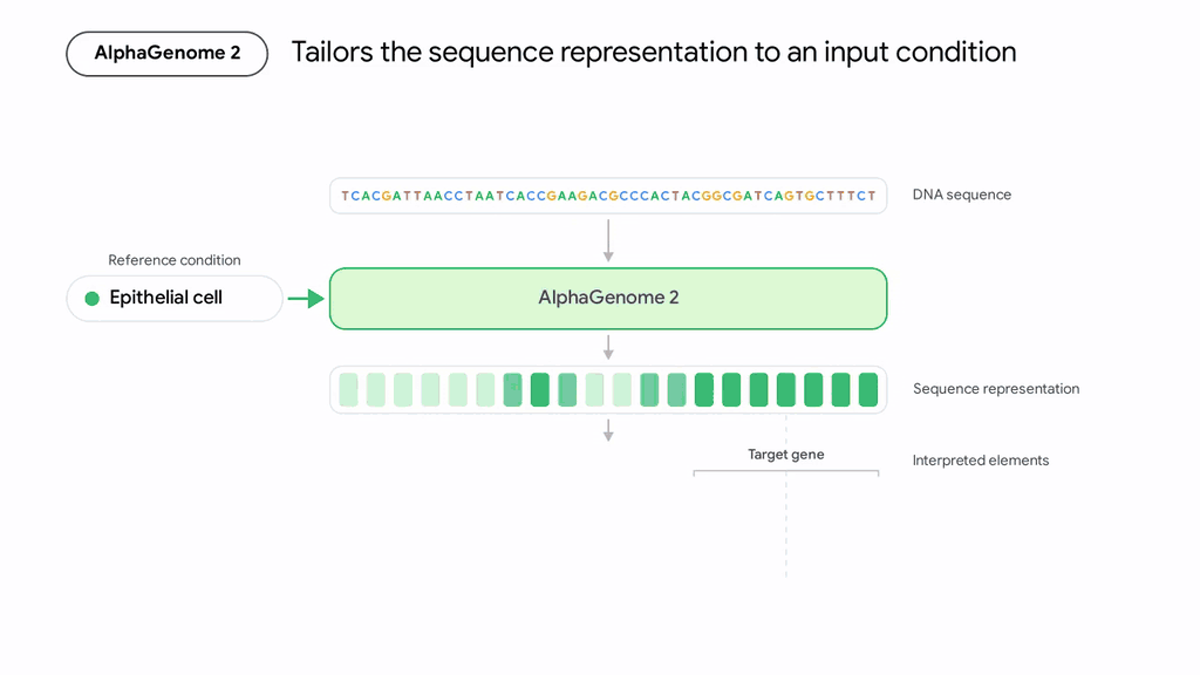
The first-generation AlphaGenome receives a sequence of approximately 1 million base pairs in length from DNA, and simultaneously outputs predictions under various organizational and experimental conditions. This approach is efficient, but the model's capabilities have to be distributed across such a large volume of output, making it less sensitive to subtle differences between similar cell types. AlphaGenome has been modified to a conditional model: each time, a target tissue, cell type, or cell state is used as a condition, and together with the DNA sequence, it focuses on predicting the effects within that specific environment.
This change is akin to replacing “average urban temperature” with “the physical sensation on a certain street during a particular period.” The average value is still useful, but diseases often affect only a small number of cells, or they appear only in conditions such as inflammation, development, and treatment responses. If models can identify the effects of mutations at a finer scale, researchers will be able to narrow down the vast list of candidates to a smaller number of verifiable targets more easily.
According to DeepMind, the number of mutations found by AlphaGenome that alter cellular gene expression is nearly twice that of the previous generation. The term "found" here refers to model predictions and benchmark evaluation results, and does not imply that all these mutations have undergone causal verification in the human body. A higher recall rate can reduce omissions, but it may also lead to more candidates that need to be ruled out through experiments. Ultimately, confirmation will still rely on cell experiments, animal models, and clinical samples.
The model also supports cross-modal completion. If researchers only provide measurements of a single type of single cells, such as gene activity, the model can infer chromatin characteristics that have not yet been measured under the same cell state. This does not render the experiments useless, but it can change the order of the experiments: first use cheaper data for screening, and then reserve the more expensive measurements for the most informative candidates.
There are still several hurdles between research tools and clinical diagnosis.
AlphaGenome 2 has been made available for non-commercial research, while API is still in private preview for commercial research. The official statement also clarifies that it is intended only for research purposes and has not yet been verified or approved for clinical diagnosis. This limitation is very important. Disease risk comes not only from DNA, but is also influenced by age, environment, lifestyle, and other genes; even if the model can accurately predict molecular-level changes, it cannot independently determine whether a person will develop a disease or how they should be treated.
The representativeness of the training data is also a critical factor. If certain populations, rare cell states, or disease stages are under-represented in the data, the model's stability in these scenarios may be compromised. Researchers need to document the source of samples, the definition of cells, and the confidence level of predictions, to avoid mistaking a seemingly accurate score for a conclusion that applies to all populations.
In the scientific research process, a more practical use is for sorting and interpretation. Whole-genome studies often yield thousands of related variations, most of which are located in regions that do not directly encode proteins. AlphaGenome can help determine which cellular regulation these variations may affect, allowing for the allocation of limited experimental budgets to the most worthwhile areas for verification. What it shortens is the distance from a clue to the experimental design, not the entire distance from the sequence to the diagnostic report.
Scientific efficiency depends on whether predictions can be reproduced.
Once the model enters the laboratory, what truly matters is not just the ranking scores. The research team needs to save the model versions, input sequences, cell conditions, and outputs to ensure that later researchers can re-run the same assessments; when API or the model is updated, it is also necessary to know which candidate rankings have changed. Without these records, the faster the prediction speed, the more difficult it becomes to explain any resulting drifts.
AlphaGenome Two single-cell atlases have transformed from static directories into tools that can generate hypotheses. They may enable more precise and faster screening of disease-related mutations, and also shift the focus to new aspects: which cell conditions are selected, which uncertainties are revealed, and which results must be verified through experiments. What science truly gains is not a machine that replaces biologists, but the ability to make more targeted decisions about what to do in the next experiment.