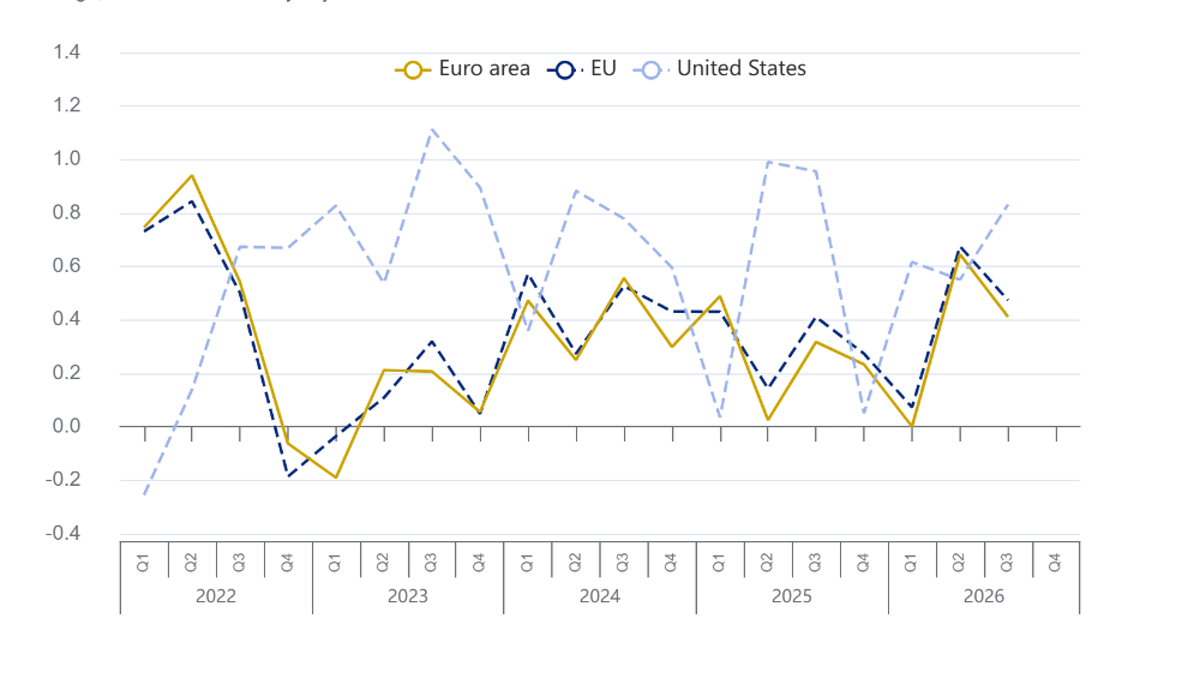

















The economy of the eurozone continued to expand in the third quarter of 2026, but new job creations did not keep pace. On November 13, a quick estimate was released: the eurozone experienced real GDP growth of 0.4% quarter-on-quarter, while the EU grew by 0.5%; employment in both regions saw zero growth quarter-on-quarter. In the previous quarter, the eurozone and the EU GDP grew by 0.6% and 0.7% respectively, with employment increasing by 0.1% in both areas.
The overall picture sends a rather mixed signal. Businesses are still producing more goods and services, but they are not creating jobs at the same rate. For families, continued growth in GDP does not necessarily mean more job opportunities right away; for businesses, increased output does not necessarily indicate that there is such a strong demand that they need to expand their teams.
Growth in output can initially be supported by efficiency and working hours.
GDP To measure economic output, the number of employed people only counts how many people are working; there is also the factor of labor hours and productivity in between. Enterprises can have their current employees work longer hours, improve processes, or use more equipment and software to increase output without increasing the number of employees. Conversely, an increase in the number of employed people does not guarantee a corresponding increase in per capita output.
This quick estimate does not provide a complete explanation of man-hours and productivity within the same set of figures, therefore it is not possible to assert directly that zero employment growth is due to automation or layoffs. It only indicates that the marginal growth in the third quarter did not manifest as an increase in the number of employed people. To determine whether the labor market is weakening, it is also necessary to consider job vacancies, unemployment rates, wages, man-hours, and industry data.
On a year-on-year basis, the Eurozone GDP grew by 1.3%, while the EU grew by 1.5%; the number of employed persons increased by 0.4% in both regions. This indicates that compared to a year ago, the economy and employment are still expanding, albeit at a faster pace of output growth. The growth has not suddenly stopped; rather, it has shifted from a situation where "both output and jobs increased" to one where "output continues to increase while jobs remain relatively stable for the time being."
National differences mean that the average value cannot represent each market.
As shown in the Eurostat table, there are significant differences in growth rates among countries in the third quarter. Ireland GDP saw a quarter-on-quarter increase of 5.5%, Romania grew by 2.1%, and Poland by 0.8%; France declined by 0.1%, Lithuania by 1.0%, while Italy remained stable. Data for some countries is still missing or labeled as experimental, so extreme values should not be simply regarded as a common trend for the entire Eurozone.
Irish data is particularly susceptible to the influence of large multinational corporations' activities. Eurostat also reminds readers that the results are still experimental and that the sources of information are not yet complete. When making regional plans for businesses, an average growth rate of 0.4% in the eurozone can only provide a general direction; it is the demand of the respective countries and industries that truly determine sales, recruitment, and investment.
In the third quarter of the United States, GDP saw a quarter-on-quarter growth of 0.8%, which is higher than the 0.4% in the eurozone. However, the two economies have different structural compositions, policies, and statistical timing points. Simply ranking countries based on quarterly figures ignores factors such as exchange rates, population, fiscal conditions, and industry mix. A more sound comparison would be to observe whether the growth is sustainable, whether it drives real income and employment, and the extent of subsequent revisions.
A quick estimate is first of all a roadmap.
This time, GDP quickly estimates to cover approximately 97% of the Eurozone and the EU GDP. The employment estimate covers 95% of the total employment in the Eurozone and 92% in the EU. Although the coverage rate is high, the term "quick" indicates that information for some countries and industries has not yet been fully obtained. Subsequent releases may revise the figures to a more precise level and provide more detailed expenditure and industry structure data.
For the European Central Bank, a combination of GDP growth and stagnant employment does not automatically lead to a single interest rate decision. If there is still pressure on wages and service prices, output growth may support a cautious approach; if recruitment and demand continue to weaken, policy will need to focus on downside risks. The central bank will also take into account inflation, wages, and credit, rather than making a decision based on just one factor.
Enterprises also need to break down the concept of "zero employment growth" for understanding. It may mean a freeze in recruitment or a reduction in job turnover, or it could be that there is no temporary need to hire new staff due to increased productivity. The changes that employees perceive often first manifest in reduced overtime, fewer vacancies, and improved bargaining power, rather than a sudden drop in the overall employment figures.
Third-quarter data indicates that the eurozone is still growing, but the transmission of growth to jobs has slowed down. The next step is to observe whether the existing teams can continue to handle more output, or whether the slowdown in demand will ultimately suppress GDP; it is also important to see if companies will re-hire after orders become more stable. This period of lag between output and employment is worth tracking more than simply celebrating a 0.4% growth.