Key Points
- As investors await the results of the mid-term elections, the Dow Jones futures fell.
- Despite strong quarterly performance, Apple and Palantir still saw their stock prices fall.
- AMD Financial reports may test the market's confidence in AI concept stocks.
On Tuesday, November 3rd, the trends of U.S. stock index futures were divergent. Investors are preparing for the mid-term elections, and the market's disappointment with the financial reports of Apple and Palantir put further pressure on the already weak technology sector.
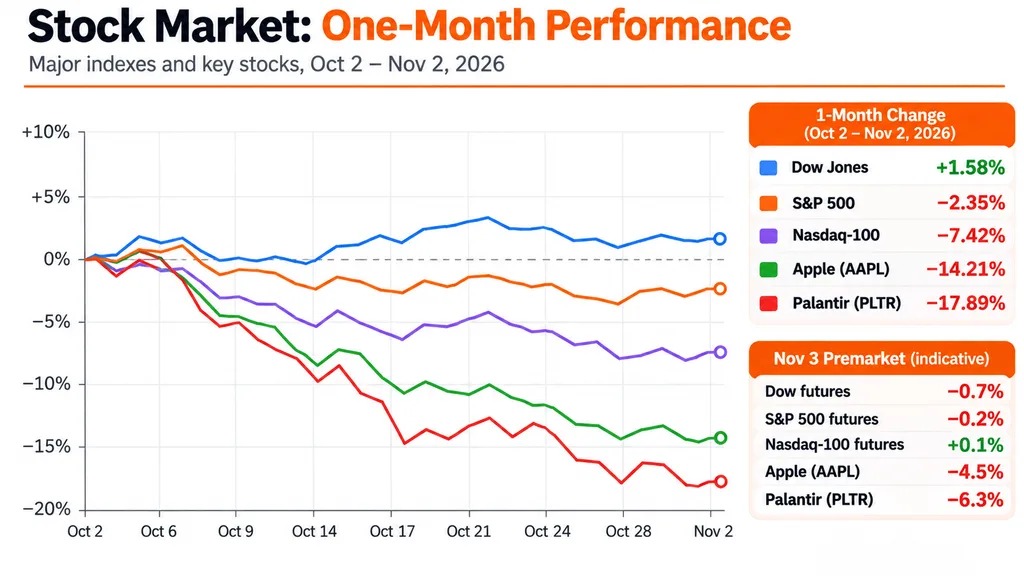
Concerns about spending on artificial intelligence and political uncertainties have dragged down global stock markets. Dow Jones index futures fell by about 0.7%, S&P 500 index futures fell by 0.2%, while Nasdaq 100 index futures saw a slight increase.
This cautious start continued the selling trend from Monday. Monday's decline pushed the Nasdaq 100 index into a technical correction zone, with it falling 10.4% from its record high set in October.
Apple and Palantir have strong performance, yet stock prices continue to fall.
This iPhone manufacturer reported revenue of $114.48 billion for the quarter, but its profit outlook disappointed investors concerned about declining profit margins and slower growth in its service business.
Palantir also fell by about 6.3% before the market opened, despite the company reporting third-quarter results that exceeded expectations and raising its revenue forecasts.
The value of the company's U.S. commercial contracts only increased by 11% year-on-year, which has raised doubts in the market about whether its exceptionally strong revenue growth, driven by AI, can continue.
This weak trend continued the sell-off in the semiconductor sector in October, during which chip manufacturers saw their market value evaporate by approximately $1.64 trillion over six trading days.
The Dow Jones, the Nasdaq, and the S&P 500 face different pressures.
Monday's trading showed that the pace of the market decline has become quite uneven.
The Dow Jones index rose 0.4% to close at 51,983.98; the S&P 500 index fell 0.5% to close at 7,541.40; the Nasdaq Composite Index declined 1.1% to close at 25,164.32.
Investors are increasingly questioning whether the massive infrastructure expenditures of large technology companies can generate sufficient returns, especially when borrowing costs remain high.
Rising yields on U.S. Treasury bonds will put pressure on the valuation of tech stocks by increasing financing costs and reducing the present value of future profits.
On Tuesday, the yield on benchmark 10-year U.S. Treasury bonds traded around 4.94%, adding another layer of concern for companies that are financing high-cost AI projects.
Factors that may drive stock market fluctuations today
The current focus of the market is on the U.S. mid-term elections on Tuesday. Investors are assessing whether the Democratic Party may regain control of Congress and potentially push for stricter regulation of the AI infrastructure.
However, the importance of corporate financial reports may also be equally prominent.
Supermicro Semiconductor Corporation ( AMD ) is scheduled to release its financial results after the close on Tuesday, and investors are hoping to see evidence that semiconductor demand remains resilient despite the recent decline in stock prices.
After Intel's record 29% decline, the pressure on AI chip manufacturers continues to increase, and with that comes the financial report test for AMD.
Author: Maya Bennett
Maya Bennett is a financial journalist with experience reporting on cryptocurrencies, stocks, and broader market trends. Her coverage focuses on Bitcoin, major digital assets, the stock market, monetary policy, as well as economic developments that influence investor sentiment. She is adept at transforming rapidly changing market stories into clear and concise reports.