


Key Points
- SEC Three new explanations for decentralized cryptographic governance
- Foundations and token voting do not automatically constitute control.
- Forcing verifiers to participate and unilaterally upgrading may be seen as a centralized signal.
The U.S. Securities and Exchange Commission (SEC) updated its guidelines on cryptocurrencies, further clarifying under what circumstances blockchain governance can lead to centralized control, and how this distinction will affect the regulatory characterization of digital assets.
In the update on November 2nd, the finance department of SEC added three new Q&A sessions, covering governance structures, validator participation, and the differences between functional networks and decentralized networks. These changes have expanded the institution's existing framework for classifying cryptographic assets. This framework distinguishes between digital commodities and assets issued through security-type investment contracts.
At the time of this announcement, Washington is still engaged in debates over broader cryptocurrency legislation, and blockchain foundations also face a question: to what extent can they exert influence without being perceived as centralized operators?
SEC Explaining when encrypted governance will become centralized
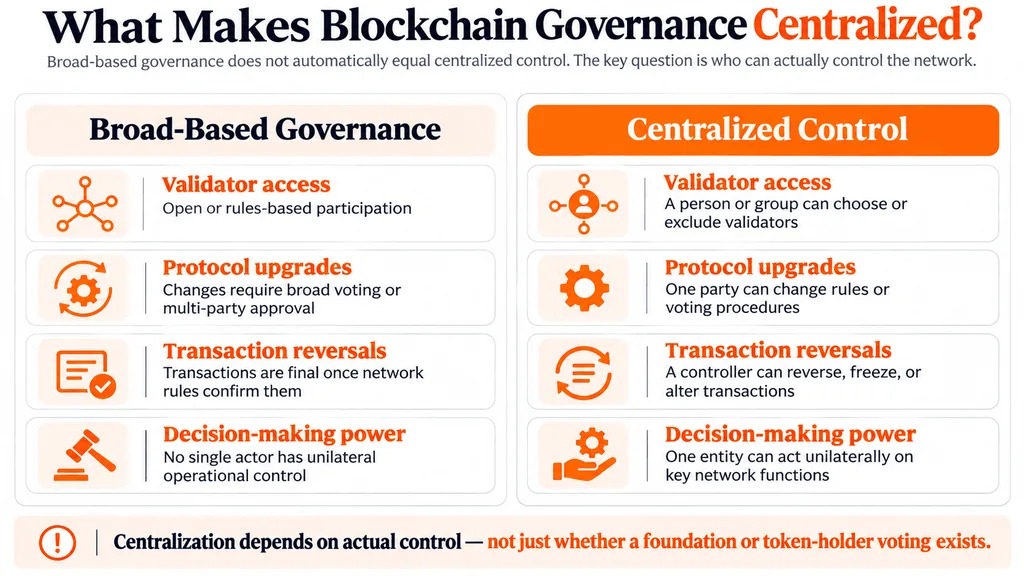
According to the new guidelines, parties involved in broad governance are generally not considered a controlling group merely because they vote on proposals or coordinate through a certain foundation.
On the contrary, the staff at SEC are concerned with whether participants have reached a common action agreement outside of the governance system, and whether there are any individuals or well-coordinated groups that hold operational, economic, or voting control.
This distinction is important for decentralized autonomous organizations ( DAO ), token holder voting systems, and blockchain foundations, as the legal structure of these entities may not necessarily reflect the actual technical control.
The guide indicates that the presence of the following types of powers may suggest centralization: unilaterally restricting network access, selecting validators, altering upgrade voting procedures, or revoking transactions.
This distinction also provides context for the long-standing issues surrounding the governance of XRP Ledger. The revision of the network's protocol requires approval from verifiers, and cannot be unilaterally decided by Ripple.
However, this guide does not classify any specific blockchain networks, nor does it determine that any particular cryptocurrency meets its decentralization criteria.
Functional blockchains are not necessarily decentralized.
Another important point to note is to distinguish between the functionality of blockchain and decentralization.
When a native cryptocurrency of a network can be used for its intended purpose, that network is considered a “functional” network. As for whether it is “decentralized,” it depends on whether the network can operate autonomously without the control of any individual or a coordinated group.
Therefore, having a functional application, active transactions, or a token that is operating normally does not alone prove that the network has achieved decentralization.
This distinction echoes the concerns raised earlier by Ripple during discussions with SEC. At that time, the company believed that the assessment of the degree of decentralization could be subjective.
SEC What does new guidance on crypto regulation mean?
Before the release of this update, SEC proposed a framework for the "Regulations on the Supervision of Cryptocurrency Assets" ( Regulation Crypto Assets ), intending to introduce a new financing exemption mechanism and establish a system that separates certain tokens from investment contracts.
This update also follows closely after Ripple requested the modification of the proposed rules. Ripple previously called for adjustments to the proposed rules regarding when cryptocurrency investment contracts should terminate.
This explanation in November may help the project team assess their governance arrangements, but it does not create any new, legally binding exemptions.
SEC clearly states that these frequently asked questions (FAQs) reflect only the views of the staff and are not rules approved by the committee; therefore, they do not have legal effect.
As the U.S. Congress continues to debate the CLARITY Act, this point remains of great importance.
Adrian Cole
Adrian Cole has been engaged in financial market reporting for over 6 years, with a focus on cryptocurrencies, stocks, and macroeconomic trends. He tracks Bitcoin, major altcoins, the U.S. stock market, interest rates, commodities, and various types of data that drive market fluctuations. Over the years, he has written hundreds of market updates and analysis articles, with an emphasis on price trends, investor sentiment, and the connections between traditional finance and digital assets.