Key Points
- Solana Tokenized stock address has increased fivefold since August
- Token rewards and memecoin transactions drive adoption and growth.
- Despite the expansion of on-chain stock activities, SOL remains under pressure around $100.
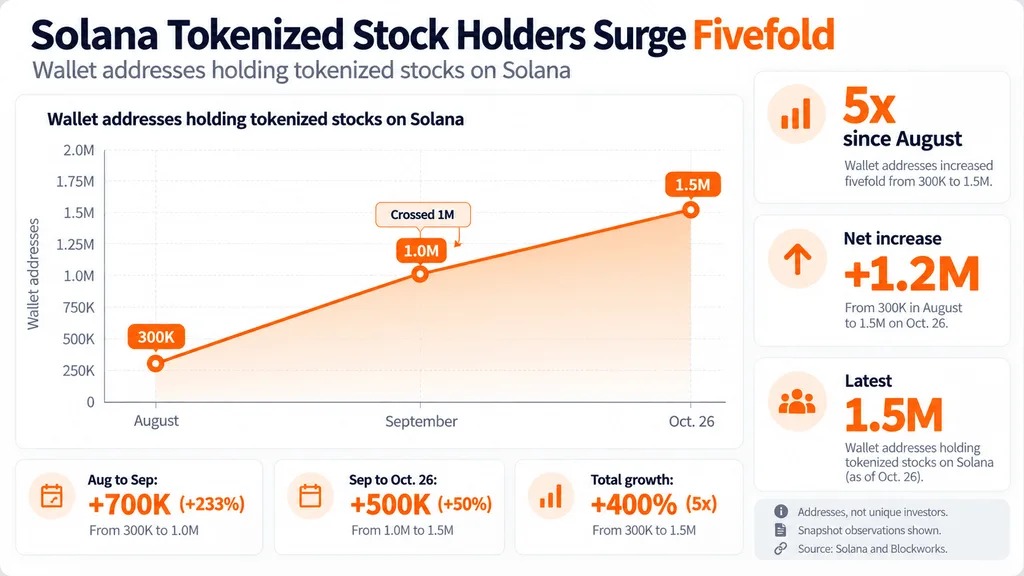
The tokenized stock market of Solana has reached a record 1.5 million holding addresses, a fivefold increase from August; meanwhile, under the pressure of continuous cryptocurrency sell-offs over several weeks, the price of SOL remains hovering around $100.
Solana announced this milestone on October 26th. This figure refers to the number of addresses holding tokenized stocks, not 1.5 million verified individuals. This distinction is important because blockchain-based stock trading is attracting increasing attention.
As reported on Monday, the trading price of SOL was close to $101, lower than the level of around $124 at the beginning of October. This divergence indicates that an increase in the adoption rate of tokenized stocks does not automatically translate into a higher demand for Solana's native cryptocurrency.
Solana Tokenized stock holders' addresses increased from 300,000 to 1.5 million
The number of addresses holding tokenized stocks on Solana has increased from approximately 300,000 in August to 1.5 million in October.
In September, the network surpassed 1 million holding addresses, with the trading volume of tokenized stocks at that time being approximately $4.4 billion, and the value of outstanding tokenized stocks amounting to about $684 million.
Even earlier, Ondo Finance had introduced over 200 tokenized stocks and ETF to that network.
However, not every address represents an investor who independently decides to buy stocks.
Blockworks finds that a $31 million token reward drives growth
Another survey released by Blockworks on October 14 found that between August 3 and October 11, the reward program distributed approximately $31 million in tokenized stocks to over 360,000 wallets.
Nearly 80% of the recipients had no prior record of purchasing tokenized stocks. Among these first-time recipients, 82% subsequently sold or transferred the tokens they received.
According to this study, in the end, only about 2% of people purchased tokenized stocks for their own purposes.
memecoin transactions have brought about another source of abnormal activity. From September 1st to October 11th, the memecoin trading pair, which is priced in tokenized stocks, recorded a trading volume of 1.76 billion US dollars, accounting for 31.5% of the 5.58 billion US dollars in decentralized trading volume of tokenized stocks tracked by Blockworks during that period.
Platforms, including StonkFun and Pump, allow traders to use tokens linked to stocks as memecoin trading pairs, thereby increasing the volume of activity reported. However, this does not necessarily represent the needs of traditional stock investors.
This does not mean that growth is meaningless. It indicates that tokenized securities are increasingly becoming part of the broader trading ecosystem of Solana.
But this will change how these data should be interpreted.
Why hasn't the price of SOL increased along with the tokenized stocks?
One explanation lies in the settlement process.
Many tokenized stock products can be purchased using USDC and other stablecoins. SOL is still required for network transaction fees, but users do not need to purchase an equivalent amount of US dollars in SOL for each stock token transaction.
Therefore, billions of dollars in traded volume of tokenized stocks does not mean that billions of dollars will be directly invested in SOL.
At the same time, the outflow of funds from Solana ETF has posed another challenge to institutional needs. The US SOL fund recorded a net outflow of $24.8 million in the week ending October 9th, reversing its previous 14 consecutive weeks of net inflows.
Previously, the weakening of the SOL price also occurred alongside the rapid growth of tokenized stock addresses, indicating that this differentiation is not a completely new phenomenon.
The tokenized stock market continues to expand across different blockchains, which may further enhance the importance of Solana as a financial infrastructure.
Author: Elara Voss
A journalist who covers the cryptocurrency market, blockchain innovation, and global digital asset regulation. She has a background in financial research and technology reporting, focusing on market fluctuations, emerging protocols, institutional adoption, and the changing role of cryptocurrencies in the global economy.