U.S. stock markets opened lower on Friday (October 23), as investors faced another decline in artificial intelligence stocks. Meanwhile, amid escalating tensions in the Middle East, oil prices approached $115 per barrel.
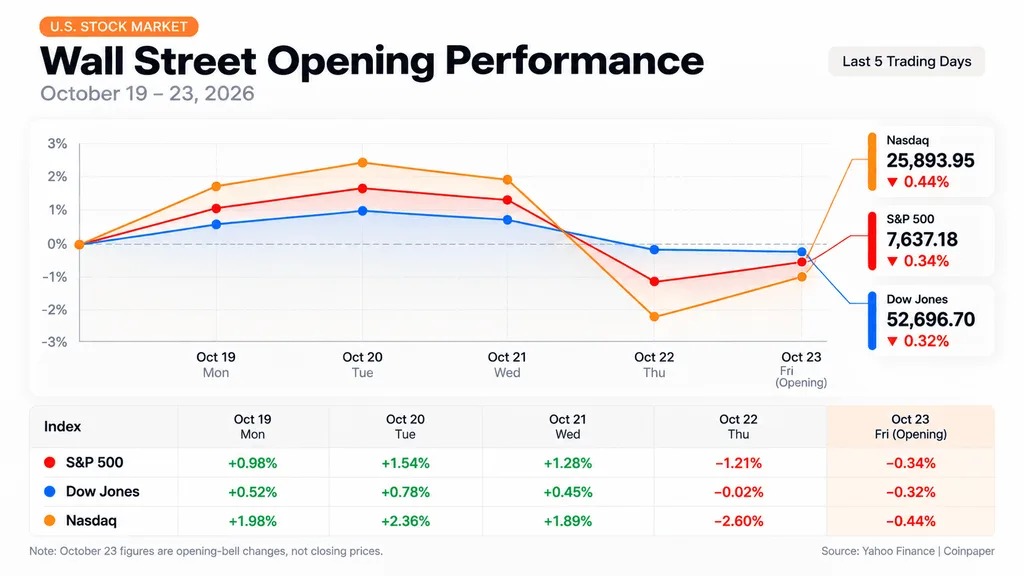
At the opening, the S&P 500 index fell by 0.34% to 7,637.18 points; the Dow Jones Industrial Average fell by 171 points, or 0.32%, to 52,696.70 points; the Nasdaq Composite Index fell by 0.44% to 25,893.95 points.
Why did the stock market fall today?
Meta On Thursday, despite profits exceeding expectations, the stock price still fell by about 7% due to investors focusing on the financial impact of its accelerated AI investments. Chip manufacturers also faced significant selling pressure, while CoreWeave was under pressure due to financing concerns.
This reaction occurred after the market's scrutiny of the Meta AI expenditure plan deepened. The company expects that capital expenditures in 2026 could reach as high as $145 billion.
Investors no longer focus solely on revenue growth; instead, they pay more attention to the cash expenditures required for building data centers, purchasing advanced processors, and securing sufficient power capacity.
This shift has intensified market concerns regarding companies' spending on AI, especially as companies re-evaluate high-cost technology projects.
This weakness also reversed some of the rebound in tech stocks on Tuesday, when investors briefly returned to semiconductors and AI infrastructure stocks.
Oil prices approaching $115 add another layer of risk to the stock market
On Friday, Brent crude oil rose to $114.72, reaching its highest level since May, following attacks on Saudi energy infrastructure that reignited concerns about supplies from the Middle East.
The upward trend in oil prices continued this week, following a fatal incident at the Saudi Aramco Shaybah oil field earlier on, and attacks that disrupted regional shipping also exacerbated market tensions.
Rising crude oil prices pose another challenge for stock investors, as energy costs affect transportation, manufacturing, and consumer spending.
Persistent oil price inflation could also complicate the Federal Reserve's interest rate prospects, making it more difficult for the market to justify even more accommodative monetary policy, even as economic growth slows down.
What will happen to the S&P 500 and the Dow Jones next?
The difference in performance between Thursday and Friday is noteworthy.
On October 22, the S&P 500 index fell by 1.21%, while the Dow Jones index rose slightly by 0.02%. Despite the overall market index decline, most individual stocks still rose, indicating that technology companies with significant weight have a notable impact on the index performance.
Our previous market analysis has explained how different sector exposures can lead to variations in index performance.