Google uses AI to accelerate the discovery of antimicrobial peptides
The Block
1h ago
Ai Focus
Google's Google Antigravity intelligent development platform can help biologists simplify the discovery process of candidate molecules such as antimicrobial peptides. Researchers have used this platform to discover a new type of antimicrobial peptide candidate molecule, which is currently undergoing wet-laboratory verification.
Helpful
No.Help

IT News on October 16th: The issue of antibiotic resistance is intensifying, and there is an urgent global need for new types of antibiotics. However, the development of new drugs is often slow and cumbersome. Google has launched the Google Antigravity intelligent development platform, which can effectively simplify this process.

Google Antigravity provides an intelligent scientific workstation that supports biologists in quickly discovering, structurally evaluating, and screening potential targets, integrating what would otherwise require dispersed searches across multiple databases into a single session. The platform also utilizes the ProtNLM model to help researchers scan millions of uncharacterized proteins in the UniProt database; this model can directly predict biological functions from amino acid sequences.
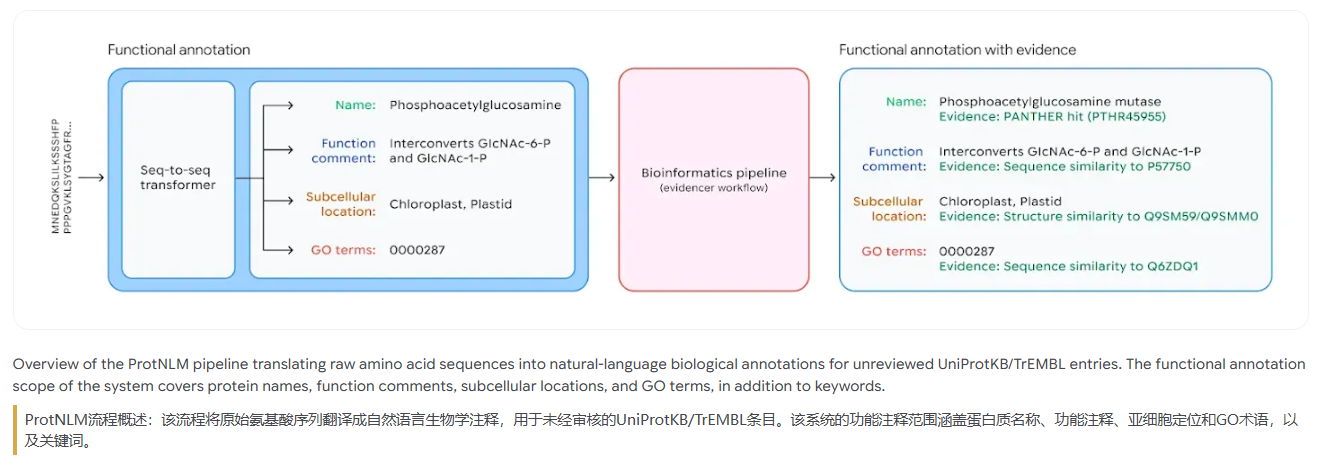
Researchers have discovered a new type of antibacterial peptide candidate molecule through Google Antigravity. It is predicted that this molecule is active against pathogens causing respiratory infections, and currently, this candidate molecule is undergoing wet laboratory validation.

As cited in a blog post from IT, antimicrobial peptides, especially bacteriocins, are very promising alternatives to traditional antibiotics. These substances have naturally evolved the ability to target fundamental weaknesses of bacteria, making it difficult for pathogens to develop resistance. Currently, billions of natural amino acid sequences have been accumulated in global databases, but the functions of a large number of these sequences remain unmarked and are still in a state of "dark matter."

The ProtNLM deep learning model developed by Google can directly read the evolutionary "grammar" of amino acid sequences and predict biological functions from the original protein sequences, adding high-confidence functional annotations to a large number of UniProt entries.
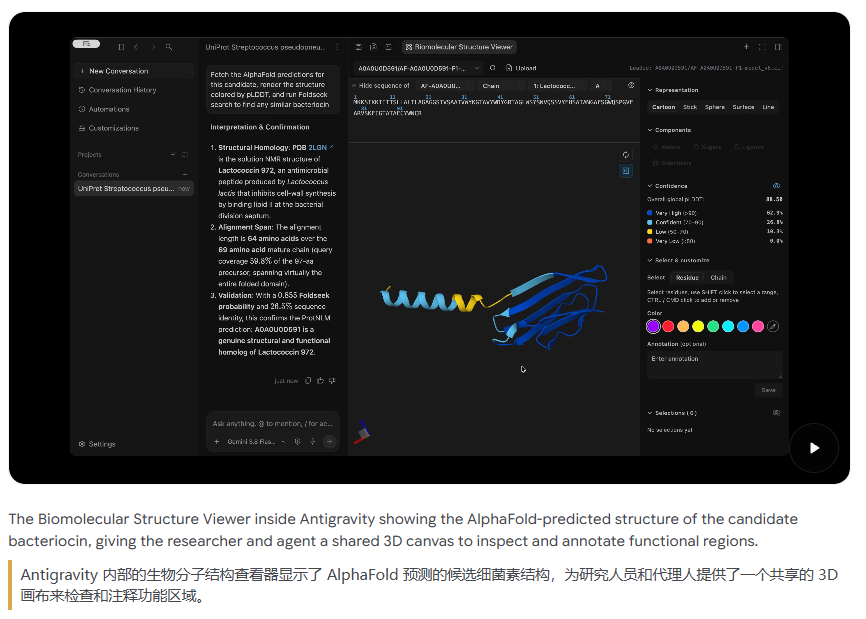
On the Antigravity platform, researchers collaborate with AI agents to conduct studies: researchers set biological objectives and control the research strategy, while the agents are responsible for coordinating across databases, conducting structural analyses, and synthesizing literature, among other intensive tasks. This model compresses what would otherwise require days of separate database screenings into a single collaborative session, significantly lowering the barriers to biological research.

The platform also comes with a Biomolecular Structure Viewer 3D visualization tool, allowing researchers and agents to collaborate on a shared 3D canvas. Agents can retrieve structures from a AlphaFold database to dynamically drive the visualization and highlight key functional areas; researchers can also mark areas of interest in 3D space, ask questions to the agents, and conduct interactive research based on these structures.

In the past, such research and development work relied on dispersed specialized software. However, Google Antigravity integrates the entire scientific reasoning process into one place, helping researchers to more efficiently explore the vast biological search space and filter out candidates with high confidence levels. This allows scientists to devote more time to verifying high-quality hypotheses and conducting experimental research.

Tip
$0
Like
0
Save
0
Views 18
CoinMeta reminds readers to view blockchain rationally, stay aware of risks, and beware of virtual token issuance and speculation. All content on this site represents market information or related viewpoints only and does not constitute any form of investment advice. If you find sensitive content, please click“Report”,and we will handle it promptly。
Submit
Comment 0
Hot
Latest
No comments yet. Be the first!
Related
Google announces that Android earthquake alerts have been pushed over 1 billion times in total, with coverage expanding to more than 200 countries and regions around the world
Google announces that since its launch in 2021, its Android earthquake warning system has sent out over 1 billion alerts in total, and has expanded its coverage from 98 countries and regions to more than 200. The company has also upgraded the "Prevention Alerts" feature, and will gradually add more earthquake information display functions in the coming months.
The Block
·2026-10-16 08:36:35
9
Apple's first touch MacBook Pro is expected to debut this month, while the full version with M7 Pro / Max will have to wait until 2027.
In his latest podcast, Bloomberg's Mark Gurman stated that Apple has essentially ceased the development of M6 chips, and its resources are now shifting towards the M7 series. According to the report, M6 is mainly used in Mac mini, iMac, and the entry-level 14-inch MacBook Pro. The upcoming OLED MacBook Pro will initially be equipped with the existing M5 Pro and M5 Max; M7, M7 Pro, M7 Max, and M7 Ultra are expected to be launched successively between 2027 and 2028.
The Block
·2026-10-16 08:36:34
9
Not just CoreWeave, data center bonds are also facing a 'collective sell-off'
According to the UK's Financial Times, the data center bond market is experiencing a widespread sell-off. Prices have fallen across the board, ranging from bonds financing large-scale projects leased to Meta, Microsoft, and NVIDIA, to debts issued by emerging cloud computing companies such as CoreWeave. Gartner predicts that if AI's infrastructure investments continue on their current trajectory, over $4 trillion in assets could be at risk of impairment by 2032; the chief investment officer of Allianz Group has warned that the data center bond market is facing a moment of "survival of the fittest."
Wallstreetcn
·2026-10-16 08:26:42
13
Bitcoin, BNB, HYPE, and ADA Price Analysis: Can Buyers Regain Control?
Bitcoin tests support around $80,000, BNB hovers above $700, HYPE holds the key support around $77, while ADA slides towards the 100-day moving average. The article analyzes the recent trends of four crypto assets, their moving average positions, and possible support and resistance zones.
U.Today
·2026-10-16 08:16:35
18
OpenAI may struggle to meet advertising revenue targets and is aggressively recruiting talents from Google and Meta
OpenAI has intensively launched advertising products, lowered pricing, and undertaken large-scale recruitment in recent months, driving a rapid increase in the number of advertising clients. By the end of August, the annual advertising revenue reached $1 billion. However, reports citing informed sources and research institutions suggest that the company's goal of achieving $2.4 billion in advertising revenue by 2026, which was set earlier this year with investors, is likely to be difficult to achieve.
The Block
·2026-10-16 07:56:18
27
View More